

9.10 Magneto-Optic Applications 225
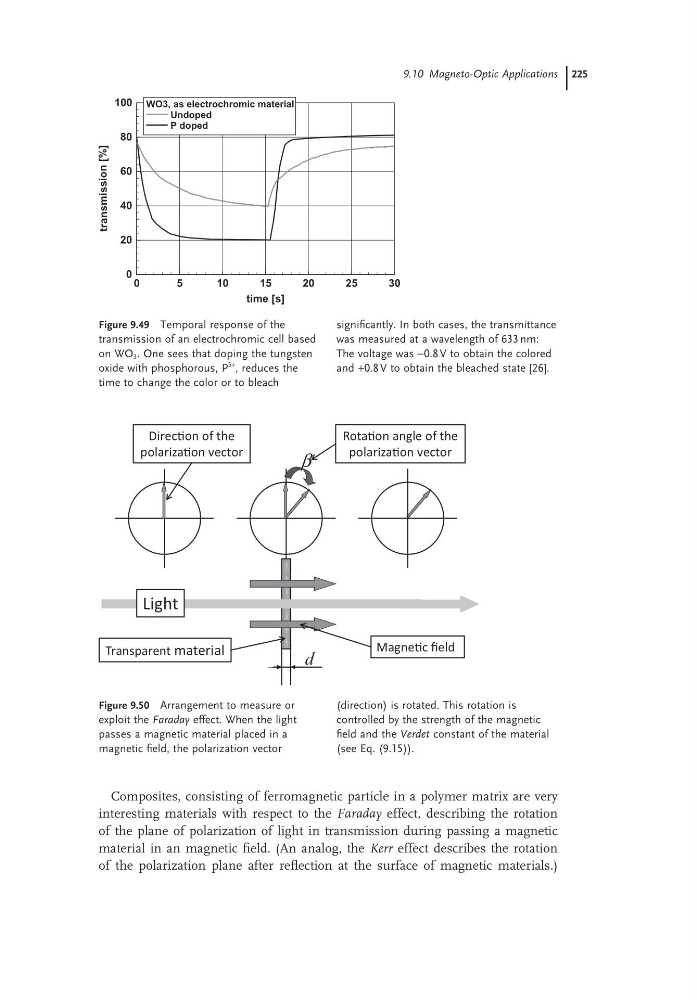
Figure 9.49 Temporal response of the
transmission of an electrochromic cell based
on WO 3 . One sees that doping the tungsten
oxide with phosphorous, P
5+
, reduces the
time to change the color or to bleach
significantly. In both cases, the transmittance
was measured at a wavelength of 633 nm:
The voltage was −0.8 V to obtain the colored
and +0.8 V to obtain the bleached state [26].
0
5
10
15
20
25
30
time [s]
0
20
40
60
80
100
transmission
[%]
WO3, as electrochromic material
Undoped
P doped
Figure 9.50 Arrangement to measure or
exploit the Faraday effect. When the light
passes a magnetic material placed in a
magnetic field, the polarization vector
(direction) is rotated. This rotation is
controlled by the strength of the magnetic
field and the Verdet constant of the material
(see Eq. (9.15)).
d
β
Transparent material
Light
DirecƟon of the
polarizaƟon vector
RotaƟon angle of the
polarizaƟon vector
MagneƟc field
Composites, consisting of ferromagnetic particle in a polymer matrix are very
interesting materials with respect to the Faraday effect, describing the rotation
of the plane of polarization of light in transmission during passing a magnetic
material in an magnetic field. (An analog, the Kerr effect describes the rotation
of the polarization plane after reflection at the surface of magnetic materials.)
Figure 9.49 Temporal response of the
transmission of an electrochromic cell based
on WO 3 . One sees that doping the tungsten
oxide with phosphorous, P
5+
, reduces the
time to change the color or to bleach
significantly. In both cases, the transmittance
was measured at a wavelength of 633 nm:
The voltage was −0.8 V to obtain the colored
and +0.8 V to obtain the bleached state [26].
0
5
10
15
20
25
30
time [s]
0
20
40
60
80
100
transmission
[%]
WO3, as electrochromic material
Undoped
P doped
Figure 9.50 Arrangement to measure or
exploit the Faraday effect. When the light
passes a magnetic material placed in a
magnetic field, the polarization vector
(direction) is rotated. This rotation is
controlled by the strength of the magnetic
field and the Verdet constant of the material
(see Eq. (9.15)).
d
β
Transparent material
Light
DirecƟon of the
polarizaƟon vector
RotaƟon angle of the
polarizaƟon vector
MagneƟc field
Composites, consisting of ferromagnetic particle in a polymer matrix are very
interesting materials with respect to the Faraday effect, describing the rotation
of the plane of polarization of light in transmission during passing a magnetic
material in an magnetic field. (An analog, the Kerr effect describes the rotation
of the polarization plane after reflection at the surface of magnetic materials.)