

226 9 Optical Properties
Usually, for optomagnetic devices, thin films of ferromagnetic materials are used.
There are attempts in the direction of using nanoparticulate ferrites in a polymer
matrix [27].
Figure 9.50 displays the general outline of an arrangement using the Faraday
effect. The rotation angle β of the polarization plane of the outgoing against the
incoming light in a transparent medium exhibiting Faraday rotation is given by
β = vd B ,
(9.15)
where v is the Verdet constant, d the thickness of the active medium, and |B| the
strength of the magnetic field.
Figure 9.50 shows the polarization plane of the incoming light, which is, during
the passage through the material with the thickness d in the magnetic field, rotated
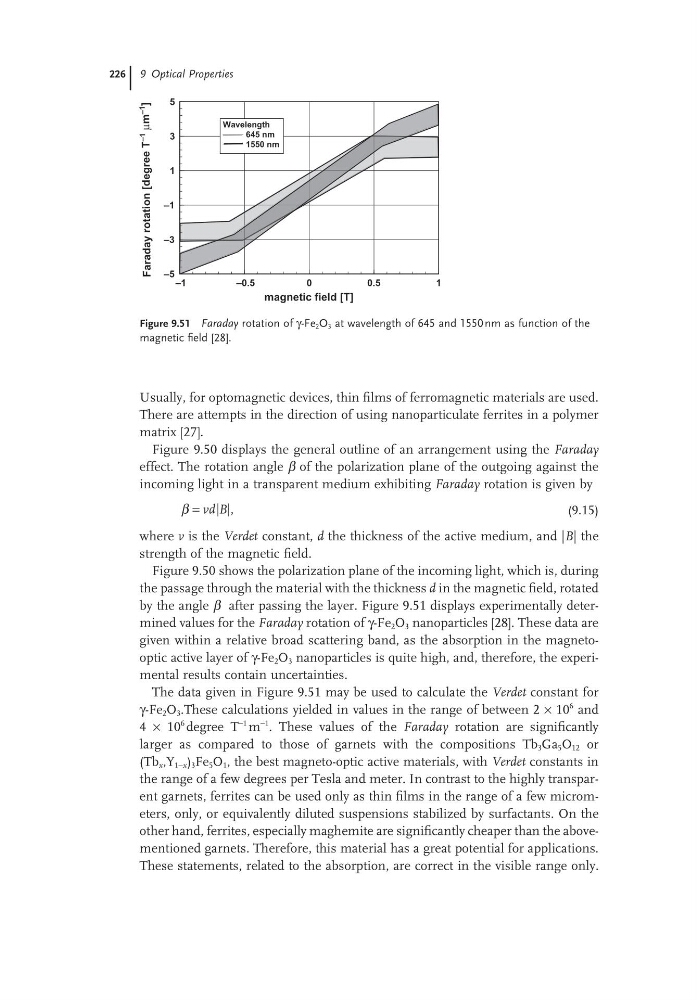
by the angle β after passing the layer. Figure 9.51 displays experimentally determined values for the Faraday rotation of γ-Fe 2 O 3 nanoparticles [28]. These data are
given within a relative broad scattering band, as the absorption in the magnetooptic active layer of γ-Fe 2 O 3 nanoparticles is quite high, and, therefore, the experimental results contain uncertainties.
The data given in Figure 9.51 may be used to calculate the Verdet constant for
γ-Fe 2 O 3 .These calculations yielded in values in the range of between 2 × 10
6 and
4 × 10
6 degree T
−1 m
−1
. These values of the Faraday rotation are significantly
larger as compared to those of garnets with the compositions Tb 3 Ga 5 O 12 or
(Tb x ,Y 1−x ) 3 Fe 5 O 1 , the best magneto-optic active materials, with Verdet constants in
the range of a few degrees per Tesla and meter. In contrast to the highly transparent garnets, ferrites can be used only as thin films in the range of a few micrometers, only, or equivalently diluted suspensions stabilized by surfactants. On the
other hand, ferrites, especially maghemite are significantly cheaper than the abovementioned garnets. Therefore, this material has a great potential for applications.
These statements, related to the absorption, are correct in the visible range only.
Figure 9.51 Faraday rotation of γ-Fe 2 O 3 at wavelength of 645 and 1550 nm as function of the
magnetic field [28].
–1
–0.5
0
0.5
1
magnetic field [T]
–5
–3
–1
1
3
5
T
–1
µm
–1
]
e
e
r
g
e
d
[
n
o
i
t
a
t
o
r
y
a
d
a
r
a
F
Wavelength
645 nm
1550 nm
Usually, for optomagnetic devices, thin films of ferromagnetic materials are used.
There are attempts in the direction of using nanoparticulate ferrites in a polymer
matrix [27].
Figure 9.50 displays the general outline of an arrangement using the Faraday
effect. The rotation angle β of the polarization plane of the outgoing against the
incoming light in a transparent medium exhibiting Faraday rotation is given by
β = vd B ,
(9.15)
where v is the Verdet constant, d the thickness of the active medium, and |B| the
strength of the magnetic field.
Figure 9.50 shows the polarization plane of the incoming light, which is, during
the passage through the material with the thickness d in the magnetic field, rotated
by the angle β after passing the layer. Figure 9.51 displays experimentally determined values for the Faraday rotation of γ-Fe 2 O 3 nanoparticles [28]. These data are
given within a relative broad scattering band, as the absorption in the magnetooptic active layer of γ-Fe 2 O 3 nanoparticles is quite high, and, therefore, the experimental results contain uncertainties.
The data given in Figure 9.51 may be used to calculate the Verdet constant for
γ-Fe 2 O 3 .These calculations yielded in values in the range of between 2 × 10
6 and
4 × 10
6 degree T
−1 m
−1
. These values of the Faraday rotation are significantly
larger as compared to those of garnets with the compositions Tb 3 Ga 5 O 12 or
(Tb x ,Y 1−x ) 3 Fe 5 O 1 , the best magneto-optic active materials, with Verdet constants in
the range of a few degrees per Tesla and meter. In contrast to the highly transparent garnets, ferrites can be used only as thin films in the range of a few micrometers, only, or equivalently diluted suspensions stabilized by surfactants. On the
other hand, ferrites, especially maghemite are significantly cheaper than the abovementioned garnets. Therefore, this material has a great potential for applications.
These statements, related to the absorption, are correct in the visible range only.
Figure 9.51 Faraday rotation of γ-Fe 2 O 3 at wavelength of 645 and 1550 nm as function of the
magnetic field [28].
–1
–0.5
0
0.5
1
magnetic field [T]
–5
–3
–1
1
3
5
T
–1
µm
–1
]
e
e
r
g
e
d
[
n
o
i
t
a
t
o
r
y
a
d
a
r
a
F
Wavelength
645 nm
1550 nm