

224 9 Optical Properties
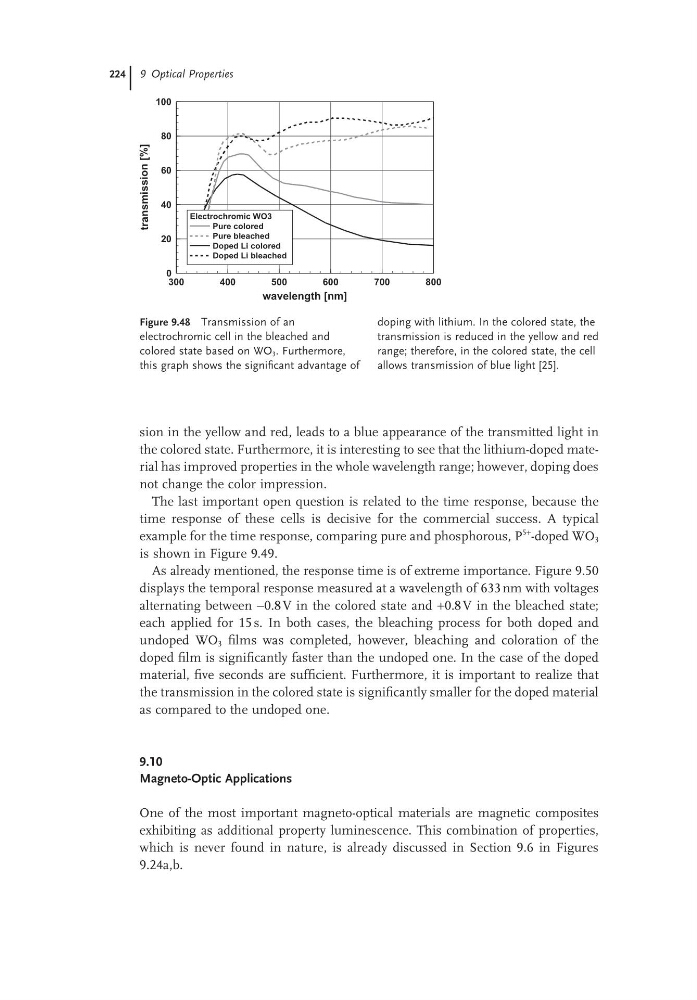
sion in the yellow and red, leads to a blue appearance of the transmitted light in
the colored state. Furthermore, it is interesting to see that the lithium-doped material has improved properties in the whole wavelength range; however, doping does
not change the color impression.
The last important open question is related to the time response, because the
time response of these cells is decisive for the commercial success. A typical
example for the time response, comparing pure and phosphorous, P
5+
-doped WO 3
is shown in Figure 9.49.
As already mentioned, the response time is of extreme importance. Figure 9.50
displays the temporal response measured at a wavelength of 633 nm with voltages
alternating between −0.8 V in the colored state and +0.8 V in the bleached state;
each applied for 15 s. In both cases, the bleaching process for both doped and
undoped WO 3 films was completed, however, bleaching and coloration of the
doped film is significantly faster than the undoped one. In the case of the doped
material, five seconds are sufficient. Furthermore, it is important to realize that
the transmission in the colored state is significantly smaller for the doped material
as compared to the undoped one.
9.10
Magneto-Optic Applications
One of the most important magneto-optical materials are magnetic composites
exhibiting as additional property luminescence. This combination of properties,
which is never found in nature, is already discussed in Section 9.6 in Figures
9.24a,b.
Figure 9.48 Transmission of an
electrochromic cell in the bleached and
colored state based on WO 3 . Furthermore,
this graph shows the significant advantage of
doping with lithium. In the colored state, the
transmission is reduced in the yellow and red
range; therefore, in the colored state, the cell
allows transmission of blue light [25].
300
400
500
600
700
800
wavelength [nm]
0
20
40
60
80
100
transmission
[%]
Electrochromic WO3
Pure colored
Pure bleached
Doped Li colored
Doped Li bleached
sion in the yellow and red, leads to a blue appearance of the transmitted light in
the colored state. Furthermore, it is interesting to see that the lithium-doped material has improved properties in the whole wavelength range; however, doping does
not change the color impression.
The last important open question is related to the time response, because the
time response of these cells is decisive for the commercial success. A typical
example for the time response, comparing pure and phosphorous, P
5+
-doped WO 3
is shown in Figure 9.49.
As already mentioned, the response time is of extreme importance. Figure 9.50
displays the temporal response measured at a wavelength of 633 nm with voltages
alternating between −0.8 V in the colored state and +0.8 V in the bleached state;
each applied for 15 s. In both cases, the bleaching process for both doped and
undoped WO 3 films was completed, however, bleaching and coloration of the
doped film is significantly faster than the undoped one. In the case of the doped
material, five seconds are sufficient. Furthermore, it is important to realize that
the transmission in the colored state is significantly smaller for the doped material
as compared to the undoped one.
9.10
Magneto-Optic Applications
One of the most important magneto-optical materials are magnetic composites
exhibiting as additional property luminescence. This combination of properties,
which is never found in nature, is already discussed in Section 9.6 in Figures
9.24a,b.
Figure 9.48 Transmission of an
electrochromic cell in the bleached and
colored state based on WO 3 . Furthermore,
this graph shows the significant advantage of
doping with lithium. In the colored state, the
transmission is reduced in the yellow and red
range; therefore, in the colored state, the cell
allows transmission of blue light [25].
300
400
500
600
700
800
wavelength [nm]
0
20
40
60
80
100
transmission
[%]
Electrochromic WO3
Pure colored
Pure bleached
Doped Li colored
Doped Li bleached