

9.9 Photochromic and Electrochromic Materials 223
Again, A
+ stands for an alkaline ion. To enable Eq. (9.14), an electrochromic cell
must provide a reservoir of alkaline ions. In the case of oxides with layered structures, such as MoO 3 , WO 3 , etc. these ions are intercalated in-between the layers.
This leads to the highest possible mobility of these charge carriers. The necessity
of a reservoir for alkaline ions and transparent electrical electrodes leads to a
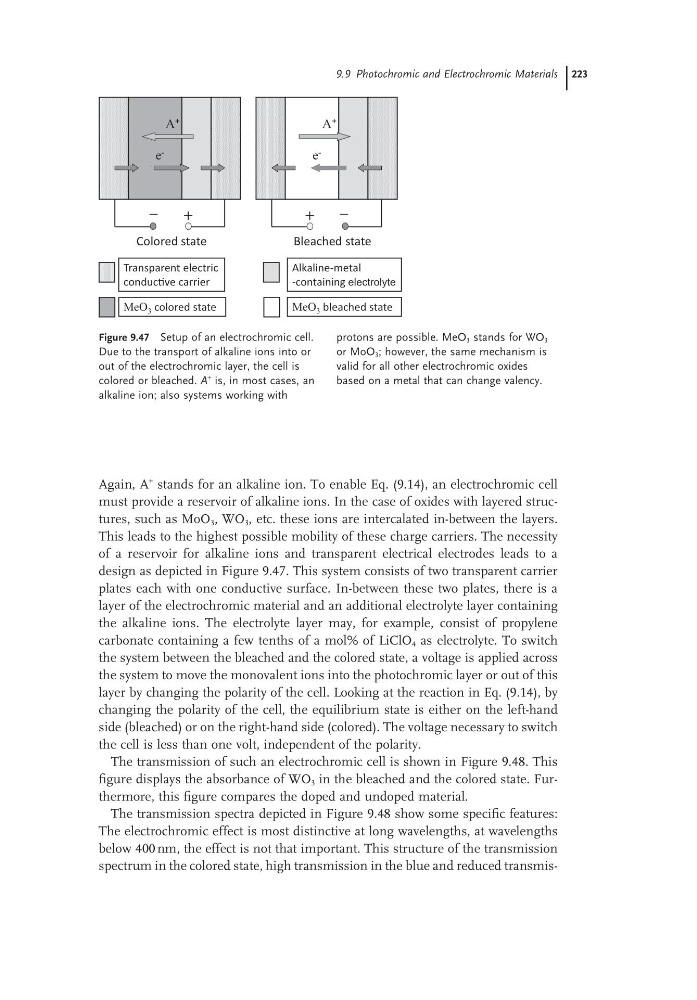
design as depicted in Figure 9.47. This system consists of two transparent carrier
plates each with one conductive surface. In-between these two plates, there is a
layer of the electrochromic material and an additional electrolyte layer containing
the alkaline ions. The electrolyte layer may, for example, consist of propylene
carbonate containing a few tenths of a mol% of LiClO 4 as electrolyte. To switch
the system between the bleached and the colored state, a voltage is applied across
the system to move the monovalent ions into the photochromic layer or out of this
layer by changing the polarity of the cell. Looking at the reaction in Eq. (9.14), by
changing the polarity of the cell, the equilibrium state is either on the left-hand
side (bleached) or on the right-hand side (colored). The voltage necessary to switch
the cell is less than one volt, independent of the polarity.
The transmission of such an electrochromic cell is shown in Figure 9.48. This
figure displays the absorbance of WO 3 in the bleached and the colored state. Furthermore, this figure compares the doped and undoped material.
The transmission spectra depicted in Figure 9.48 show some specific features:
The electrochromic effect is most distinctive at long wavelengths, at wavelengths
below 400 nm, the effect is not that important. This structure of the transmission
spectrum in the colored state, high transmission in the blue and reduced transmisFigure 9.47 Setup of an electrochromic cell.
Due to the transport of alkaline ions into or
out of the electrochromic layer, the cell is
colored or bleached. A
+ is, in most cases, an
alkaline ion; also systems working with
protons are possible. MeO 3 stands for WO 3
or MoO 3 ; however, the same mechanism is
valid for all other electrochromic oxides
based on a metal that can change valency.
A +
e -
+
_
Colored state
A +
e -
+
_
Bleached state
Transparent electric
conducƟve carrier
Alkaline-metal
-containing electrolyte
MeO 3 colored state
MeO 3 bleached state
Again, A
+ stands for an alkaline ion. To enable Eq. (9.14), an electrochromic cell
must provide a reservoir of alkaline ions. In the case of oxides with layered structures, such as MoO 3 , WO 3 , etc. these ions are intercalated in-between the layers.
This leads to the highest possible mobility of these charge carriers. The necessity
of a reservoir for alkaline ions and transparent electrical electrodes leads to a
design as depicted in Figure 9.47. This system consists of two transparent carrier
plates each with one conductive surface. In-between these two plates, there is a
layer of the electrochromic material and an additional electrolyte layer containing
the alkaline ions. The electrolyte layer may, for example, consist of propylene
carbonate containing a few tenths of a mol% of LiClO 4 as electrolyte. To switch
the system between the bleached and the colored state, a voltage is applied across
the system to move the monovalent ions into the photochromic layer or out of this
layer by changing the polarity of the cell. Looking at the reaction in Eq. (9.14), by
changing the polarity of the cell, the equilibrium state is either on the left-hand
side (bleached) or on the right-hand side (colored). The voltage necessary to switch
the cell is less than one volt, independent of the polarity.
The transmission of such an electrochromic cell is shown in Figure 9.48. This
figure displays the absorbance of WO 3 in the bleached and the colored state. Furthermore, this figure compares the doped and undoped material.
The transmission spectra depicted in Figure 9.48 show some specific features:
The electrochromic effect is most distinctive at long wavelengths, at wavelengths
below 400 nm, the effect is not that important. This structure of the transmission
spectrum in the colored state, high transmission in the blue and reduced transmisFigure 9.47 Setup of an electrochromic cell.
Due to the transport of alkaline ions into or
out of the electrochromic layer, the cell is
colored or bleached. A
+ is, in most cases, an
alkaline ion; also systems working with
protons are possible. MeO 3 stands for WO 3
or MoO 3 ; however, the same mechanism is
valid for all other electrochromic oxides
based on a metal that can change valency.
A +
e -
+
_
Colored state
A +
e -
+
_
Bleached state
Transparent electric
conducƟve carrier
Alkaline-metal
-containing electrolyte
MeO 3 colored state
MeO 3 bleached state