

222 9 Optical Properties
From Figure 9.45 it is obvious that the intensity of coloration increases with
time. However, the time needed for saturation is very long; a photochromic change
of the color up to the saturation level is a very slow process. A clear indication that
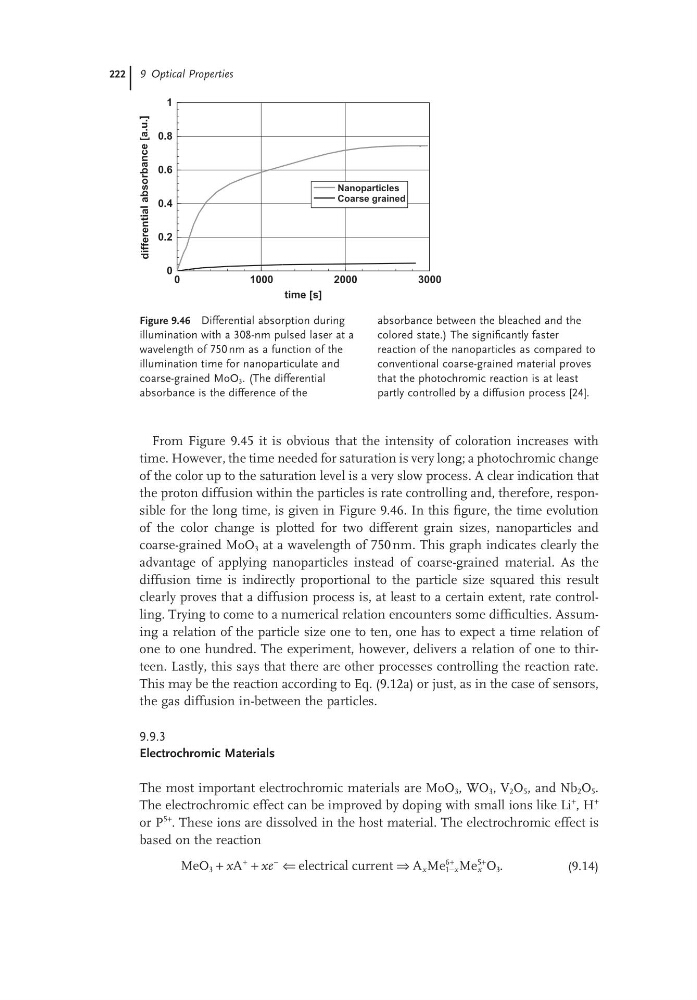
the proton diffusion within the particles is rate controlling and, therefore, responsible for the long time, is given in Figure 9.46. In this figure, the time evolution
of the color change is plotted for two different grain sizes, nanoparticles and
coarse-grained MoO 3 at a wavelength of 750 nm. This graph indicates clearly the
advantage of applying nanoparticles instead of coarse-grained material. As the
diffusion time is indirectly proportional to the particle size squared this result
clearly proves that a diffusion process is, at least to a certain extent, rate controlling. Trying to come to a numerical relation encounters some difficulties. Assuming a relation of the particle size one to ten, one has to expect a time relation of
one to one hundred. The experiment, however, delivers a relation of one to thirteen. Lastly, this says that there are other processes controlling the reaction rate.
This may be the reaction according to Eq. (9.12a) or just, as in the case of sensors,
the gas diffusion in-between the particles.
9.9.3
Electrochromic Materials
The most important electrochromic materials are MoO 3 , WO 3 , V 2 O 5 , and Nb 2 O 5 .
The electrochromic effect can be improved by doping with small ions like Li
+ , H
+
or P
5+
. These ions are dissolved in the host material. The electrochromic effect is
based on the reaction
MeO
A
electrical current A Me Me O
3
1
6
5
3
+
+
⇐
⇒
+
−
−
+
+
x
xe
x
x
x
.
(9.14)
Figure 9.46 Differential absorption during
illumination with a 308-nm pulsed laser at a
wavelength of 750 nm as a function of the
illumination time for nanoparticulate and
coarse-grained MoO 3 . (The differential
absorbance is the difference of the
absorbance between the bleached and the
colored state.) The significantly faster
reaction of the nanoparticles as compared to
conventional coarse-grained material proves
that the photochromic reaction is at least
partly controlled by a diffusion process [24].
0
1000
2000
3000
time [s]
0
0.2
0.4
0.6
0.8
1
differential
absorbance
[a.u.]
Nanoparticles
Coarse grained
From Figure 9.45 it is obvious that the intensity of coloration increases with
time. However, the time needed for saturation is very long; a photochromic change
of the color up to the saturation level is a very slow process. A clear indication that
the proton diffusion within the particles is rate controlling and, therefore, responsible for the long time, is given in Figure 9.46. In this figure, the time evolution
of the color change is plotted for two different grain sizes, nanoparticles and
coarse-grained MoO 3 at a wavelength of 750 nm. This graph indicates clearly the
advantage of applying nanoparticles instead of coarse-grained material. As the
diffusion time is indirectly proportional to the particle size squared this result
clearly proves that a diffusion process is, at least to a certain extent, rate controlling. Trying to come to a numerical relation encounters some difficulties. Assuming a relation of the particle size one to ten, one has to expect a time relation of
one to one hundred. The experiment, however, delivers a relation of one to thirteen. Lastly, this says that there are other processes controlling the reaction rate.
This may be the reaction according to Eq. (9.12a) or just, as in the case of sensors,
the gas diffusion in-between the particles.
9.9.3
Electrochromic Materials
The most important electrochromic materials are MoO 3 , WO 3 , V 2 O 5 , and Nb 2 O 5 .
The electrochromic effect can be improved by doping with small ions like Li
+ , H
+
or P
5+
. These ions are dissolved in the host material. The electrochromic effect is
based on the reaction
MeO
A
electrical current A Me Me O
3
1
6
5
3
+
+
⇐
⇒
+
−
−
+
+
x
xe
x
x
x
.
(9.14)
Figure 9.46 Differential absorption during
illumination with a 308-nm pulsed laser at a
wavelength of 750 nm as a function of the
illumination time for nanoparticulate and
coarse-grained MoO 3 . (The differential
absorbance is the difference of the
absorbance between the bleached and the
colored state.) The significantly faster
reaction of the nanoparticles as compared to
conventional coarse-grained material proves
that the photochromic reaction is at least
partly controlled by a diffusion process [24].
0
1000
2000
3000
time [s]
0
0.2
0.4
0.6
0.8
1
differential
absorbance
[a.u.]
Nanoparticles
Coarse grained