

9.9 Photochromic and Electrochromic Materials 221
oxides are excited by energy-rich photons, positively charged holes and free electrons are formed. The holes react with adsorbed water and produce protons:
H O h
H O
2
2
2
+
⇒
+
+
+
.
(9.12a)
The protons react with the oxide, which changes the stoichiometry
MeO
H
H Me Me O
3
1
6
5
3
+
+
⇒
+
−
−
+
+
x
xe
x
x
x
.
(9.12b)
The material formed according to Eq. (9.12b) changes color to blue or green. The
oxygen radicals either occupy vacancy sites inside the material or escape from the
particle. The possible immediate recombination of the charge carriers, h
+
+ e
−
⇒ heat,
reduces the performance of the material. As the reaction according to Eq. (9.12a)
needs exchange with the surrounding atmosphere, controlling the performance is
difficult. The reaction according to Eq. (9.12a) is rate controlling occurring at the
surface, the step according to Eq. (9.12b) is diffusion controlled. However, even
when the diffusion of protons is relatively fast, lastly, this is the rate-controlling
step.
The phenomena provoked by protons may be obtained with alkaline-metal
doping, too. For alkaline-metal-doped materials, Eq. (9.12b) writes:
MeO
A
A Me Me O
3
1
6
5
3
+
+
⇒
+
−
−
+
+
x
xe
x
x
x
.
(9.13)
A
+ is a monovalent ion, generally an alkaline ion. However, also in doped materials, the efficiency of the system depends on the number of free electrons that can
react with the metal Me.
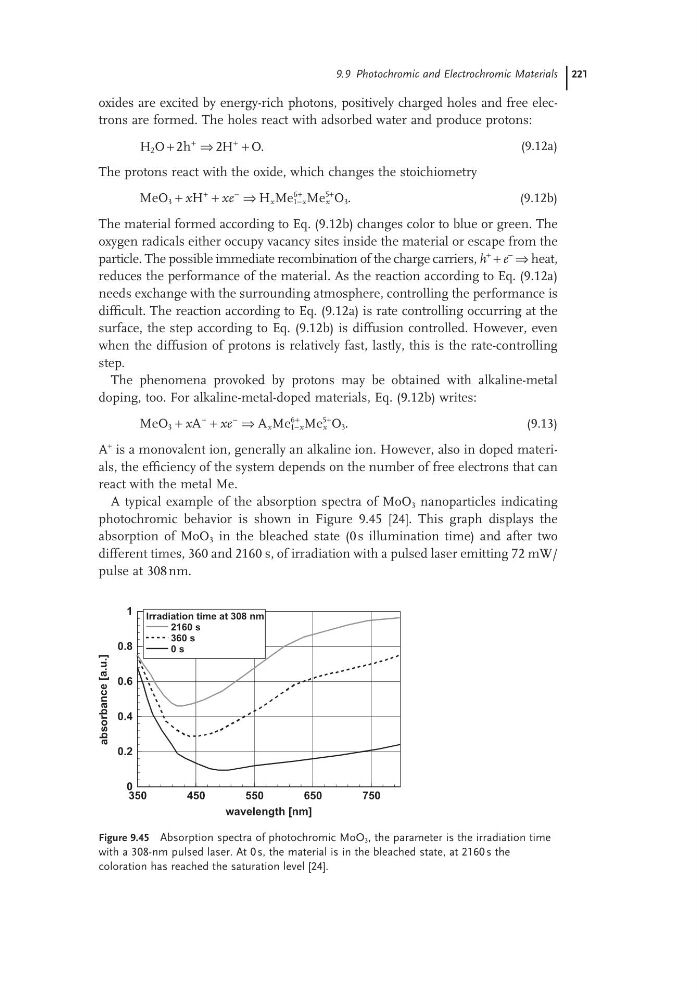
A typical example of the absorption spectra of MoO 3 nanoparticles indicating
photochromic behavior is shown in Figure 9.45 [24]. This graph displays the
absorption of MoO 3 in the bleached state (0 s illumination time) and after two
different times, 360 and 2160 s, of irradiation with a pulsed laser emitting 72 mW/
pulse at 308 nm.
Figure 9.45 Absorption spectra of photochromic MoO 3 , the parameter is the irradiation time
with a 308-nm pulsed laser. At 0 s, the material is in the bleached state, at 2160 s the
coloration has reached the saturation level [24].
350
450
550
650
750
wavelength [nm]
0
0.2
0.4
0.6
0.8
1
absorbance
[a.u.]
Irradiation time at 308 nm
2160 s
360 s
0 s
oxides are excited by energy-rich photons, positively charged holes and free electrons are formed. The holes react with adsorbed water and produce protons:
H O h
H O
2
2
2
+
⇒
+
+
+
.
(9.12a)
The protons react with the oxide, which changes the stoichiometry
MeO
H
H Me Me O
3
1
6
5
3
+
+
⇒
+
−
−
+
+
x
xe
x
x
x
.
(9.12b)
The material formed according to Eq. (9.12b) changes color to blue or green. The
oxygen radicals either occupy vacancy sites inside the material or escape from the
particle. The possible immediate recombination of the charge carriers, h
+
+ e
−
⇒ heat,
reduces the performance of the material. As the reaction according to Eq. (9.12a)
needs exchange with the surrounding atmosphere, controlling the performance is
difficult. The reaction according to Eq. (9.12a) is rate controlling occurring at the
surface, the step according to Eq. (9.12b) is diffusion controlled. However, even
when the diffusion of protons is relatively fast, lastly, this is the rate-controlling
step.
The phenomena provoked by protons may be obtained with alkaline-metal
doping, too. For alkaline-metal-doped materials, Eq. (9.12b) writes:
MeO
A
A Me Me O
3
1
6
5
3
+
+
⇒
+
−
−
+
+
x
xe
x
x
x
.
(9.13)
A
+ is a monovalent ion, generally an alkaline ion. However, also in doped materials, the efficiency of the system depends on the number of free electrons that can
react with the metal Me.
A typical example of the absorption spectra of MoO 3 nanoparticles indicating
photochromic behavior is shown in Figure 9.45 [24]. This graph displays the
absorption of MoO 3 in the bleached state (0 s illumination time) and after two
different times, 360 and 2160 s, of irradiation with a pulsed laser emitting 72 mW/
pulse at 308 nm.
Figure 9.45 Absorption spectra of photochromic MoO 3 , the parameter is the irradiation time
with a 308-nm pulsed laser. At 0 s, the material is in the bleached state, at 2160 s the
coloration has reached the saturation level [24].
350
450
550
650
750
wavelength [nm]
0
0.2
0.4
0.6
0.8
1
absorbance
[a.u.]
Irradiation time at 308 nm
2160 s
360 s
0 s