

214 9 Optical Properties
oxidation and hydrolysis. For protection, coating with a polymer is advised. This
leads to the necessity of nanocomposites. Looking at the special type of nanocomposites with a ceramic core and an organic lumophore, one has the huge advantage
of a nearly infinite number of compounds with different properties. Furthermore,
these composites are the only chance to combine optical and magnetic properties
in one particle.
The considerations are different, looking the optical absorbance. Knowledge of
the absorbance is necessary to find an optimal wavelength for excitation and,
most importantly, in the case of application as a pigment. In particular, for the
application as a pigment, detailed considerations with respect to long-term stability are necessary. Sometimes, this point makes the application of some particles
difficult, or, the final product must be protected against too much light, oxidation,
and hydrolysis. A comparison of three different types of optical absorbers is given
in Figure 9.39. It compares the behavior of an organic compound (FTIC, fluorescein isothiocyanate) with a metal, Au, and a semiconductor, ZnSe. The semiconductor excels in a clear expressed absorption edge. With respect to pigments,
this gives by far the best colors. The metallic absorber is characterized by the
plasmon resonance peak and on the short-wavelength side of this peak a
minimum of the absorbance. This minimum is the reason for a slight discoloration. In the case of gold particles, a red pigment, this gives rise to a slight blue
hue, which is typical of the so-called gold ruby glass. Looking at the organic
absorber, one sees similar problems as described in the case of gold; however,
it is much more pronounced.
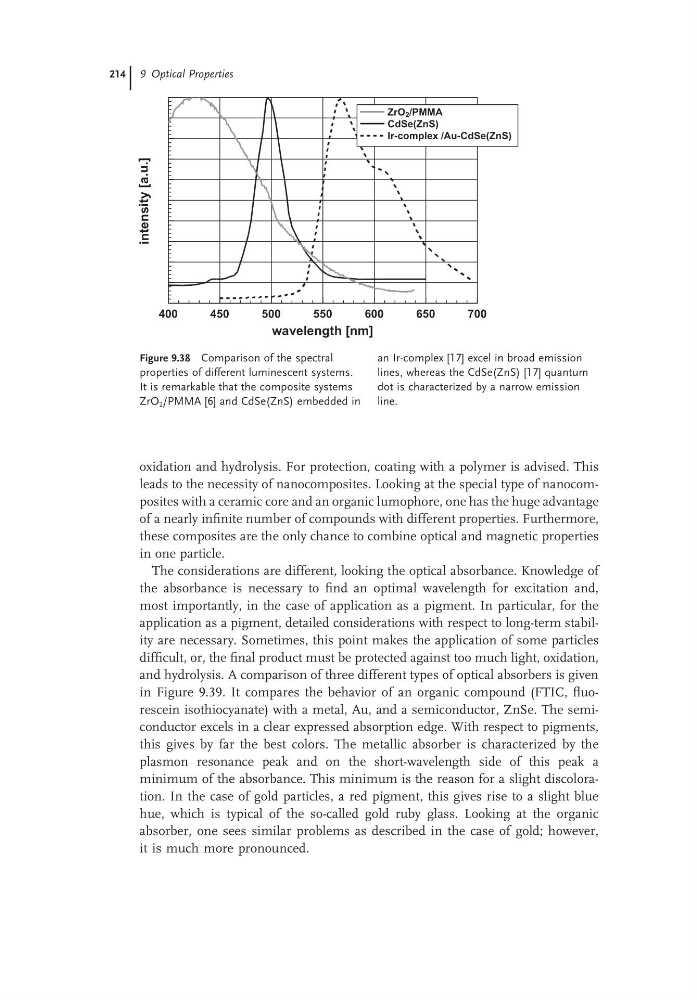
Figure 9.38 Comparison of the spectral
properties of different luminescent systems.
It is remarkable that the composite systems
ZrO 2 /PMMA [6] and CdSe(ZnS) embedded in
an Ir-complex [17] excel in broad emission
lines, whereas the CdSe(ZnS) [17] quantum
dot is characterized by a narrow emission
line.
400
450
500
550
600
650
700
wavelength [nm]
0
1
2
3
4
5
6
7
8
9
10
intensity
[a.u.]
ZrO 2 /PMMA
CdSe(ZnS)
Ir-complex /Au-CdSe(ZnS)
oxidation and hydrolysis. For protection, coating with a polymer is advised. This
leads to the necessity of nanocomposites. Looking at the special type of nanocomposites with a ceramic core and an organic lumophore, one has the huge advantage
of a nearly infinite number of compounds with different properties. Furthermore,
these composites are the only chance to combine optical and magnetic properties
in one particle.
The considerations are different, looking the optical absorbance. Knowledge of
the absorbance is necessary to find an optimal wavelength for excitation and,
most importantly, in the case of application as a pigment. In particular, for the
application as a pigment, detailed considerations with respect to long-term stability are necessary. Sometimes, this point makes the application of some particles
difficult, or, the final product must be protected against too much light, oxidation,
and hydrolysis. A comparison of three different types of optical absorbers is given
in Figure 9.39. It compares the behavior of an organic compound (FTIC, fluorescein isothiocyanate) with a metal, Au, and a semiconductor, ZnSe. The semiconductor excels in a clear expressed absorption edge. With respect to pigments,
this gives by far the best colors. The metallic absorber is characterized by the
plasmon resonance peak and on the short-wavelength side of this peak a
minimum of the absorbance. This minimum is the reason for a slight discoloration. In the case of gold particles, a red pigment, this gives rise to a slight blue
hue, which is typical of the so-called gold ruby glass. Looking at the organic
absorber, one sees similar problems as described in the case of gold; however,
it is much more pronounced.
Figure 9.38 Comparison of the spectral
properties of different luminescent systems.
It is remarkable that the composite systems
ZrO 2 /PMMA [6] and CdSe(ZnS) embedded in
an Ir-complex [17] excel in broad emission
lines, whereas the CdSe(ZnS) [17] quantum
dot is characterized by a narrow emission
line.
400
450
500
550
600
650
700
wavelength [nm]
0
1
2
3
4
5
6
7
8
9
10
intensity
[a.u.]
ZrO 2 /PMMA
CdSe(ZnS)
Ir-complex /Au-CdSe(ZnS)