

9.7 Selection of a Lumophore or Absorber 213
9.7
Selection of a Lumophore or Absorber
In the previous sections, a series of different nanoparticles and nanocomposites
with special optical properties with respect to absorption and emission were discussed. Now the question arises which one of these possibilities is best for a
specific application. A first clue for an answer may be found in Figure 9.38. In
this figure, the emission spectra of three different types of emitters are presented.
Obviously, generally, one has to distinguish between particles emitting in a broad
band and particles emitting a relatively sharp line. In the class of the broadband
emitter, one finds organic / inorganic nanocomposites, whereas, only quantum
dots emit in a narrow spectrum. The latter statement is true only in cases where
the particle-size distribution is narrow. On the other hand, quantum dots stemming from a production that delivers a broad particle-size distribution, may also
be useful as broadband emitter. Besides the emission spectra, other criteria are
necessary for selection. Such criteria are stability against UV-radiation and, not
least, stability against oxidation and hydrolysis. In particular, many types of
quantum dots are sensitive to chemical degradation. The narrow-band emitters,
such as the quantum dots, have their main application in medicine and biology,
where it is often necessary to provide particles, emitting in different colors;
however, with the same surface chemistry. This makes multiplexed detection of
different biological targets possible. The tunability of the emitted wavelength, of
quantum dots, gives the possibility to adjust the emission in the near-IR, allowing
fluorescence imaging in living organisms. It is well known that many of the
semiconducting compounds that may be used for quantum dots are sensitive to
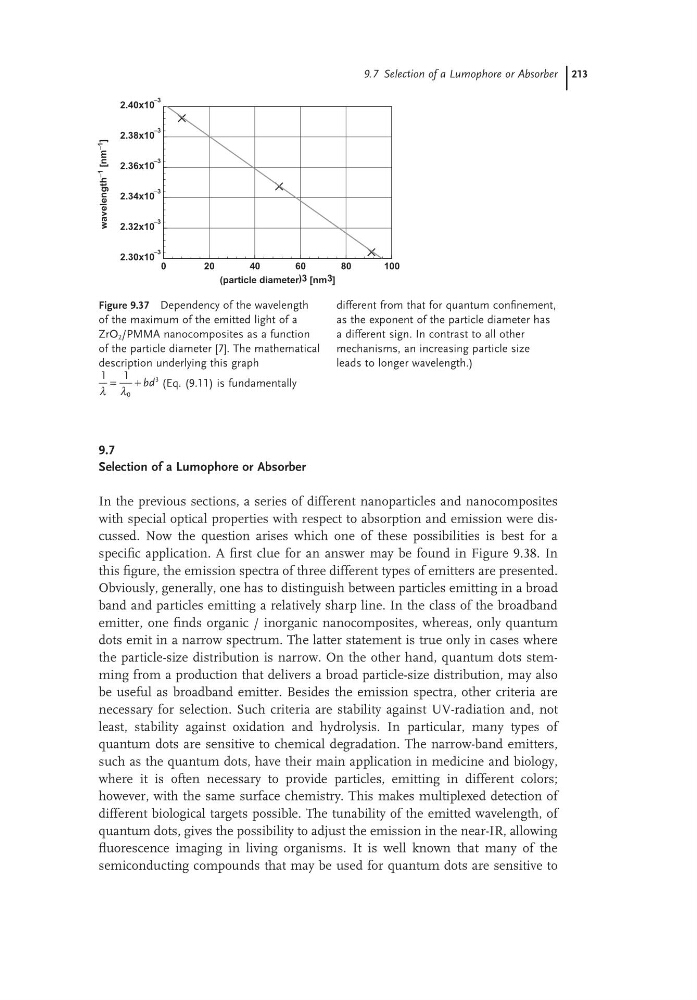
Figure 9.37 Dependency of the wavelength
of the maximum of the emitted light of a
ZrO 2 /PMMA nanocomposites as a function
of the particle diameter [7]. The mathematical
description underlying this graph
1 1
0
3
λ λ
=
+ bd (Eq. (9.11) is fundamentally
different from that for quantum confinement,
as the exponent of the particle diameter has
a different sign. In contrast to all other
mechanisms, an increasing particle size
leads to longer wavelength.)
0
20
40
60
80
100
(particle diameter )3 [nm 3 ]
2.30x10
–3
2.32x10
–3
2.34x10
–3
2.36x10
–3
2.38x10
–3
2.40x10
–3
wavelength
–1
[nm
–1
]
9.7
Selection of a Lumophore or Absorber
In the previous sections, a series of different nanoparticles and nanocomposites
with special optical properties with respect to absorption and emission were discussed. Now the question arises which one of these possibilities is best for a
specific application. A first clue for an answer may be found in Figure 9.38. In
this figure, the emission spectra of three different types of emitters are presented.
Obviously, generally, one has to distinguish between particles emitting in a broad
band and particles emitting a relatively sharp line. In the class of the broadband
emitter, one finds organic / inorganic nanocomposites, whereas, only quantum
dots emit in a narrow spectrum. The latter statement is true only in cases where
the particle-size distribution is narrow. On the other hand, quantum dots stemming from a production that delivers a broad particle-size distribution, may also
be useful as broadband emitter. Besides the emission spectra, other criteria are
necessary for selection. Such criteria are stability against UV-radiation and, not
least, stability against oxidation and hydrolysis. In particular, many types of
quantum dots are sensitive to chemical degradation. The narrow-band emitters,
such as the quantum dots, have their main application in medicine and biology,
where it is often necessary to provide particles, emitting in different colors;
however, with the same surface chemistry. This makes multiplexed detection of
different biological targets possible. The tunability of the emitted wavelength, of
quantum dots, gives the possibility to adjust the emission in the near-IR, allowing
fluorescence imaging in living organisms. It is well known that many of the
semiconducting compounds that may be used for quantum dots are sensitive to
Figure 9.37 Dependency of the wavelength
of the maximum of the emitted light of a
ZrO 2 /PMMA nanocomposites as a function
of the particle diameter [7]. The mathematical
description underlying this graph
1 1
0
3
λ λ
=
+ bd (Eq. (9.11) is fundamentally
different from that for quantum confinement,
as the exponent of the particle diameter has
a different sign. In contrast to all other
mechanisms, an increasing particle size
leads to longer wavelength.)
0
20
40
60
80
100
(particle diameter )3 [nm 3 ]
2.30x10
–3
2.32x10
–3
2.34x10
–3
2.36x10
–3
2.38x10
–3
2.40x10
–3
wavelength
–1
[nm
–1
]