

210 9 Optical Properties
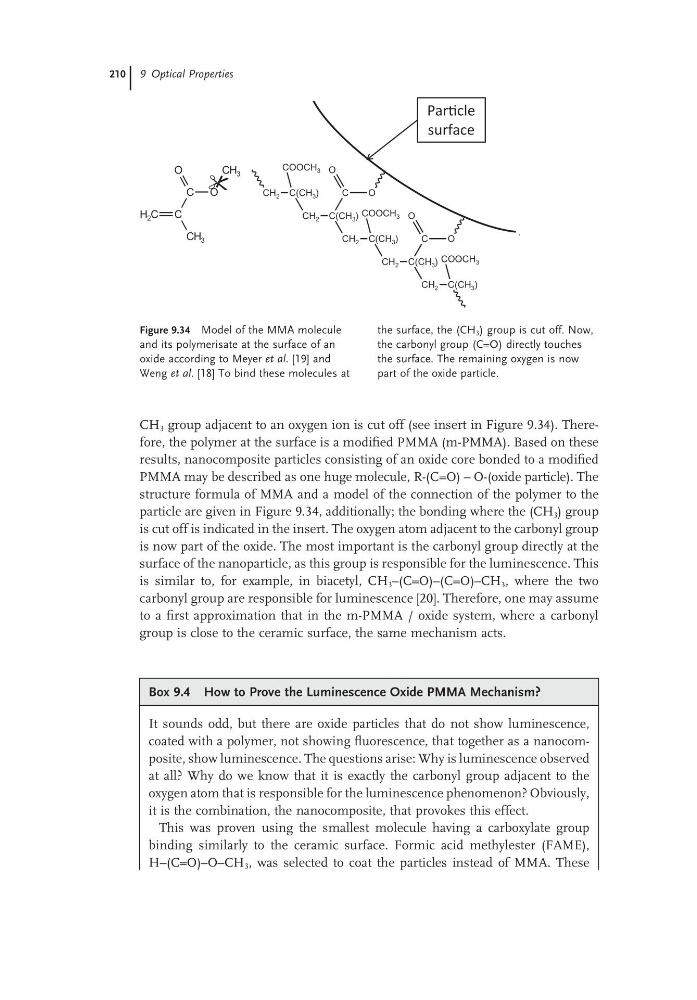
CH 3 group adjacent to an oxygen ion is cut off (see insert in Figure 9.34). Therefore, the polymer at the surface is a modified PMMA (m-PMMA). Based on these
results, nanocomposite particles consisting of an oxide core bonded to a modified
PMMA may be described as one huge molecule, R-(C=O) – O-(oxide particle). The
structure formula of MMA and a model of the connection of the polymer to the
particle are given in Figure 9.34, additionally; the bonding where the (CH 3 ) group
is cut off is indicated in the insert. The oxygen atom adjacent to the carbonyl group
is now part of the oxide. The most important is the carbonyl group directly at the
surface of the nanoparticle, as this group is responsible for the luminescence. This
is similar to, for example, in biacetyl, CH 3 –(C=O)–(C=O)–CH 3 , where the two
carbonyl group are responsible for luminescence [20]. Therefore, one may assume
to a first approximation that in the m-PMMA / oxide system, where a carbonyl
group is close to the ceramic surface, the same mechanism acts.
Figure 9.34 Model of the MMA molecule
and its polymerisate at the surface of an
oxide according to Meyer et al. [19] and
Weng et al. [18] To bind these molecules at
the surface, the (CH 3 ) group is cut off. Now,
the carbonyl group (C=O) directly touches
the surface. The remaining oxygen is now
part of the oxide particle.
CH 2 C(CH 3 )
CH 2
C
O
O
C(CH 3 )
CH 2 C(CH 3 )
C(CH 3 )
CH 2
C
O
O
COOCH 3
COOCH 3
CH 2 C(CH 3 )
COOCH 3
H 2 C C
CH 3
C
O
O
CH 3
ParƟcle
surface
Box 9.4 How to Prove the Luminescence Oxide PMMA Mechanism?
It sounds odd, but there are oxide particles that do not show luminescence,
coated with a polymer, not showing fluorescence, that together as a nanocomposite, show luminescence. The questions arise: Why is luminescence observed
at all? Why do we know that it is exactly the carbonyl group adjacent to the
oxygen atom that is responsible for the luminescence phenomenon? Obviously,
it is the combination, the nanocomposite, that provokes this effect.
This was proven using the smallest molecule having a carboxylate group
binding similarly to the ceramic surface. Formic acid methylester (FAME),
H–(C=O)–O–CH 3 , was selected to coat the particles instead of MMA. These
CH 3 group adjacent to an oxygen ion is cut off (see insert in Figure 9.34). Therefore, the polymer at the surface is a modified PMMA (m-PMMA). Based on these
results, nanocomposite particles consisting of an oxide core bonded to a modified
PMMA may be described as one huge molecule, R-(C=O) – O-(oxide particle). The
structure formula of MMA and a model of the connection of the polymer to the
particle are given in Figure 9.34, additionally; the bonding where the (CH 3 ) group
is cut off is indicated in the insert. The oxygen atom adjacent to the carbonyl group
is now part of the oxide. The most important is the carbonyl group directly at the
surface of the nanoparticle, as this group is responsible for the luminescence. This
is similar to, for example, in biacetyl, CH 3 –(C=O)–(C=O)–CH 3 , where the two
carbonyl group are responsible for luminescence [20]. Therefore, one may assume
to a first approximation that in the m-PMMA / oxide system, where a carbonyl
group is close to the ceramic surface, the same mechanism acts.
Figure 9.34 Model of the MMA molecule
and its polymerisate at the surface of an
oxide according to Meyer et al. [19] and
Weng et al. [18] To bind these molecules at
the surface, the (CH 3 ) group is cut off. Now,
the carbonyl group (C=O) directly touches
the surface. The remaining oxygen is now
part of the oxide particle.
CH 2 C(CH 3 )
CH 2
C
O
O
C(CH 3 )
CH 2 C(CH 3 )
C(CH 3 )
CH 2
C
O
O
COOCH 3
COOCH 3
CH 2 C(CH 3 )
COOCH 3
H 2 C C
CH 3
C
O
O
CH 3
ParƟcle
surface
Box 9.4 How to Prove the Luminescence Oxide PMMA Mechanism?
It sounds odd, but there are oxide particles that do not show luminescence,
coated with a polymer, not showing fluorescence, that together as a nanocomposite, show luminescence. The questions arise: Why is luminescence observed
at all? Why do we know that it is exactly the carbonyl group adjacent to the
oxygen atom that is responsible for the luminescence phenomenon? Obviously,
it is the combination, the nanocomposite, that provokes this effect.
This was proven using the smallest molecule having a carboxylate group
binding similarly to the ceramic surface. Formic acid methylester (FAME),
H–(C=O)–O–CH 3 , was selected to coat the particles instead of MMA. These