

9.6 Luminescent Nanocomposites 209
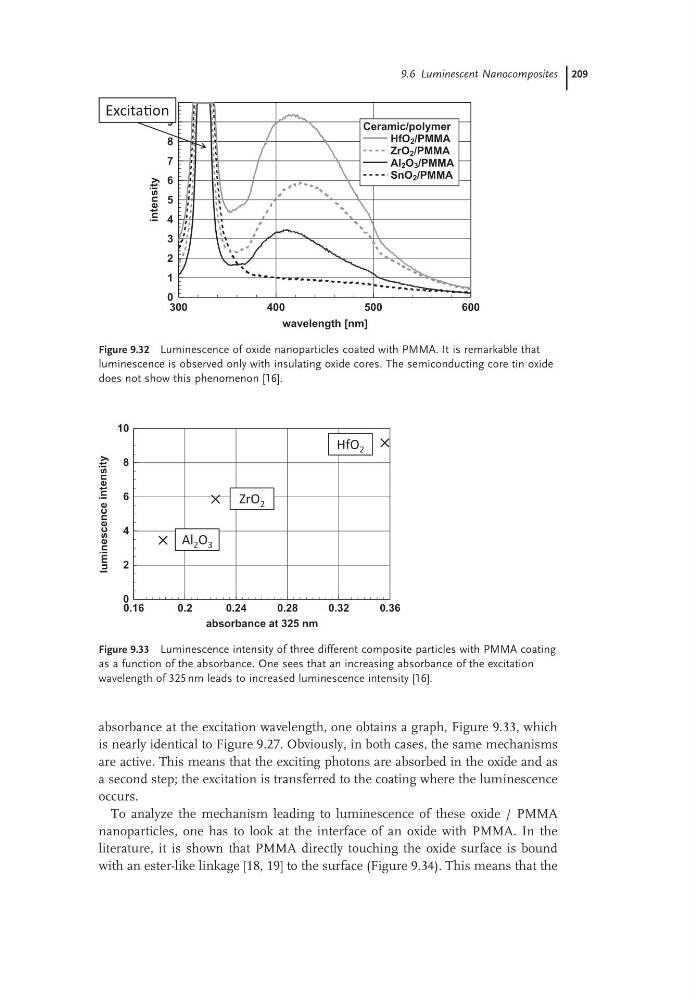
absorbance at the excitation wavelength, one obtains a graph, Figure 9.33, which
is nearly identical to Figure 9.27. Obviously, in both cases, the same mechanisms
are active. This means that the exciting photons are absorbed in the oxide and as
a second step; the excitation is transferred to the coating where the luminescence
occurs.
To analyze the mechanism leading to luminescence of these oxide / PMMA
nanoparticles, one has to look at the interface of an oxide with PMMA. In the
literature, it is shown that PMMA directly touching the oxide surface is bound
with an ester-like linkage [18, 19] to the surface (Figure 9.34). This means that the
Figure 9.32 Luminescence of oxide nanoparticles coated with PMMA. It is remarkable that
luminescence is observed only with insulating oxide cores. The semiconducting core tin oxide
does not show this phenomenon [16].
300
400
500
600
wavelength [nm]
0
1
2
3
4
5
6
7
8
9
10
intensity
Ceramic/polymer
HfO 2 /PMMA
ZrO 2 /PMMA
Al 2 O 3 /PMMA
SnO 2 /PMMA
ExcitaƟon
Figure 9.33 Luminescence intensity of three different composite particles with PMMA coating
as a function of the absorbance. One sees that an increasing absorbance of the excitation
wavelength of 325 nm leads to increased luminescence intensity [16].
0.16
0.2
0.24
0.28
0.32
0.36
absorbance at 325 nm
0
2
4
6
8
10
luminescence
intensity
Al 2 O 3
HfO 2
ZrO 2
absorbance at the excitation wavelength, one obtains a graph, Figure 9.33, which
is nearly identical to Figure 9.27. Obviously, in both cases, the same mechanisms
are active. This means that the exciting photons are absorbed in the oxide and as
a second step; the excitation is transferred to the coating where the luminescence
occurs.
To analyze the mechanism leading to luminescence of these oxide / PMMA
nanoparticles, one has to look at the interface of an oxide with PMMA. In the
literature, it is shown that PMMA directly touching the oxide surface is bound
with an ester-like linkage [18, 19] to the surface (Figure 9.34). This means that the
Figure 9.32 Luminescence of oxide nanoparticles coated with PMMA. It is remarkable that
luminescence is observed only with insulating oxide cores. The semiconducting core tin oxide
does not show this phenomenon [16].
300
400
500
600
wavelength [nm]
0
1
2
3
4
5
6
7
8
9
10
intensity
Ceramic/polymer
HfO 2 /PMMA
ZrO 2 /PMMA
Al 2 O 3 /PMMA
SnO 2 /PMMA
ExcitaƟon
Figure 9.33 Luminescence intensity of three different composite particles with PMMA coating
as a function of the absorbance. One sees that an increasing absorbance of the excitation
wavelength of 325 nm leads to increased luminescence intensity [16].
0.16
0.2
0.24
0.28
0.32
0.36
absorbance at 325 nm
0
2
4
6
8
10
luminescence
intensity
Al 2 O 3
HfO 2
ZrO 2