

208 9 Optical Properties
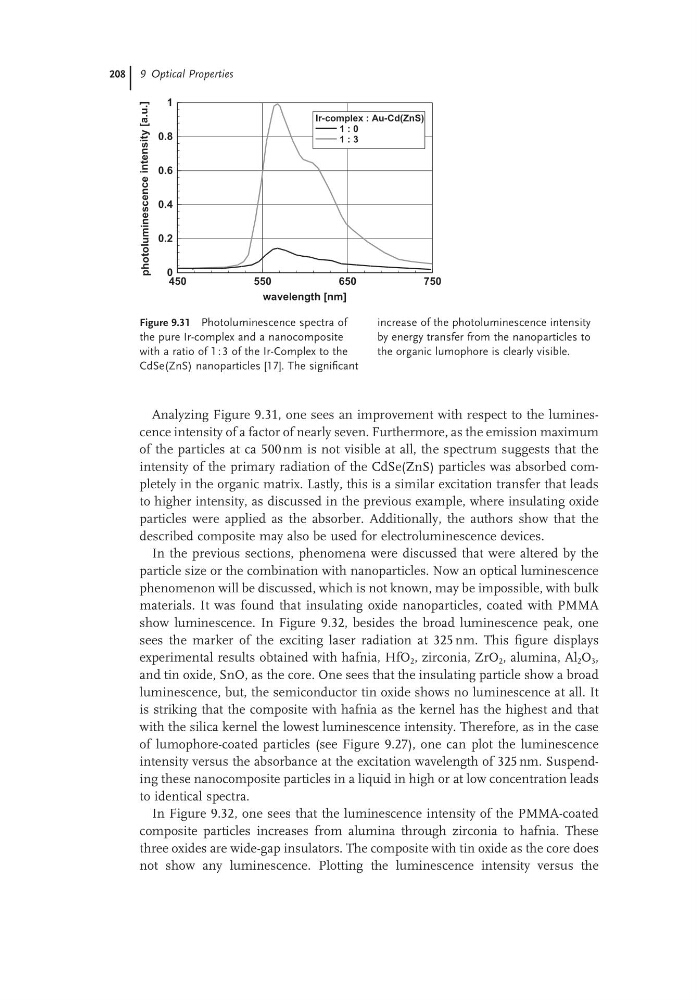
Analyzing Figure 9.31, one sees an improvement with respect to the luminescence intensity of a factor of nearly seven. Furthermore, as the emission maximum
of the particles at ca 500 nm is not visible at all, the spectrum suggests that the
intensity of the primary radiation of the CdSe(ZnS) particles was absorbed completely in the organic matrix. Lastly, this is a similar excitation transfer that leads
to higher intensity, as discussed in the previous example, where insulating oxide
particles were applied as the absorber. Additionally, the authors show that the
described composite may also be used for electroluminescence devices.
In the previous sections, phenomena were discussed that were altered by the
particle size or the combination with nanoparticles. Now an optical luminescence
phenomenon will be discussed, which is not known, may be impossible, with bulk
materials. It was found that insulating oxide nanoparticles, coated with PMMA
show luminescence. In Figure 9.32, besides the broad luminescence peak, one
sees the marker of the exciting laser radiation at 325 nm. This figure displays
experimental results obtained with hafnia, HfO 2 , zirconia, ZrO 2 , alumina, Al 2 O 3 ,
and tin oxide, SnO, as the core. One sees that the insulating particle show a broad
luminescence, but, the semiconductor tin oxide shows no luminescence at all. It
is striking that the composite with hafnia as the kernel has the highest and that
with the silica kernel the lowest luminescence intensity. Therefore, as in the case
of lumophore-coated particles (see Figure 9.27), one can plot the luminescence
intensity versus the absorbance at the excitation wavelength of 325 nm. Suspending these nanocomposite particles in a liquid in high or at low concentration leads
to identical spectra.
In Figure 9.32, one sees that the luminescence intensity of the PMMA-coated
composite particles increases from alumina through zirconia to hafnia. These
three oxides are wide-gap insulators. The composite with tin oxide as the core does
not show any luminescence. Plotting the luminescence intensity versus the
Figure 9.31 Photoluminescence spectra of
the pure Ir-complex and a nanocomposite
with a ratio of 1 : 3 of the Ir-Complex to the
CdSe(ZnS) nanoparticles [17]. The significant
increase of the photoluminescence intensity
by energy transfer from the nanoparticles to
the organic lumophore is clearly visible.
450
550
650
750
wavelength [nm]
0
0.2
0.4
0.6
0.8
1
photoluminescence
intensity
[a.u.]
Ir-complex : Au-Cd(ZnS)
1 : 0
1 : 3
Analyzing Figure 9.31, one sees an improvement with respect to the luminescence intensity of a factor of nearly seven. Furthermore, as the emission maximum
of the particles at ca 500 nm is not visible at all, the spectrum suggests that the
intensity of the primary radiation of the CdSe(ZnS) particles was absorbed completely in the organic matrix. Lastly, this is a similar excitation transfer that leads
to higher intensity, as discussed in the previous example, where insulating oxide
particles were applied as the absorber. Additionally, the authors show that the
described composite may also be used for electroluminescence devices.
In the previous sections, phenomena were discussed that were altered by the
particle size or the combination with nanoparticles. Now an optical luminescence
phenomenon will be discussed, which is not known, may be impossible, with bulk
materials. It was found that insulating oxide nanoparticles, coated with PMMA
show luminescence. In Figure 9.32, besides the broad luminescence peak, one
sees the marker of the exciting laser radiation at 325 nm. This figure displays
experimental results obtained with hafnia, HfO 2 , zirconia, ZrO 2 , alumina, Al 2 O 3 ,
and tin oxide, SnO, as the core. One sees that the insulating particle show a broad
luminescence, but, the semiconductor tin oxide shows no luminescence at all. It
is striking that the composite with hafnia as the kernel has the highest and that
with the silica kernel the lowest luminescence intensity. Therefore, as in the case
of lumophore-coated particles (see Figure 9.27), one can plot the luminescence
intensity versus the absorbance at the excitation wavelength of 325 nm. Suspending these nanocomposite particles in a liquid in high or at low concentration leads
to identical spectra.
In Figure 9.32, one sees that the luminescence intensity of the PMMA-coated
composite particles increases from alumina through zirconia to hafnia. These
three oxides are wide-gap insulators. The composite with tin oxide as the core does
not show any luminescence. Plotting the luminescence intensity versus the
Figure 9.31 Photoluminescence spectra of
the pure Ir-complex and a nanocomposite
with a ratio of 1 : 3 of the Ir-Complex to the
CdSe(ZnS) nanoparticles [17]. The significant
increase of the photoluminescence intensity
by energy transfer from the nanoparticles to
the organic lumophore is clearly visible.
450
550
650
750
wavelength [nm]
0
0.2
0.4
0.6
0.8
1
photoluminescence
intensity
[a.u.]
Ir-complex : Au-Cd(ZnS)
1 : 0
1 : 3