

9.6 Luminescent Nanocomposites 207
to iron oxide as the core; it is rather found with any other insulating oxide as
the core.
In the previous section, the case of increasing the luminescence efficiency by
the application of an insulating particle as a photon absorber and transfer
of this excitation to an organic lumophor at the surface was discussed. Now, a
different type of increase in the luminescence efficiency will be discussed. Assume
a semiconducting nanoparticle as the core and again an organic lumophor as
embedding matrix. The particle and lumophore are selected in such a way
that the emission of the core excites the coating. Liu et al. [17] developed
on the combination of CdSe(ZnS) nanoparticles as the core with an organic
lumophore, a triplet iridium(III) complex (Bis(4-trifluoro-methyl)-2-phenylbenzothiazolatoacetylacetonate-iridium(III)). Furthermore, this specific combination was selected because the emission of the organic lumophore comes close to
white light. In this study, the CdSe(ZnS) particles with sizes around 1 nm, covered
gold nanoparticles with 5 nm diameter. The proximity of the CdSe/ZnS clusters to the gold nanoparticles leads to a slight blueshift as compared to pure
CdSe(ZnS) nanoparticles. Interestingly, the photoluminescence intensity of the
gold-containing agglomerates exceeds that of isolated CdSe(ZnS) nanoparticles.
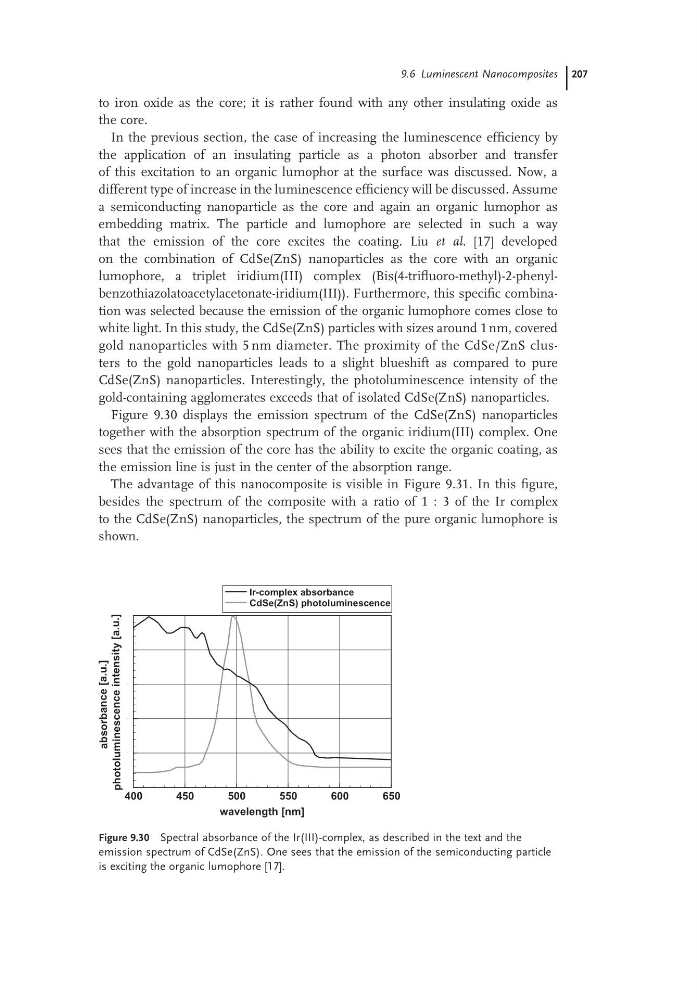
Figure 9.30 displays the emission spectrum of the CdSe(ZnS) nanoparticles
together with the absorption spectrum of the organic iridium(III) complex. One
sees that the emission of the core has the ability to excite the organic coating, as
the emission line is just in the center of the absorption range.
The advantage of this nanocomposite is visible in Figure 9.31. In this figure,
besides the spectrum of the composite with a ratio of 1 : 3 of the Ir complex
to the CdSe(ZnS) nanoparticles, the spectrum of the pure organic lumophore is
shown.
Figure 9.30 Spectral absorbance of the Ir(III)-complex, as described in the text and the
emission spectrum of CdSe(ZnS). One sees that the emission of the semiconducting particle
is exciting the organic lumophore [17].
400
450
500
550
600
650
wavelength [nm]
0
0.2
0.4
0.6
0.8
1
absorbance
[a.u.]
photoluminescence
intensity
[a.u.]
Ir-complex absorbance
CdSe(ZnS) photoluminescence
to iron oxide as the core; it is rather found with any other insulating oxide as
the core.
In the previous section, the case of increasing the luminescence efficiency by
the application of an insulating particle as a photon absorber and transfer
of this excitation to an organic lumophor at the surface was discussed. Now, a
different type of increase in the luminescence efficiency will be discussed. Assume
a semiconducting nanoparticle as the core and again an organic lumophor as
embedding matrix. The particle and lumophore are selected in such a way
that the emission of the core excites the coating. Liu et al. [17] developed
on the combination of CdSe(ZnS) nanoparticles as the core with an organic
lumophore, a triplet iridium(III) complex (Bis(4-trifluoro-methyl)-2-phenylbenzothiazolatoacetylacetonate-iridium(III)). Furthermore, this specific combination was selected because the emission of the organic lumophore comes close to
white light. In this study, the CdSe(ZnS) particles with sizes around 1 nm, covered
gold nanoparticles with 5 nm diameter. The proximity of the CdSe/ZnS clusters to the gold nanoparticles leads to a slight blueshift as compared to pure
CdSe(ZnS) nanoparticles. Interestingly, the photoluminescence intensity of the
gold-containing agglomerates exceeds that of isolated CdSe(ZnS) nanoparticles.
Figure 9.30 displays the emission spectrum of the CdSe(ZnS) nanoparticles
together with the absorption spectrum of the organic iridium(III) complex. One
sees that the emission of the core has the ability to excite the organic coating, as
the emission line is just in the center of the absorption range.
The advantage of this nanocomposite is visible in Figure 9.31. In this figure,
besides the spectrum of the composite with a ratio of 1 : 3 of the Ir complex
to the CdSe(ZnS) nanoparticles, the spectrum of the pure organic lumophore is
shown.
Figure 9.30 Spectral absorbance of the Ir(III)-complex, as described in the text and the
emission spectrum of CdSe(ZnS). One sees that the emission of the semiconducting particle
is exciting the organic lumophore [17].
400
450
500
550
600
650
wavelength [nm]
0
0.2
0.4
0.6
0.8
1
absorbance
[a.u.]
photoluminescence
intensity
[a.u.]
Ir-complex absorbance
CdSe(ZnS) photoluminescence