

206 9 Optical Properties
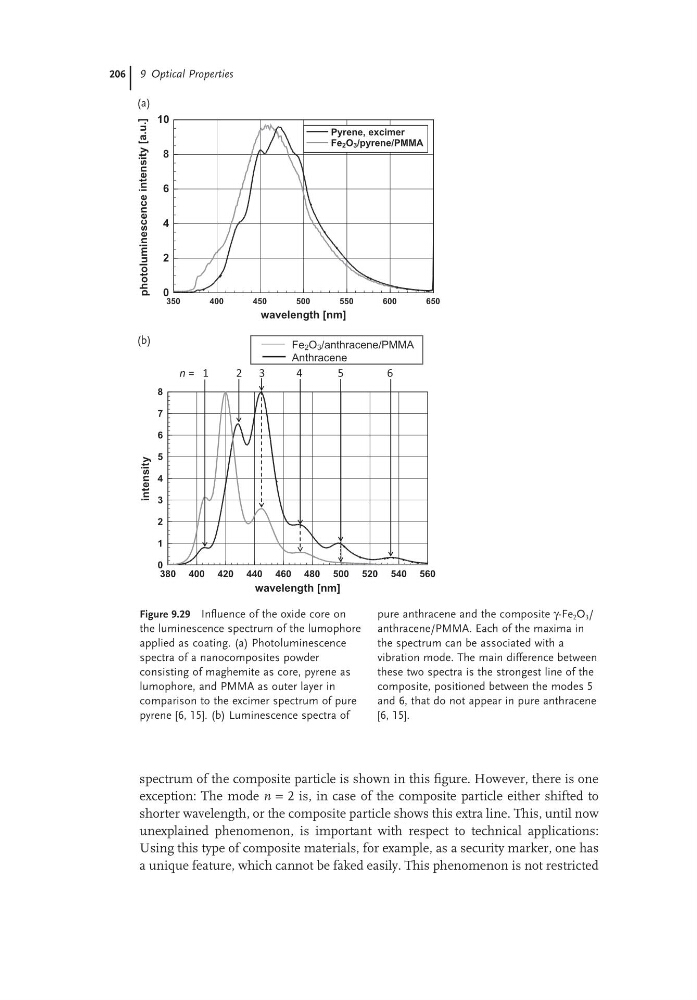
spectrum of the composite particle is shown in this figure. However, there is one
exception: The mode n = 2 is, in case of the composite particle either shifted to
shorter wavelength, or the composite particle shows this extra line. This, until now
unexplained phenomenon, is important with respect to technical applications:
Using this type of composite materials, for example, as a security marker, one has
a unique feature, which cannot be faked easily. This phenomenon is not restricted
Figure 9.29 Influence of the oxide core on
the luminescence spectrum of the lumophore
applied as coating. (a) Photoluminescence
spectra of a nanocomposites powder
consisting of maghemite as core, pyrene as
lumophore, and PMMA as outer layer in
comparison to the excimer spectrum of pure
pyrene [6, 15]. (b) Luminescence spectra of
pure anthracene and the composite γ-Fe 2 O 3 /
anthracene/PMMA. Each of the maxima in
the spectrum can be associated with a
vibration mode. The main difference between
these two spectra is the strongest line of the
composite, positioned between the modes 5
and 6, that do not appear in pure anthracene
[6, 15].
350
400
450
500
550
600
650
wavelength [nm]
0
2
4
6
8
10
photoluminescence
intensity
[a.u.]
Pyrene, excimer
Fe2O3/pyrene/PMMA
380 400 420 440 460 480 500 520 540 560
wavelength [nm]
0
1
2
3
4
5
6
7
8
intensity
n = 1
2 3
4
5
6
Fe 2 O 3 /anthracene/PMMA
Anthracene
(a)
(b)
spectrum of the composite particle is shown in this figure. However, there is one
exception: The mode n = 2 is, in case of the composite particle either shifted to
shorter wavelength, or the composite particle shows this extra line. This, until now
unexplained phenomenon, is important with respect to technical applications:
Using this type of composite materials, for example, as a security marker, one has
a unique feature, which cannot be faked easily. This phenomenon is not restricted
Figure 9.29 Influence of the oxide core on
the luminescence spectrum of the lumophore
applied as coating. (a) Photoluminescence
spectra of a nanocomposites powder
consisting of maghemite as core, pyrene as
lumophore, and PMMA as outer layer in
comparison to the excimer spectrum of pure
pyrene [6, 15]. (b) Luminescence spectra of
pure anthracene and the composite γ-Fe 2 O 3 /
anthracene/PMMA. Each of the maxima in
the spectrum can be associated with a
vibration mode. The main difference between
these two spectra is the strongest line of the
composite, positioned between the modes 5
and 6, that do not appear in pure anthracene
[6, 15].
350
400
450
500
550
600
650
wavelength [nm]
0
2
4
6
8
10
photoluminescence
intensity
[a.u.]
Pyrene, excimer
Fe2O3/pyrene/PMMA
380 400 420 440 460 480 500 520 540 560
wavelength [nm]
0
1
2
3
4
5
6
7
8
intensity
n = 1
2 3
4
5
6
Fe 2 O 3 /anthracene/PMMA
Anthracene
(a)
(b)