

204 9 Optical Properties
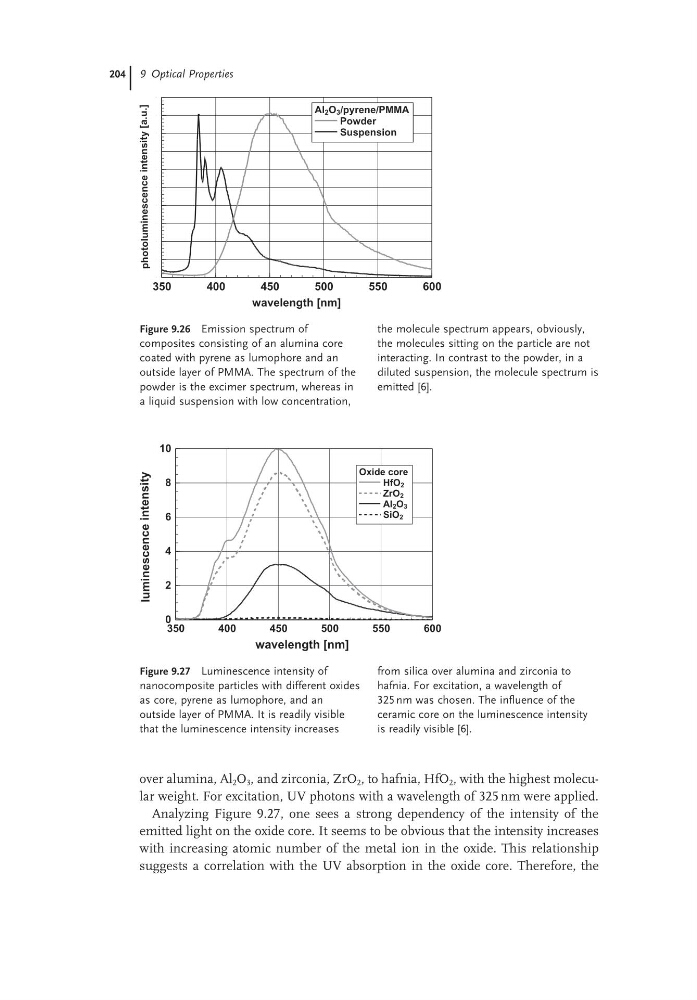
over alumina, Al 2 O 3 , and zirconia, ZrO 2 , to hafnia, HfO 2 , with the highest molecular weight. For excitation, UV photons with a wavelength of 325 nm were applied.
Analyzing Figure 9.27, one sees a strong dependency of the intensity of the
emitted light on the oxide core. It seems to be obvious that the intensity increases
with increasing atomic number of the metal ion in the oxide. This relationship
suggests a correlation with the UV absorption in the oxide core. Therefore, the
Figure 9.27 Luminescence intensity of
nanocomposite particles with different oxides
as core, pyrene as lumophore, and an
outside layer of PMMA. It is readily visible
that the luminescence intensity increases
from silica over alumina and zirconia to
hafnia. For excitation, a wavelength of
325 nm was chosen. The influence of the
ceramic core on the luminescence intensity
is readily visible [6].
350
400
450
500
550
600
wavelength [nm]
0
2
4
6
8
10
luminescence
intensity
Oxide core
HfO2
ZrO2
Al2O3
SiO2
Figure 9.26 Emission spectrum of
composites consisting of an alumina core
coated with pyrene as lumophore and an
outside layer of PMMA. The spectrum of the
powder is the excimer spectrum, whereas in
a liquid suspension with low concentration,
the molecule spectrum appears, obviously,
the molecules sitting on the particle are not
interacting. In contrast to the powder, in a
diluted suspension, the molecule spectrum is
emitted [6].
350
400
450
500
550
600
wavelength [nm]
0
1
2
3
4
5
6
7
8
9
10
photoluminescence
intensity
[a.u.]
Al 2 O 3 /pyrene/PMMA
Powder
Suspension
over alumina, Al 2 O 3 , and zirconia, ZrO 2 , to hafnia, HfO 2 , with the highest molecular weight. For excitation, UV photons with a wavelength of 325 nm were applied.
Analyzing Figure 9.27, one sees a strong dependency of the intensity of the
emitted light on the oxide core. It seems to be obvious that the intensity increases
with increasing atomic number of the metal ion in the oxide. This relationship
suggests a correlation with the UV absorption in the oxide core. Therefore, the
Figure 9.27 Luminescence intensity of
nanocomposite particles with different oxides
as core, pyrene as lumophore, and an
outside layer of PMMA. It is readily visible
that the luminescence intensity increases
from silica over alumina and zirconia to
hafnia. For excitation, a wavelength of
325 nm was chosen. The influence of the
ceramic core on the luminescence intensity
is readily visible [6].
350
400
450
500
550
600
wavelength [nm]
0
2
4
6
8
10
luminescence
intensity
Oxide core
HfO2
ZrO2
Al2O3
SiO2
Figure 9.26 Emission spectrum of
composites consisting of an alumina core
coated with pyrene as lumophore and an
outside layer of PMMA. The spectrum of the
powder is the excimer spectrum, whereas in
a liquid suspension with low concentration,
the molecule spectrum appears, obviously,
the molecules sitting on the particle are not
interacting. In contrast to the powder, in a
diluted suspension, the molecule spectrum is
emitted [6].
350
400
450
500
550
600
wavelength [nm]
0
1
2
3
4
5
6
7
8
9
10
photoluminescence
intensity
[a.u.]
Al 2 O 3 /pyrene/PMMA
Powder
Suspension