

9.6 Luminescent Nanocomposites 203
At the surface of a nanoparticle, the lumophore molecules are extremely tight
side to side. Now one may ask if there is an interaction between the molecules,
sitting at the surface, to form an excimer. This interesting question was analyzed
using pyrene-covered alumina nanoparticles. Figure 9.26 presents the results.
This figure compares the spectra obtained from these particles as powder
and suspended in a liquid. One sees the excimer spectrum in case of the powder,
which is not surprising, as the particles are close together. More surprising is the
spectrum of the particles suspended in a liquid in extremely low concentration.
In this case, the molecule spectrum appears. Obviously, the excimer formation is
only from particle to particle and not from molecule to molecule sitting on the
same particle.
The next open question is of a possible interaction between the oxide core and
the organic lumophore at the surface. The background to this question is twofold:
Where are the UV photons absorbed and what is the oxide core’s influence on the
emission spectrum? The reason for the first question is obvious. One can think
that the large amount of material in the particle core acts as a parasitic absorber
reducing the efficiency of the nanocomposite. An answer to this question is
obtained by analyzing a series of composites consisting of different oxide cores,
the same lumophore, in this case pyrene, and a PMMA layer at the outside. The
results of these experiments are summarized in Figure 9.27. For these experiments, the series of oxides from silica, SiO 2 , with the lowest molecular weight,
Box 9.3 Structure of the Molecules Pyrene and Anthracene
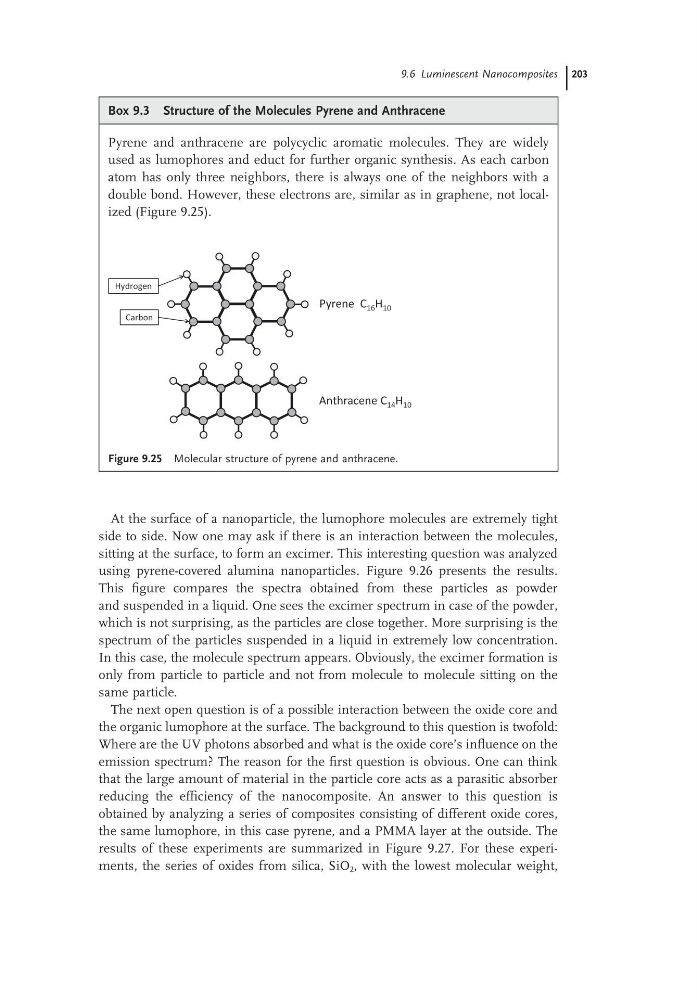
Pyrene and anthracene are polycyclic aromatic molecules. They are widely
used as lumophores and educt for further organic synthesis. As each carbon
atom has only three neighbors, there is always one of the neighbors with a
double bond. However, these electrons are, similar as in graphene, not localized (Figure 9.25).
Figure 9.25 Molecular structure of pyrene and anthracene.
Pyrene C 16 H 10
Anthracene C 14 H 10
Hydrogen
Carbon
At the surface of a nanoparticle, the lumophore molecules are extremely tight
side to side. Now one may ask if there is an interaction between the molecules,
sitting at the surface, to form an excimer. This interesting question was analyzed
using pyrene-covered alumina nanoparticles. Figure 9.26 presents the results.
This figure compares the spectra obtained from these particles as powder
and suspended in a liquid. One sees the excimer spectrum in case of the powder,
which is not surprising, as the particles are close together. More surprising is the
spectrum of the particles suspended in a liquid in extremely low concentration.
In this case, the molecule spectrum appears. Obviously, the excimer formation is
only from particle to particle and not from molecule to molecule sitting on the
same particle.
The next open question is of a possible interaction between the oxide core and
the organic lumophore at the surface. The background to this question is twofold:
Where are the UV photons absorbed and what is the oxide core’s influence on the
emission spectrum? The reason for the first question is obvious. One can think
that the large amount of material in the particle core acts as a parasitic absorber
reducing the efficiency of the nanocomposite. An answer to this question is
obtained by analyzing a series of composites consisting of different oxide cores,
the same lumophore, in this case pyrene, and a PMMA layer at the outside. The
results of these experiments are summarized in Figure 9.27. For these experiments, the series of oxides from silica, SiO 2 , with the lowest molecular weight,
Box 9.3 Structure of the Molecules Pyrene and Anthracene
Pyrene and anthracene are polycyclic aromatic molecules. They are widely
used as lumophores and educt for further organic synthesis. As each carbon
atom has only three neighbors, there is always one of the neighbors with a
double bond. However, these electrons are, similar as in graphene, not localized (Figure 9.25).
Figure 9.25 Molecular structure of pyrene and anthracene.
Pyrene C 16 H 10
Anthracene C 14 H 10
Hydrogen
Carbon