

202 9 Optical Properties
color of the design according to Figure 9.23 is size independent. It depends only
on the selected lumophore.
As an example, the design of luminescent magnetic particles is explained.
This example is thus very special, as magnetism and luminescence are never
found together in nature. As mentioned above, this combination of properties,
combined with special functionalization, is needed in applications connected to
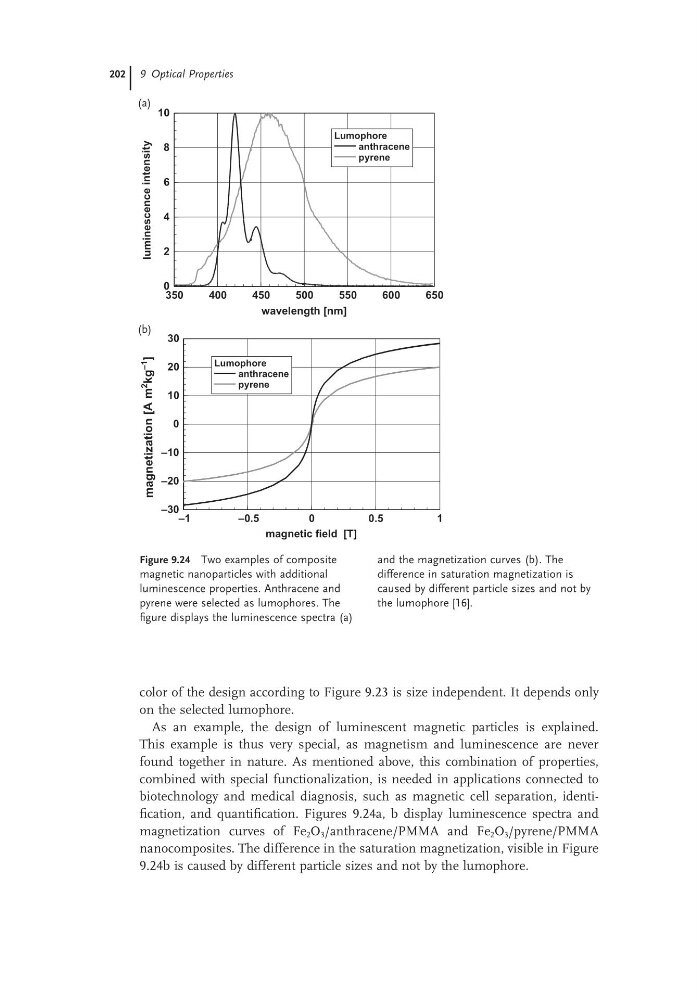
biotechnology and medical diagnosis, such as magnetic cell separation, identification, and quantification. Figures 9.24a, b display luminescence spectra and
magnetization curves of Fe 2 O 3 /anthracene/PMMA and Fe 2 O 3 /pyrene/PMMA
nanocomposites. The difference in the saturation magnetization, visible in Figure
9.24b is caused by different particle sizes and not by the lumophore.
Figure 9.24 Two examples of composite
magnetic nanoparticles with additional
luminescence properties. Anthracene and
pyrene were selected as lumophores. The
figure displays the luminescence spectra (a)
and the magnetization curves (b). The
difference in saturation magnetization is
caused by different particle sizes and not by
the lumophore [16].
350
400
450
500
550
600
650
wavelength [nm]
0
2
4
6
8
10
luminescence
intensity
Lumophore
anthracene
pyrene
–1
–0.5
0
0.5
1
magnetic field [T]
–30
–20
–10
0
10
20
30
magnetization
[A
m
2
kg
–1
]
Lumophore
anthracene
pyrene
(a)
(b)
color of the design according to Figure 9.23 is size independent. It depends only
on the selected lumophore.
As an example, the design of luminescent magnetic particles is explained.
This example is thus very special, as magnetism and luminescence are never
found together in nature. As mentioned above, this combination of properties,
combined with special functionalization, is needed in applications connected to
biotechnology and medical diagnosis, such as magnetic cell separation, identification, and quantification. Figures 9.24a, b display luminescence spectra and
magnetization curves of Fe 2 O 3 /anthracene/PMMA and Fe 2 O 3 /pyrene/PMMA
nanocomposites. The difference in the saturation magnetization, visible in Figure
9.24b is caused by different particle sizes and not by the lumophore.
Figure 9.24 Two examples of composite
magnetic nanoparticles with additional
luminescence properties. Anthracene and
pyrene were selected as lumophores. The
figure displays the luminescence spectra (a)
and the magnetization curves (b). The
difference in saturation magnetization is
caused by different particle sizes and not by
the lumophore [16].
350
400
450
500
550
600
650
wavelength [nm]
0
2
4
6
8
10
luminescence
intensity
Lumophore
anthracene
pyrene
–1
–0.5
0
0.5
1
magnetic field [T]
–30
–20
–10
0
10
20
30
magnetization
[A
m
2
kg
–1
]
Lumophore
anthracene
pyrene
(a)
(b)