

9.6 Luminescent Nanocomposites 201
these compounds for luminescent composites. All the more so, as many of the
elements for the semiconducting compounds, cadmium, selenium, tellurium, etc.
are toxic or carginogenic. Furthermore, most of the luminescent compound used
for quantum dots lack stability against oxidation and hydrolysis. Under certain
circumstances, these problems make handling and, therefore, application of these
materials difficult. Furthermore, especially applications in biotechnology and
medical diagnostics have a need for bifunctional particles combining luminescence and ferromagnetism. This demand cannot be satisfied with any of the semiconducting compounds. This necessity was the starting point for the development
of new types of luminescent particles. One direction to overcome these problems
was based on semiconducting particles based on rare-earth-doped insulating
oxides. However, these materials do not exhibit ferromagnetism.
A completely new approach [6, 15, 16] to overcome the problems described
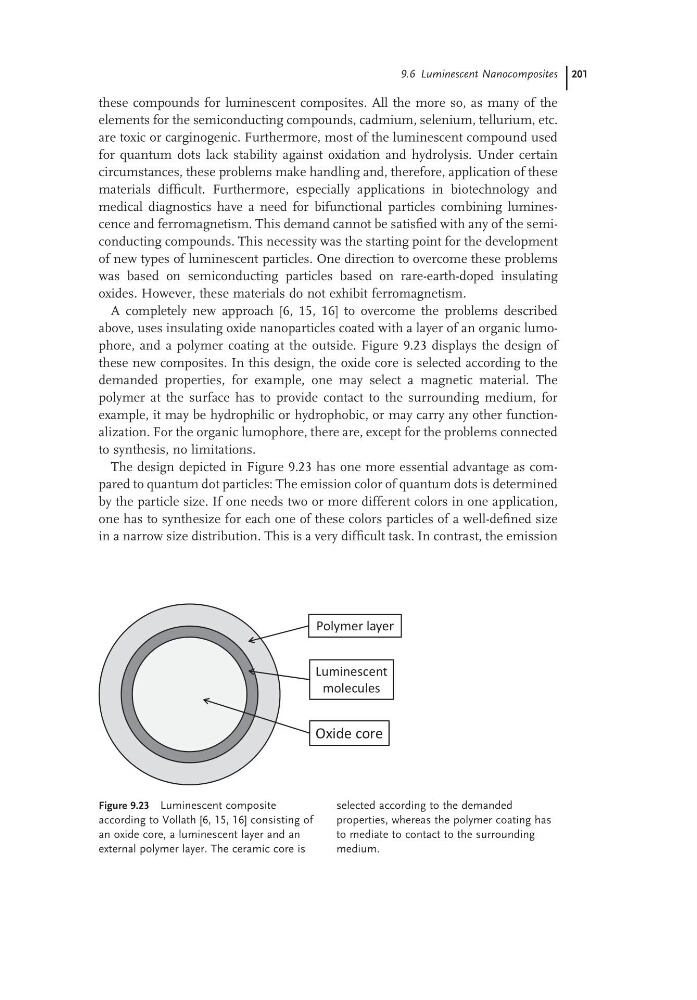
above, uses insulating oxide nanoparticles coated with a layer of an organic lumophore, and a polymer coating at the outside. Figure 9.23 displays the design of
these new composites. In this design, the oxide core is selected according to the
demanded properties, for example, one may select a magnetic material. The
polymer at the surface has to provide contact to the surrounding medium, for
example, it may be hydrophilic or hydrophobic, or may carry any other functionalization. For the organic lumophore, there are, except for the problems connected
to synthesis, no limitations.
The design depicted in Figure 9.23 has one more essential advantage as compared to quantum dot particles: The emission color of quantum dots is determined
by the particle size. If one needs two or more different colors in one application,
one has to synthesize for each one of these colors particles of a well-defined size
in a narrow size distribution. This is a very difficult task. In contrast, the emission
Figure 9.23 Luminescent composite
according to Vollath [6, 15, 16] consisting of
an oxide core, a luminescent layer and an
external polymer layer. The ceramic core is
selected according to the demanded
properties, whereas the polymer coating has
to mediate to contact to the surrounding
medium.
Oxide core
Luminescent
molecules
Polymer layer
these compounds for luminescent composites. All the more so, as many of the
elements for the semiconducting compounds, cadmium, selenium, tellurium, etc.
are toxic or carginogenic. Furthermore, most of the luminescent compound used
for quantum dots lack stability against oxidation and hydrolysis. Under certain
circumstances, these problems make handling and, therefore, application of these
materials difficult. Furthermore, especially applications in biotechnology and
medical diagnostics have a need for bifunctional particles combining luminescence and ferromagnetism. This demand cannot be satisfied with any of the semiconducting compounds. This necessity was the starting point for the development
of new types of luminescent particles. One direction to overcome these problems
was based on semiconducting particles based on rare-earth-doped insulating
oxides. However, these materials do not exhibit ferromagnetism.
A completely new approach [6, 15, 16] to overcome the problems described
above, uses insulating oxide nanoparticles coated with a layer of an organic lumophore, and a polymer coating at the outside. Figure 9.23 displays the design of
these new composites. In this design, the oxide core is selected according to the
demanded properties, for example, one may select a magnetic material. The
polymer at the surface has to provide contact to the surrounding medium, for
example, it may be hydrophilic or hydrophobic, or may carry any other functionalization. For the organic lumophore, there are, except for the problems connected
to synthesis, no limitations.
The design depicted in Figure 9.23 has one more essential advantage as compared to quantum dot particles: The emission color of quantum dots is determined
by the particle size. If one needs two or more different colors in one application,
one has to synthesize for each one of these colors particles of a well-defined size
in a narrow size distribution. This is a very difficult task. In contrast, the emission
Figure 9.23 Luminescent composite
according to Vollath [6, 15, 16] consisting of
an oxide core, a luminescent layer and an
external polymer layer. The ceramic core is
selected according to the demanded
properties, whereas the polymer coating has
to mediate to contact to the surrounding
medium.
Oxide core
Luminescent
molecules
Polymer layer