

200 9 Optical Properties
are to a certain degree independent of the particle or rod diameter; this not
an indicator of a narrow distribution of the diameters of these objects. This is
different for the peak of the longitudinal resonances. They are very broad; as these
resonances are strongly dependent of the aspect ratio (see Figure 9.20), this indicates a broad distribution of the length of the nanorods.
Gold nanoparticles were the first man-made nanoparticles. The Sumerians,
more than 2500 years ago, used inclusions of gold nanoparticles to obtain red
coloration. This material, called “gold ruby glass” is still produced (see also Chapter
2). High-quality gold ruby glasses excel in a red color with a slight blue hue
obtained by nearly ideally spherical particles. In glasses, the particle size of the
gold nanoparticles is stabilized by adding tin dioxide into the glass matrix. Besides
gold, nanoparticles of silver, copper, and platinum, or alloys of these metals are
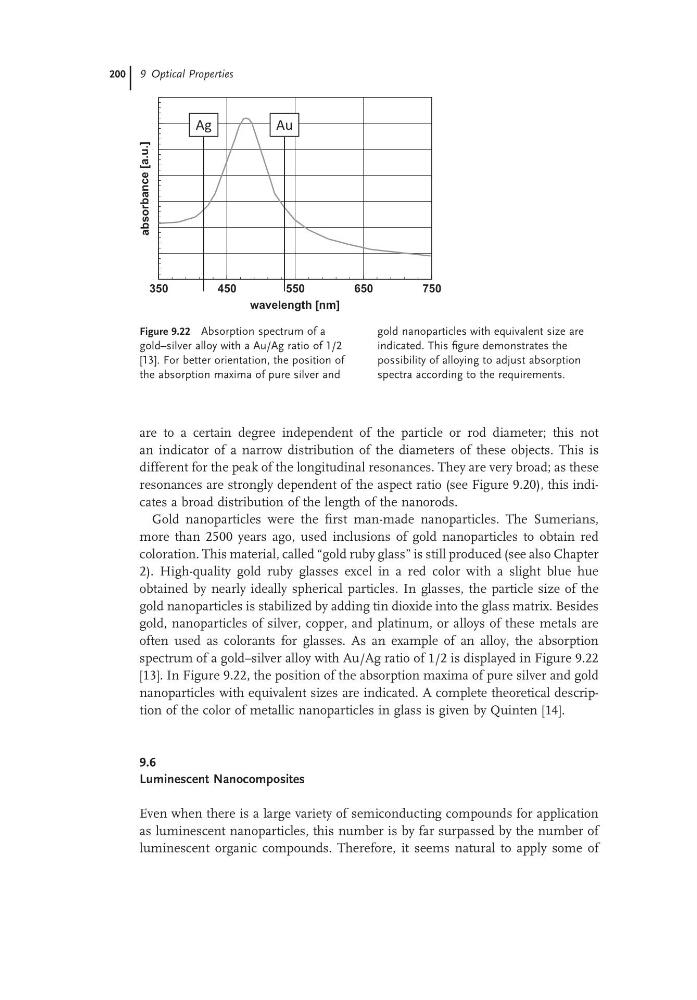
often used as colorants for glasses. As an example of an alloy, the absorption
spectrum of a gold–silver alloy with Au/Ag ratio of 1/2 is displayed in Figure 9.22
[13]. In Figure 9.22, the position of the absorption maxima of pure silver and gold
nanoparticles with equivalent sizes are indicated. A complete theoretical description of the color of metallic nanoparticles in glass is given by Quinten [14].
9.6
Luminescent Nanocomposites
Even when there is a large variety of semiconducting compounds for application
as luminescent nanoparticles, this number is by far surpassed by the number of
luminescent organic compounds. Therefore, it seems natural to apply some of
Figure 9.22 Absorption spectrum of a
gold–silver alloy with a Au/Ag ratio of 1/2
[13]. For better orientation, the position of
the absorption maxima of pure silver and
gold nanoparticles with equivalent size are
indicated. This figure demonstrates the
possibility of alloying to adjust absorption
spectra according to the requirements.
350
450
550
650
750
wavelength [nm]
0
2
4
6
8
10
12
14
absorbance
[a.u.]
Ag
Au
are to a certain degree independent of the particle or rod diameter; this not
an indicator of a narrow distribution of the diameters of these objects. This is
different for the peak of the longitudinal resonances. They are very broad; as these
resonances are strongly dependent of the aspect ratio (see Figure 9.20), this indicates a broad distribution of the length of the nanorods.
Gold nanoparticles were the first man-made nanoparticles. The Sumerians,
more than 2500 years ago, used inclusions of gold nanoparticles to obtain red
coloration. This material, called “gold ruby glass” is still produced (see also Chapter
2). High-quality gold ruby glasses excel in a red color with a slight blue hue
obtained by nearly ideally spherical particles. In glasses, the particle size of the
gold nanoparticles is stabilized by adding tin dioxide into the glass matrix. Besides
gold, nanoparticles of silver, copper, and platinum, or alloys of these metals are
often used as colorants for glasses. As an example of an alloy, the absorption
spectrum of a gold–silver alloy with Au/Ag ratio of 1/2 is displayed in Figure 9.22
[13]. In Figure 9.22, the position of the absorption maxima of pure silver and gold
nanoparticles with equivalent sizes are indicated. A complete theoretical description of the color of metallic nanoparticles in glass is given by Quinten [14].
9.6
Luminescent Nanocomposites
Even when there is a large variety of semiconducting compounds for application
as luminescent nanoparticles, this number is by far surpassed by the number of
luminescent organic compounds. Therefore, it seems natural to apply some of
Figure 9.22 Absorption spectrum of a
gold–silver alloy with a Au/Ag ratio of 1/2
[13]. For better orientation, the position of
the absorption maxima of pure silver and
gold nanoparticles with equivalent size are
indicated. This figure demonstrates the
possibility of alloying to adjust absorption
spectra according to the requirements.
350
450
550
650
750
wavelength [nm]
0
2
4
6
8
10
12
14
absorbance
[a.u.]
Ag
Au