

194 9 Optical Properties
The most important semiconducting compounds used for luminescent systems
are the sulfides, selenides, and tellurides of zinc and cadmium; this huge group
of compounds, which show at least some mutual solubility, also zinc oxide is an
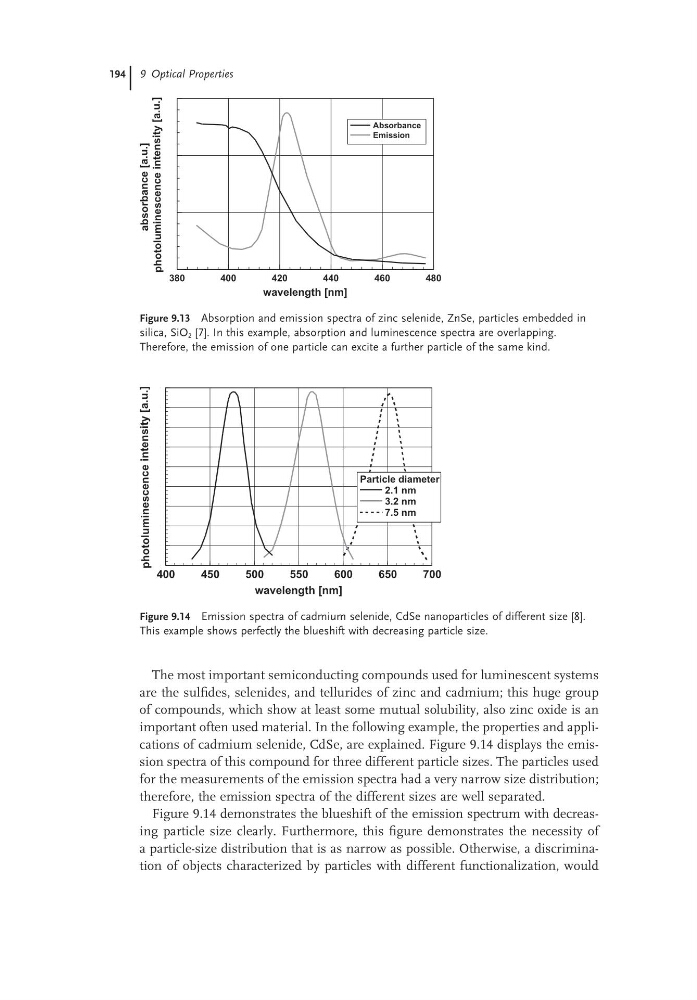
important often used material. In the following example, the properties and applications of cadmium selenide, CdSe, are explained. Figure 9.14 displays the emission spectra of this compound for three different particle sizes. The particles used
for the measurements of the emission spectra had a very narrow size distribution;
therefore, the emission spectra of the different sizes are well separated.
Figure 9.14 demonstrates the blueshift of the emission spectrum with decreasing particle size clearly. Furthermore, this figure demonstrates the necessity of
a particle-size distribution that is as narrow as possible. Otherwise, a discrimination of objects characterized by particles with different functionalization, would
Figure 9.13 Absorption and emission spectra of zinc selenide, ZnSe, particles embedded in
silica, SiO 2 [7]. In this example, absorption and luminescence spectra are overlapping.
Therefore, the emission of one particle can excite a further particle of the same kind.
380
400
420
440
460
480
wavelength [nm]
0
4
8
12
absorbance
[a.u.]
photoluminescence
intensity
[a.u.]
Absorbance
Emission
Figure 9.14 Emission spectra of cadmium selenide, CdSe nanoparticles of different size [8].
This example shows perfectly the blueshift with decreasing particle size.
400
450
500
550
600
650
700
wavelength [nm]
0
1
2
3
4
5
6
7
8
9
photoluminescence
intensity
[a.u.]
Particle diameter
2.1 nm
3.2 nm
7.5 nm
The most important semiconducting compounds used for luminescent systems
are the sulfides, selenides, and tellurides of zinc and cadmium; this huge group
of compounds, which show at least some mutual solubility, also zinc oxide is an
important often used material. In the following example, the properties and applications of cadmium selenide, CdSe, are explained. Figure 9.14 displays the emission spectra of this compound for three different particle sizes. The particles used
for the measurements of the emission spectra had a very narrow size distribution;
therefore, the emission spectra of the different sizes are well separated.
Figure 9.14 demonstrates the blueshift of the emission spectrum with decreasing particle size clearly. Furthermore, this figure demonstrates the necessity of
a particle-size distribution that is as narrow as possible. Otherwise, a discrimination of objects characterized by particles with different functionalization, would
Figure 9.13 Absorption and emission spectra of zinc selenide, ZnSe, particles embedded in
silica, SiO 2 [7]. In this example, absorption and luminescence spectra are overlapping.
Therefore, the emission of one particle can excite a further particle of the same kind.
380
400
420
440
460
480
wavelength [nm]
0
4
8
12
absorbance
[a.u.]
photoluminescence
intensity
[a.u.]
Absorbance
Emission
Figure 9.14 Emission spectra of cadmium selenide, CdSe nanoparticles of different size [8].
This example shows perfectly the blueshift with decreasing particle size.
400
450
500
550
600
650
700
wavelength [nm]
0
1
2
3
4
5
6
7
8
9
photoluminescence
intensity
[a.u.]
Particle diameter
2.1 nm
3.2 nm
7.5 nm