

9.4 Semiconducting Particles in the Quantum-Confinement Range 195
be impossible. The color of the emitted light can be influenced, as depicted, by
the particle size and additionally by the composition of the particles. This is
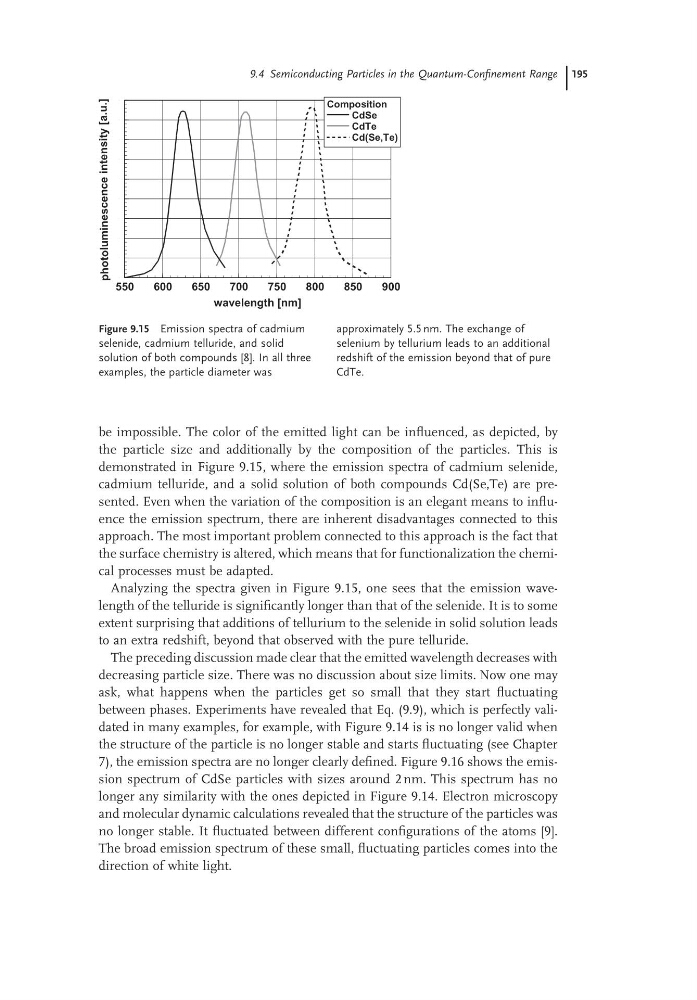
demonstrated in Figure 9.15, where the emission spectra of cadmium selenide,
cadmium telluride, and a solid solution of both compounds Cd(Se,Te) are presented. Even when the variation of the composition is an elegant means to influence the emission spectrum, there are inherent disadvantages connected to this
approach. The most important problem connected to this approach is the fact that
the surface chemistry is altered, which means that for functionalization the chemical processes must be adapted.
Analyzing the spectra given in Figure 9.15, one sees that the emission wavelength of the telluride is significantly longer than that of the selenide. It is to some
extent surprising that additions of tellurium to the selenide in solid solution leads
to an extra redshift, beyond that observed with the pure telluride.
The preceding discussion made clear that the emitted wavelength decreases with
decreasing particle size. There was no discussion about size limits. Now one may
ask, what happens when the particles get so small that they start fluctuating
between phases. Experiments have revealed that Eq. (9.9), which is perfectly validated in many examples, for example, with Figure 9.14 is is no longer valid when
the structure of the particle is no longer stable and starts fluctuating (see Chapter
7), the emission spectra are no longer clearly defined. Figure 9.16 shows the emission spectrum of CdSe particles with sizes around 2 nm. This spectrum has no
longer any similarity with the ones depicted in Figure 9.14. Electron microscopy
and molecular dynamic calculations revealed that the structure of the particles was
no longer stable. It fluctuated between different configurations of the atoms [9].
The broad emission spectrum of these small, fluctuating particles comes into the
direction of white light.
Figure 9.15 Emission spectra of cadmium
selenide, cadmium telluride, and solid
solution of both compounds [8]. In all three
examples, the particle diameter was
approximately 5.5 nm. The exchange of
selenium by tellurium leads to an additional
redshift of the emission beyond that of pure
CdTe.
550
600
650
700
750
800
850
900
wavelength [nm]
0
1
2
3
4
5
6
7
8
9
photoluminescence
intensity
[a.u.]
Composition
CdSe
CdTe
Cd(Se,Te)
be impossible. The color of the emitted light can be influenced, as depicted, by
the particle size and additionally by the composition of the particles. This is
demonstrated in Figure 9.15, where the emission spectra of cadmium selenide,
cadmium telluride, and a solid solution of both compounds Cd(Se,Te) are presented. Even when the variation of the composition is an elegant means to influence the emission spectrum, there are inherent disadvantages connected to this
approach. The most important problem connected to this approach is the fact that
the surface chemistry is altered, which means that for functionalization the chemical processes must be adapted.
Analyzing the spectra given in Figure 9.15, one sees that the emission wavelength of the telluride is significantly longer than that of the selenide. It is to some
extent surprising that additions of tellurium to the selenide in solid solution leads
to an extra redshift, beyond that observed with the pure telluride.
The preceding discussion made clear that the emitted wavelength decreases with
decreasing particle size. There was no discussion about size limits. Now one may
ask, what happens when the particles get so small that they start fluctuating
between phases. Experiments have revealed that Eq. (9.9), which is perfectly validated in many examples, for example, with Figure 9.14 is is no longer valid when
the structure of the particle is no longer stable and starts fluctuating (see Chapter
7), the emission spectra are no longer clearly defined. Figure 9.16 shows the emission spectrum of CdSe particles with sizes around 2 nm. This spectrum has no
longer any similarity with the ones depicted in Figure 9.14. Electron microscopy
and molecular dynamic calculations revealed that the structure of the particles was
no longer stable. It fluctuated between different configurations of the atoms [9].
The broad emission spectrum of these small, fluctuating particles comes into the
direction of white light.
Figure 9.15 Emission spectra of cadmium
selenide, cadmium telluride, and solid
solution of both compounds [8]. In all three
examples, the particle diameter was
approximately 5.5 nm. The exchange of
selenium by tellurium leads to an additional
redshift of the emission beyond that of pure
CdTe.
550
600
650
700
750
800
850
900
wavelength [nm]
0
1
2
3
4
5
6
7
8
9
photoluminescence
intensity
[a.u.]
Composition
CdSe
CdTe
Cd(Se,Te)