

9.4 Semiconducting Particles in the Quantum-Confinement Range 193
Some systems of particles (this is also known for molecules) showing luminescence show a further interesting property: The spectra of absorption and emission
are overlapping. This leads to the surprising fact that the emission of one particle
can excite a further particle of the same kind. This phenomenon can be exploited
to transport information from one particle to the next. Figure 9.13 shows this,
using the example of zinc selenide, ZnSe, particles embedded in silica, SiO 2 .
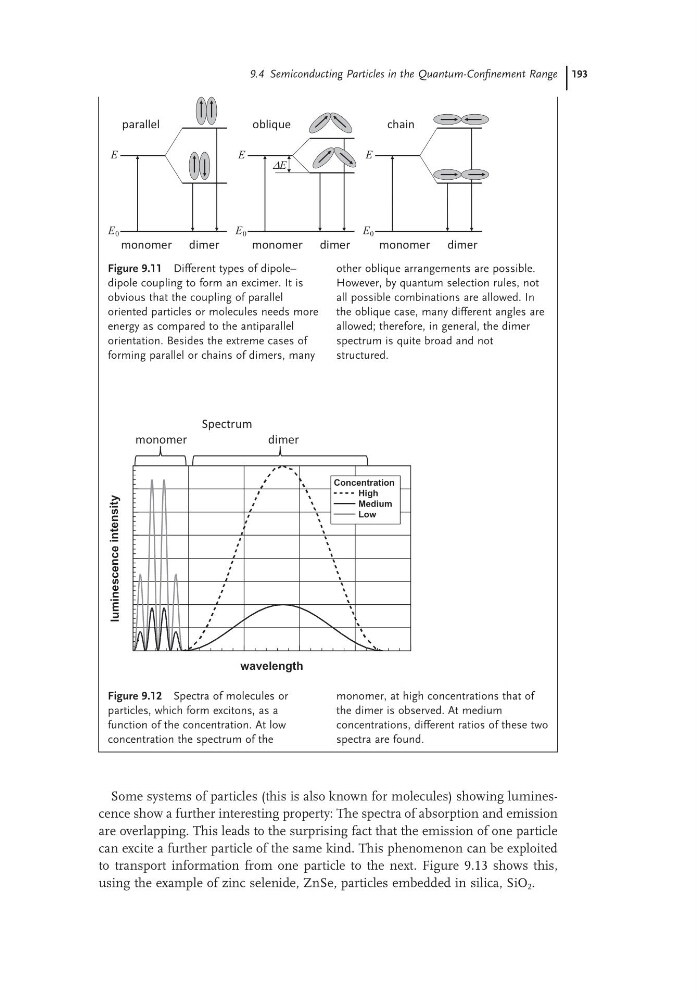
Figure 9.11 Different types of dipole–
dipole coupling to form an excimer. It is
obvious that the coupling of parallel
oriented particles or molecules needs more
energy as compared to the antiparallel
orientation. Besides the extreme cases of
forming parallel or chains of dimers, many
other oblique arrangements are possible.
However, by quantum selection rules, not
all possible combinations are allowed. In
the oblique case, many different angles are
allowed; therefore, in general, the dimer
spectrum is quite broad and not
structured.
E 0
E
monomer dimer
parallel
E 0
E
monomer dimer
chain
E 0
E
oblique
∆E
monomer dimer
Figure 9.12 Spectra of molecules or
particles, which form excitons, as a
function of the concentration. At low
concentration the spectrum of the
monomer, at high concentrations that of
the dimer is observed. At medium
concentrations, different ratios of these two
spectra are found.
0
50
100
150
200
250
wavelength
0
0.5
1
1.5
2
2.5
3
3.5
4
luminescence
intensity
Concentration
High
Medium
Low
Spectrum
monomer
dimer
Some systems of particles (this is also known for molecules) showing luminescence show a further interesting property: The spectra of absorption and emission
are overlapping. This leads to the surprising fact that the emission of one particle
can excite a further particle of the same kind. This phenomenon can be exploited
to transport information from one particle to the next. Figure 9.13 shows this,
using the example of zinc selenide, ZnSe, particles embedded in silica, SiO 2 .
Figure 9.11 Different types of dipole–
dipole coupling to form an excimer. It is
obvious that the coupling of parallel
oriented particles or molecules needs more
energy as compared to the antiparallel
orientation. Besides the extreme cases of
forming parallel or chains of dimers, many
other oblique arrangements are possible.
However, by quantum selection rules, not
all possible combinations are allowed. In
the oblique case, many different angles are
allowed; therefore, in general, the dimer
spectrum is quite broad and not
structured.
E 0
E
monomer dimer
parallel
E 0
E
monomer dimer
chain
E 0
E
oblique
∆E
monomer dimer
Figure 9.12 Spectra of molecules or
particles, which form excitons, as a
function of the concentration. At low
concentration the spectrum of the
monomer, at high concentrations that of
the dimer is observed. At medium
concentrations, different ratios of these two
spectra are found.
0
50
100
150
200
250
wavelength
0
0.5
1
1.5
2
2.5
3
3.5
4
luminescence
intensity
Concentration
High
Medium
Low
Spectrum
monomer
dimer