

192 9 Optical Properties
Box 9.2 Excimer Formation
Excited particles or organic molecules often form a dipole. Such dipoles interact, within a maximal distance of 10 to 15 nm. In cases where the excited
particles or molecules form dipoles and these objects are close enough excimers are formed. Hence, an excimer is a dimer, formed by dipole–dipole
interactions, when such an excited molecule or particle comes in close contact
to a second one of the same type. Therefore, one has to distinguish between
the spectra of the molecule or isolated particle and that of the excimer. This
process is shown in Figure 9.11 in a drastically simplified manner.
Excimer formation leads to changes in the energy levels. Antiparallel coupling reduces, and parallel coupling of the dipoles increases, the energy of the
energy levels. Parallel arrangement or arrangement in chains of the molecules
or particles are extreme possibilities of dimer formation. However, most probable are oblique arrangements, where, by the quantum selection rules, many
different angles are allowed. This broad range of possibilities leads to broad,
unstructured spectra. In general, dipolar arrangements reducing the energy of
the system are the most probable ones.
As mentioned above, at low concentrations of particles or molecules, for
example, suspended in a liquid, one finds the spectrum of the monomer, which
means of a single isolated particle or molecule. At high concentrations, where
the interaction probability of the objects is high, the dimer spectrum is observed.
At medium concentrations, the two types of spectra are found in different
intensity ratios. This is depicted in Figure 9.12.
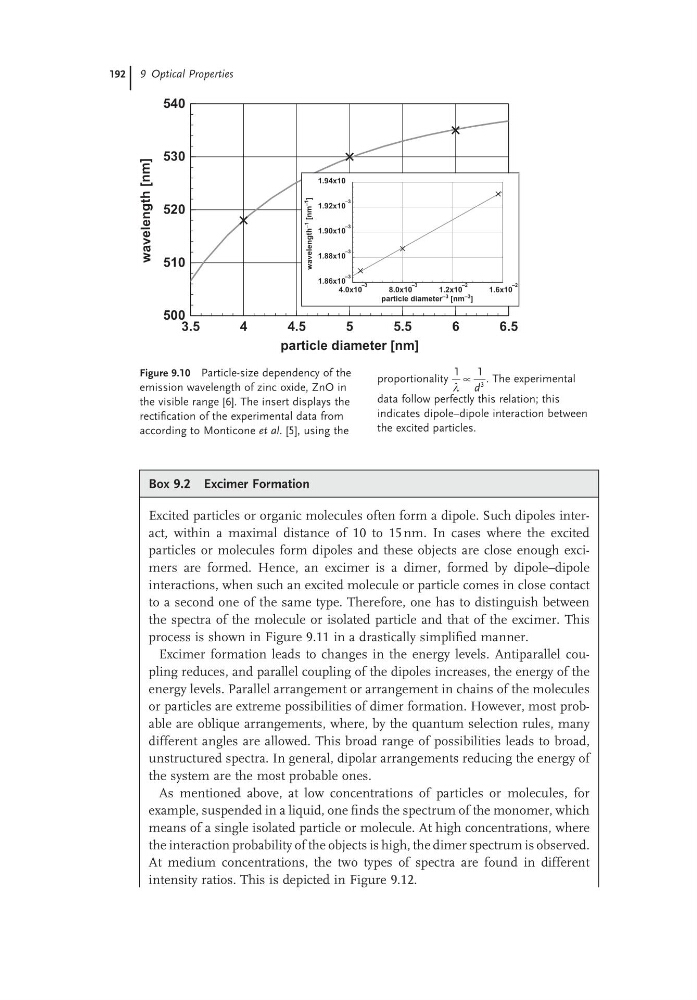
Figure 9.10 Particle-size dependency of the
emission wavelength of zinc oxide, ZnO in
the visible range [6]. The insert displays the
rectification of the experimental data from
according to Monticone et al. [5], using the
3.5
4
4.5
5
5.5
6
6.5
particle diameter [nm]
500
510
520
530
540
wavelength
[nm]
4.0x10
–3
8.0x10
–3
1.2x10
–2
1.6x10
–2
particle diameter
–3 [nm
–3 ]
1.86x10
–3
1.88x10
–3
1.90x10
–3
1.92x10
–3
1.94x10
wavelength
–1
[nm
–1
]
proportionality
1
1
3
λ
∝ d
. The experimental
data follow perfectly this relation; this
indicates dipole–dipole interaction between
the excited particles.
Box 9.2 Excimer Formation
Excited particles or organic molecules often form a dipole. Such dipoles interact, within a maximal distance of 10 to 15 nm. In cases where the excited
particles or molecules form dipoles and these objects are close enough excimers are formed. Hence, an excimer is a dimer, formed by dipole–dipole
interactions, when such an excited molecule or particle comes in close contact
to a second one of the same type. Therefore, one has to distinguish between
the spectra of the molecule or isolated particle and that of the excimer. This
process is shown in Figure 9.11 in a drastically simplified manner.
Excimer formation leads to changes in the energy levels. Antiparallel coupling reduces, and parallel coupling of the dipoles increases, the energy of the
energy levels. Parallel arrangement or arrangement in chains of the molecules
or particles are extreme possibilities of dimer formation. However, most probable are oblique arrangements, where, by the quantum selection rules, many
different angles are allowed. This broad range of possibilities leads to broad,
unstructured spectra. In general, dipolar arrangements reducing the energy of
the system are the most probable ones.
As mentioned above, at low concentrations of particles or molecules, for
example, suspended in a liquid, one finds the spectrum of the monomer, which
means of a single isolated particle or molecule. At high concentrations, where
the interaction probability of the objects is high, the dimer spectrum is observed.
At medium concentrations, the two types of spectra are found in different
intensity ratios. This is depicted in Figure 9.12.
Figure 9.10 Particle-size dependency of the
emission wavelength of zinc oxide, ZnO in
the visible range [6]. The insert displays the
rectification of the experimental data from
according to Monticone et al. [5], using the
3.5
4
4.5
5
5.5
6
6.5
particle diameter [nm]
500
510
520
530
540
wavelength
[nm]
4.0x10
–3
8.0x10
–3
1.2x10
–2
1.6x10
–2
particle diameter
–3 [nm
–3 ]
1.86x10
–3
1.88x10
–3
1.90x10
–3
1.92x10
–3
1.94x10
wavelength
–1
[nm
–1
]
proportionality
1
1
3
λ
∝ d
. The experimental
data follow perfectly this relation; this
indicates dipole–dipole interaction between
the excited particles.