

9.4 Semiconducting Particles in the Quantum-Confinement Range 191
isolated particle, which means in reality, for systems with extremely low concentrations. In many cases, there are a few more phenomena influencing the systems
of quantum confinement stemming, for example, from the interaction of the
particles. Often, excited particles form dipoles. Such dipoles have a maximum
distance of interaction in the range between 10 and 15 nm. Within this distance,
dipolar particles interact; they form an excimer, a process influencing the optical
properties significantly. (Excimer formation is often observed in the case of organic
lumophores.) An example for the dipole–dipole interaction of excited nanoparticles is zinc oxide, ZnO [5]. This influences the emission wavelength of the composites significantly. In a system with high concentration, where dipole–dipole
interaction occurs, the energy of the emitted photons is not proportional to
1
2
d
(d . . . particle diameter), rather a dependency like
1
3
d
is theoretically predicted and
experimentally observed [5, 6]. Figure 9.10 displays the emission wavelength
of ZnO coated with poly methyl methacrylate (PMMA) as a function of the particle
size [6]. The insert displays the proportionality of the photon energy (inversely
proportional to the wavelength) with the particle diameter. The rectification was
obtained by plotting against
1
3
d
. This fulfills exactly the theoretical considerations
of Monticone et al. [5] for particles showing dipole–dipole interactions. The minor
deviations of the experimental data from the fitted line are due to experimental
uncertainties, in special related to the determination of the particle size.
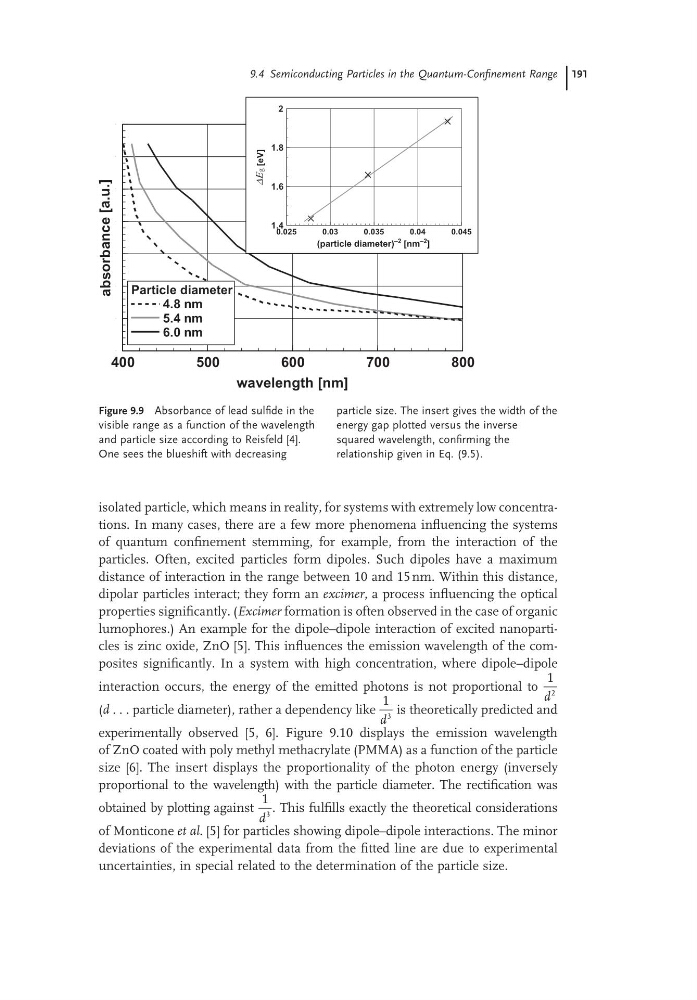
Figure 9.9 Absorbance of lead sulfide in the
visible range as a function of the wavelength
and particle size according to Reisfeld [4].
One sees the blueshift with decreasing
particle size. The insert gives the width of the
energy gap plotted versus the inverse
squared wavelength, confirming the
relationship given in Eq. (9.5).
400
500
600
700
800
wavelength [nm]
0
2
4
6
8
10
12
14
absorbance
[a.u.]
Particle diameter
4.8 nm
5.4 nm
6.0 nm
0.025
0.03
0.035
0.04
0.045
(particle diameter)
–2 [nm
–2 ]
1.4
1.6
1.8
2
∆Ε g
[eV]
isolated particle, which means in reality, for systems with extremely low concentrations. In many cases, there are a few more phenomena influencing the systems
of quantum confinement stemming, for example, from the interaction of the
particles. Often, excited particles form dipoles. Such dipoles have a maximum
distance of interaction in the range between 10 and 15 nm. Within this distance,
dipolar particles interact; they form an excimer, a process influencing the optical
properties significantly. (Excimer formation is often observed in the case of organic
lumophores.) An example for the dipole–dipole interaction of excited nanoparticles is zinc oxide, ZnO [5]. This influences the emission wavelength of the composites significantly. In a system with high concentration, where dipole–dipole
interaction occurs, the energy of the emitted photons is not proportional to
1
2
d
(d . . . particle diameter), rather a dependency like
1
3
d
is theoretically predicted and
experimentally observed [5, 6]. Figure 9.10 displays the emission wavelength
of ZnO coated with poly methyl methacrylate (PMMA) as a function of the particle
size [6]. The insert displays the proportionality of the photon energy (inversely
proportional to the wavelength) with the particle diameter. The rectification was
obtained by plotting against
1
3
d
. This fulfills exactly the theoretical considerations
of Monticone et al. [5] for particles showing dipole–dipole interactions. The minor
deviations of the experimental data from the fitted line are due to experimental
uncertainties, in special related to the determination of the particle size.
Figure 9.9 Absorbance of lead sulfide in the
visible range as a function of the wavelength
and particle size according to Reisfeld [4].
One sees the blueshift with decreasing
particle size. The insert gives the width of the
energy gap plotted versus the inverse
squared wavelength, confirming the
relationship given in Eq. (9.5).
400
500
600
700
800
wavelength [nm]
0
2
4
6
8
10
12
14
absorbance
[a.u.]
Particle diameter
4.8 nm
5.4 nm
6.0 nm
0.025
0.03
0.035
0.04
0.045
(particle diameter)
–2 [nm
–2 ]
1.4
1.6
1.8
2
∆Ε g
[eV]