

186 9 Optical Properties
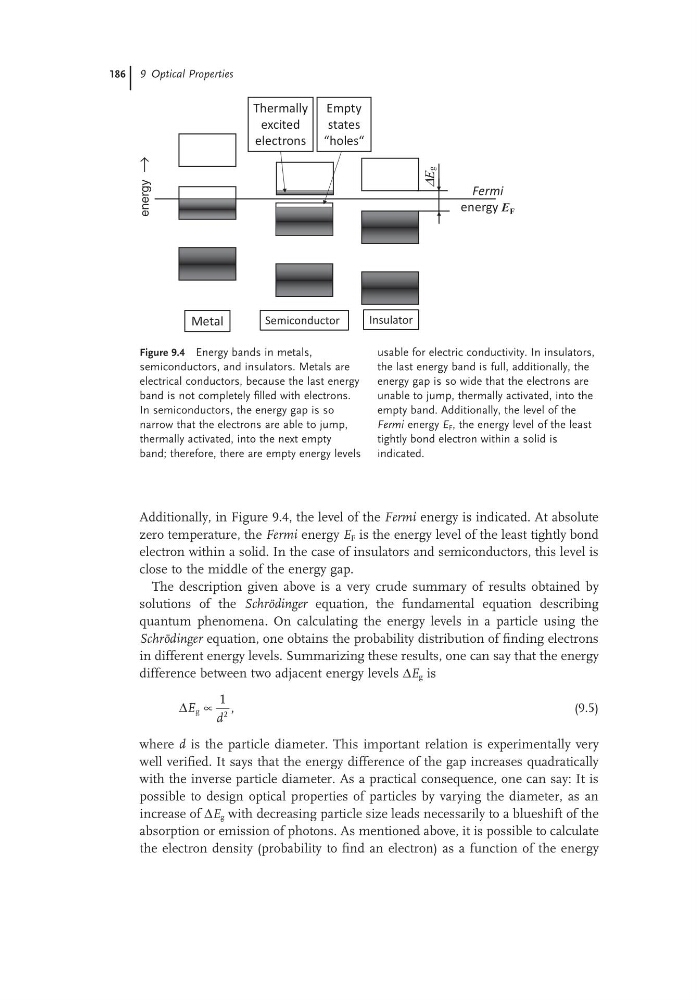
Additionally, in Figure 9.4, the level of the Fermi energy is indicated. At absolute
zero temperature, the Fermi energy E F is the energy level of the least tightly bond
electron within a solid. In the case of insulators and semiconductors, this level is
close to the middle of the energy gap.
The description given above is a very crude summary of results obtained by
solutions of the Schrödinger equation, the fundamental equation describing
quantum phenomena. On calculating the energy levels in a particle using the
Schrödinger equation, one obtains the probability distribution of finding electrons
in different energy levels. Summarizing these results, one can say that the energy
difference between two adjacent energy levels ΔE g is
∆E
d
g ∝
1
2
,
(9.5)
where d is the particle diameter. This important relation is experimentally very
well verified. It says that the energy difference of the gap increases quadratically
with the inverse particle diameter. As a practical consequence, one can say: It is
possible to design optical properties of particles by varying the diameter, as an
increase of ΔE g with decreasing particle size leads necessarily to a blueshift of the
absorption or emission of photons. As mentioned above, it is possible to calculate
the electron density (probability to find an electron) as a function of the energy
Figure 9.4 Energy bands in metals,
semiconductors, and insulators. Metals are
electrical conductors, because the last energy
band is not completely filled with electrons.
In semiconductors, the energy gap is so
narrow that the electrons are able to jump,
thermally activated, into the next empty
band; therefore, there are empty energy levels
usable for electric conductivity. In insulators,
the last energy band is full, additionally, the
energy gap is so wide that the electrons are
unable to jump, thermally activated, into the
empty band. Additionally, the level of the
Fermi energy E F , the energy level of the least
tightly bond electron within a solid is
indicated.
Thermally
excited
electrons
Empty
states
“holes“
Fermi
energy E F
energy
→
∆E
Metal
Semiconductor
Insulator
g
Additionally, in Figure 9.4, the level of the Fermi energy is indicated. At absolute
zero temperature, the Fermi energy E F is the energy level of the least tightly bond
electron within a solid. In the case of insulators and semiconductors, this level is
close to the middle of the energy gap.
The description given above is a very crude summary of results obtained by
solutions of the Schrödinger equation, the fundamental equation describing
quantum phenomena. On calculating the energy levels in a particle using the
Schrödinger equation, one obtains the probability distribution of finding electrons
in different energy levels. Summarizing these results, one can say that the energy
difference between two adjacent energy levels ΔE g is
∆E
d
g ∝
1
2
,
(9.5)
where d is the particle diameter. This important relation is experimentally very
well verified. It says that the energy difference of the gap increases quadratically
with the inverse particle diameter. As a practical consequence, one can say: It is
possible to design optical properties of particles by varying the diameter, as an
increase of ΔE g with decreasing particle size leads necessarily to a blueshift of the
absorption or emission of photons. As mentioned above, it is possible to calculate
the electron density (probability to find an electron) as a function of the energy
Figure 9.4 Energy bands in metals,
semiconductors, and insulators. Metals are
electrical conductors, because the last energy
band is not completely filled with electrons.
In semiconductors, the energy gap is so
narrow that the electrons are able to jump,
thermally activated, into the next empty
band; therefore, there are empty energy levels
usable for electric conductivity. In insulators,
the last energy band is full, additionally, the
energy gap is so wide that the electrons are
unable to jump, thermally activated, into the
empty band. Additionally, the level of the
Fermi energy E F , the energy level of the least
tightly bond electron within a solid is
indicated.
Thermally
excited
electrons
Empty
states
“holes“
Fermi
energy E F
energy
→
∆E
Metal
Semiconductor
Insulator
g