

9.3 Size-Dependent Optical Properties – Quantum Confinement 187
level for small particles. Figure 9.5 displays such results for insulating and metallic
particles.
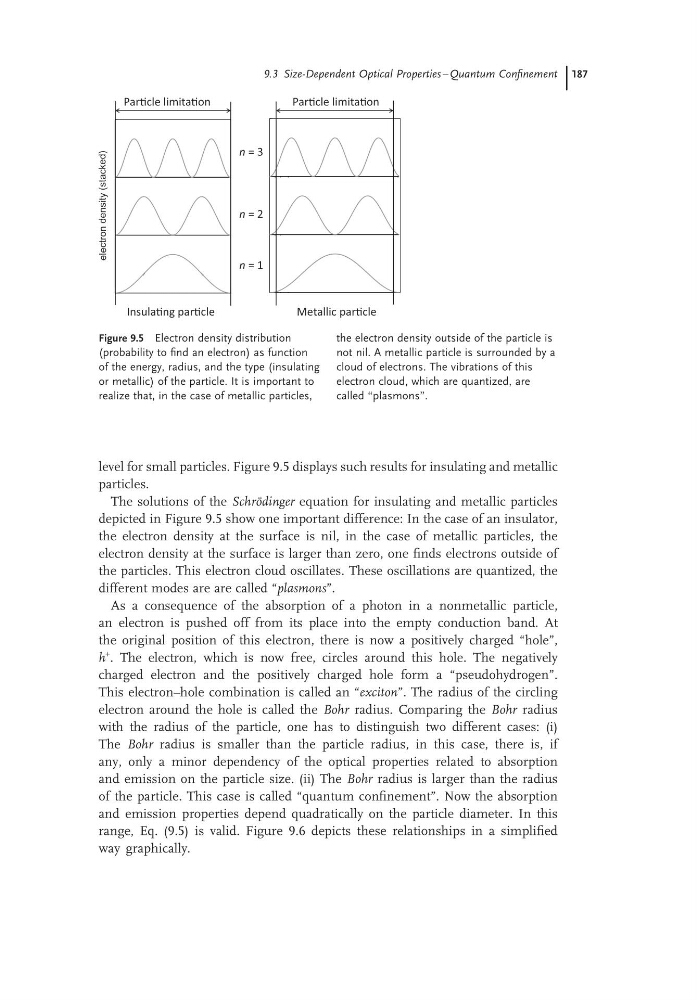
The solutions of the Schrödinger equation for insulating and metallic particles
depicted in Figure 9.5 show one important difference: In the case of an insulator,
the electron density at the surface is nil, in the case of metallic particles, the
electron density at the surface is larger than zero, one finds electrons outside of
the particles. This electron cloud oscillates. These oscillations are quantized, the
different modes are are called “plasmons”.
As a consequence of the absorption of a photon in a nonmetallic particle,
an electron is pushed off from its place into the empty conduction band. At
the original position of this electron, there is now a positively charged “hole”,
h
+
. The electron, which is now free, circles around this hole. The negatively
charged electron and the positively charged hole form a “pseudohydrogen”.
This electron–hole combination is called an “exciton”. The radius of the circling
electron around the hole is called the Bohr radius. Comparing the Bohr radius
with the radius of the particle, one has to distinguish two different cases: (i)
The Bohr radius is smaller than the particle radius, in this case, there is, if
any, only a minor dependency of the optical properties related to absorption
and emission on the particle size. (ii) The Bohr radius is larger than the radius
of the particle. This case is called “quantum confinement”. Now the absorption
and emission properties depend quadratically on the particle diameter. In this
range, Eq. (9.5) is valid. Figure 9.6 depicts these relationships in a simplified
way graphically.
Figure 9.5 Electron density distribution
(probability to find an electron) as function
of the energy, radius, and the type (insulating
or metallic) of the particle. It is important to
realize that, in the case of metallic particles,
the electron density outside of the particle is
not nil. A metallic particle is surrounded by a
cloud of electrons. The vibrations of this
electron cloud, which are quantized, are
called “plasmons”.
0
1
0
4.5
electron
density
(stacked)
0
1
0
4.5
n = 3
n = 2
n = 1
ParƟcle limitaƟon
ParƟcle limitaƟon
InsulaƟng parƟcle
Metallic parƟcle
level for small particles. Figure 9.5 displays such results for insulating and metallic
particles.
The solutions of the Schrödinger equation for insulating and metallic particles
depicted in Figure 9.5 show one important difference: In the case of an insulator,
the electron density at the surface is nil, in the case of metallic particles, the
electron density at the surface is larger than zero, one finds electrons outside of
the particles. This electron cloud oscillates. These oscillations are quantized, the
different modes are are called “plasmons”.
As a consequence of the absorption of a photon in a nonmetallic particle,
an electron is pushed off from its place into the empty conduction band. At
the original position of this electron, there is now a positively charged “hole”,
h
+
. The electron, which is now free, circles around this hole. The negatively
charged electron and the positively charged hole form a “pseudohydrogen”.
This electron–hole combination is called an “exciton”. The radius of the circling
electron around the hole is called the Bohr radius. Comparing the Bohr radius
with the radius of the particle, one has to distinguish two different cases: (i)
The Bohr radius is smaller than the particle radius, in this case, there is, if
any, only a minor dependency of the optical properties related to absorption
and emission on the particle size. (ii) The Bohr radius is larger than the radius
of the particle. This case is called “quantum confinement”. Now the absorption
and emission properties depend quadratically on the particle diameter. In this
range, Eq. (9.5) is valid. Figure 9.6 depicts these relationships in a simplified
way graphically.
Figure 9.5 Electron density distribution
(probability to find an electron) as function
of the energy, radius, and the type (insulating
or metallic) of the particle. It is important to
realize that, in the case of metallic particles,
the electron density outside of the particle is
not nil. A metallic particle is surrounded by a
cloud of electrons. The vibrations of this
electron cloud, which are quantized, are
called “plasmons”.
0
1
0
4.5
electron
density
(stacked)
0
1
0
4.5
n = 3
n = 2
n = 1
ParƟcle limitaƟon
ParƟcle limitaƟon
InsulaƟng parƟcle
Metallic parƟcle