

9.3 Size-Dependent Optical Properties – Quantum Confinement 185
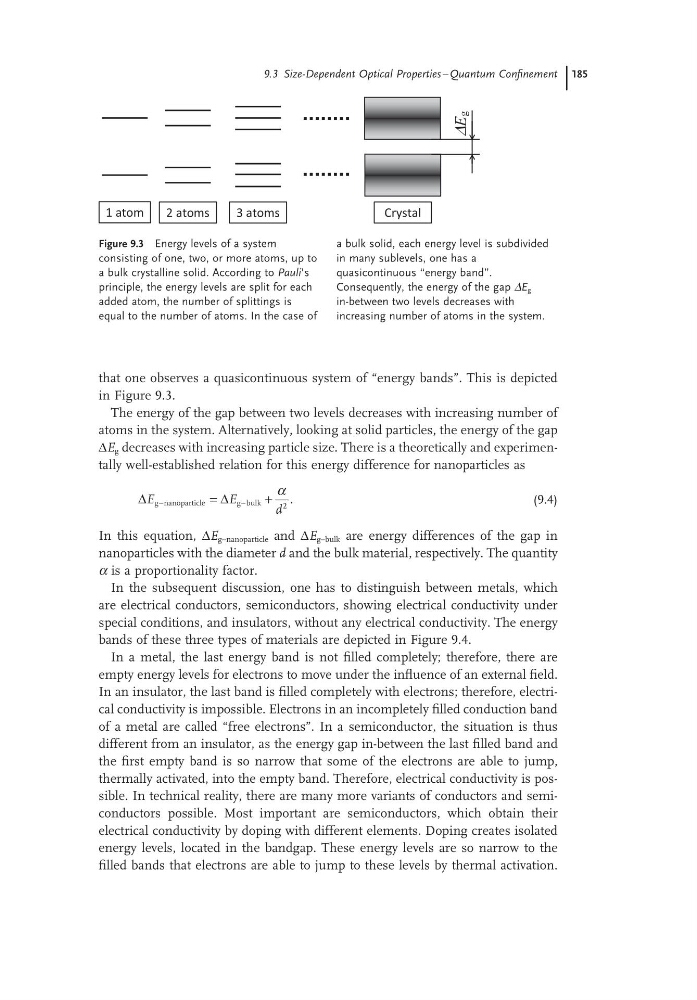
Figure 9.3 Energy levels of a system
consisting of one, two, or more atoms, up to
a bulk crystalline solid. According to Pauli’s
principle, the energy levels are split for each
added atom, the number of splittings is
equal to the number of atoms. In the case of
a bulk solid, each energy level is subdivided
in many sublevels, one has a
quasicontinuous “energy band”.
Consequently, the energy of the gap ΔE g
in-between two levels decreases with
increasing number of atoms in the system.
1 atom
2 atoms
3 atoms
Crystal
∆Eg
that one observes a quasicontinuous system of “energy bands”. This is depicted
in Figure 9.3.
The energy of the gap between two levels decreases with increasing number of
atoms in the system. Alternatively, looking at solid particles, the energy of the gap
ΔE g decreases with increasing particle size. There is a theoretically and experimentally well-established relation for this energy difference for nanoparticles as
∆
∆
E
E
d
g nanoparticle
g bulk
−
−
=
+
α
2
.
(9.4)
In this equation, ΔE g−nanoparticle and ΔE g−bulk are energy differences of the gap in
nanoparticles with the diameter d and the bulk material, respectively. The quantity
α is a proportionality factor.
In the subsequent discussion, one has to distinguish between metals, which
are electrical conductors, semiconductors, showing electrical conductivity under
special conditions, and insulators, without any electrical conductivity. The energy
bands of these three types of materials are depicted in Figure 9.4.
In a metal, the last energy band is not filled completely; therefore, there are
empty energy levels for electrons to move under the influence of an external field.
In an insulator, the last band is filled completely with electrons; therefore, electrical conductivity is impossible. Electrons in an incompletely filled conduction band
of a metal are called “free electrons”. In a semiconductor, the situation is thus
different from an insulator, as the energy gap in-between the last filled band and
the first empty band is so narrow that some of the electrons are able to jump,
thermally activated, into the empty band. Therefore, electrical conductivity is possible. In technical reality, there are many more variants of conductors and semiconductors possible. Most important are semiconductors, which obtain their
electrical conductivity by doping with different elements. Doping creates isolated
energy levels, located in the bandgap. These energy levels are so narrow to the
filled bands that electrons are able to jump to these levels by thermal activation.
Figure 9.3 Energy levels of a system
consisting of one, two, or more atoms, up to
a bulk crystalline solid. According to Pauli’s
principle, the energy levels are split for each
added atom, the number of splittings is
equal to the number of atoms. In the case of
a bulk solid, each energy level is subdivided
in many sublevels, one has a
quasicontinuous “energy band”.
Consequently, the energy of the gap ΔE g
in-between two levels decreases with
increasing number of atoms in the system.
1 atom
2 atoms
3 atoms
Crystal
∆Eg
that one observes a quasicontinuous system of “energy bands”. This is depicted
in Figure 9.3.
The energy of the gap between two levels decreases with increasing number of
atoms in the system. Alternatively, looking at solid particles, the energy of the gap
ΔE g decreases with increasing particle size. There is a theoretically and experimentally well-established relation for this energy difference for nanoparticles as
∆
∆
E
E
d
g nanoparticle
g bulk
−
−
=
+
α
2
.
(9.4)
In this equation, ΔE g−nanoparticle and ΔE g−bulk are energy differences of the gap in
nanoparticles with the diameter d and the bulk material, respectively. The quantity
α is a proportionality factor.
In the subsequent discussion, one has to distinguish between metals, which
are electrical conductors, semiconductors, showing electrical conductivity under
special conditions, and insulators, without any electrical conductivity. The energy
bands of these three types of materials are depicted in Figure 9.4.
In a metal, the last energy band is not filled completely; therefore, there are
empty energy levels for electrons to move under the influence of an external field.
In an insulator, the last band is filled completely with electrons; therefore, electrical conductivity is impossible. Electrons in an incompletely filled conduction band
of a metal are called “free electrons”. In a semiconductor, the situation is thus
different from an insulator, as the energy gap in-between the last filled band and
the first empty band is so narrow that some of the electrons are able to jump,
thermally activated, into the empty band. Therefore, electrical conductivity is possible. In technical reality, there are many more variants of conductors and semiconductors possible. Most important are semiconductors, which obtain their
electrical conductivity by doping with different elements. Doping creates isolated
energy levels, located in the bandgap. These energy levels are so narrow to the
filled bands that electrons are able to jump to these levels by thermal activation.