

184 9 Optical Properties
the human eye, are ZnO and ZrO 2 . However, as these oxides are photocatalysts,
one has to be very careful when using them as UV absorber, as this may lead to
self-destructing systems. A possibility to eliminate this problem is coating the
absorber particles with silica or alumina, as these oxides are not active as catalysts.
Furthermore, the particle size has to be carefully related to the onset wavelength
of absorption.
9.3
Size-Dependent Optical Properties – Quantum Confinement
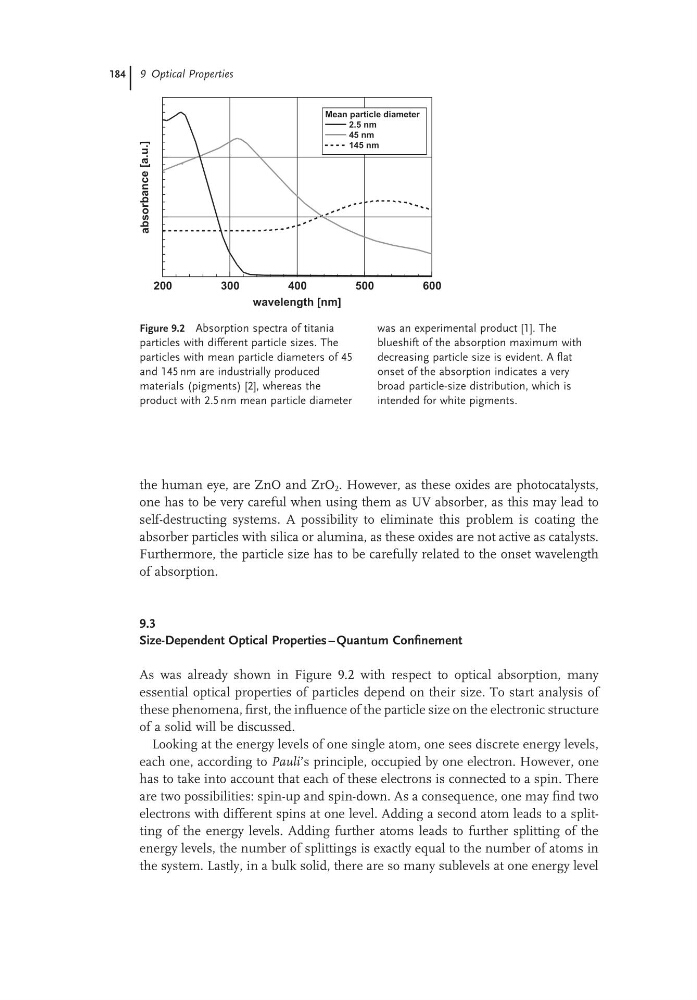
As was already shown in Figure 9.2 with respect to optical absorption, many
essential optical properties of particles depend on their size. To start analysis of
these phenomena, first, the influence of the particle size on the electronic structure
of a solid will be discussed.
Looking at the energy levels of one single atom, one sees discrete energy levels,
each one, according to Pauli’s principle, occupied by one electron. However, one
has to take into account that each of these electrons is connected to a spin. There
are two possibilities: spin-up and spin-down. As a consequence, one may find two
electrons with different spins at one level. Adding a second atom leads to a splitting of the energy levels. Adding further atoms leads to further splitting of the
energy levels, the number of splittings is exactly equal to the number of atoms in
the system. Lastly, in a bulk solid, there are so many sublevels at one energy level
Figure 9.2 Absorption spectra of titania
particles with different particle sizes. The
particles with mean particle diameters of 45
and 145 nm are industrially produced
materials (pigments) [2], whereas the
product with 2.5 nm mean particle diameter
was an experimental product [1]. The
blueshift of the absorption maximum with
decreasing particle size is evident. A flat
onset of the absorption indicates a very
broad particle-size distribution, which is
intended for white pigments.
200
300
400
500
600
wavelength [nm]
0
4
8
12
absorbance
[a.u.]
Mean particle diameter
2.5 nm
45 nm
145 nm
the human eye, are ZnO and ZrO 2 . However, as these oxides are photocatalysts,
one has to be very careful when using them as UV absorber, as this may lead to
self-destructing systems. A possibility to eliminate this problem is coating the
absorber particles with silica or alumina, as these oxides are not active as catalysts.
Furthermore, the particle size has to be carefully related to the onset wavelength
of absorption.
9.3
Size-Dependent Optical Properties – Quantum Confinement
As was already shown in Figure 9.2 with respect to optical absorption, many
essential optical properties of particles depend on their size. To start analysis of
these phenomena, first, the influence of the particle size on the electronic structure
of a solid will be discussed.
Looking at the energy levels of one single atom, one sees discrete energy levels,
each one, according to Pauli’s principle, occupied by one electron. However, one
has to take into account that each of these electrons is connected to a spin. There
are two possibilities: spin-up and spin-down. As a consequence, one may find two
electrons with different spins at one level. Adding a second atom leads to a splitting of the energy levels. Adding further atoms leads to further splitting of the
energy levels, the number of splittings is exactly equal to the number of atoms in
the system. Lastly, in a bulk solid, there are so many sublevels at one energy level
Figure 9.2 Absorption spectra of titania
particles with different particle sizes. The
particles with mean particle diameters of 45
and 145 nm are industrially produced
materials (pigments) [2], whereas the
product with 2.5 nm mean particle diameter
was an experimental product [1]. The
blueshift of the absorption maximum with
decreasing particle size is evident. A flat
onset of the absorption indicates a very
broad particle-size distribution, which is
intended for white pigments.
200
300
400
500
600
wavelength [nm]
0
4
8
12
absorbance
[a.u.]
Mean particle diameter
2.5 nm
45 nm
145 nm