

176 8 Magnetic Nanomaterials, Superparamagnetism
were preoriented during the fabrication process. Generally, magnetic composites
of this type are produced by means of powder metallurgical methods.
There are two different types of exchangecoupled hard magnetic materials. In
both cases, the magnetic hard phase is embedded in a soft magnetic matrix. The
varieties differ in the arrangement of the hard magnetic phase. On the lefthand
side, the particles with broad size distribution are oriented randomly, whereas, on
the righthand side, the material exhibits an optimized structure, where the hard
magnetic particles with uniform particle size are oriented parallel close to the axis
of the work piece. It is important to mention that in exchangecoupled magnetically hard materials the amount of the expensive hard component is small, in
many cases, a volume fraction of 10 vol% is sufficient; it is rarely more than
50 vol%. Provided the particles are sufficiently small, the effective constant of
anisotropy of such a system is close to that of the hard magnetic phase even for
equal volume fractions of both magnetic phases.
There is a lot of scientific research going on in the area of exchangecoupled
magnetic materials, as these are the best magnetically hard materials that are
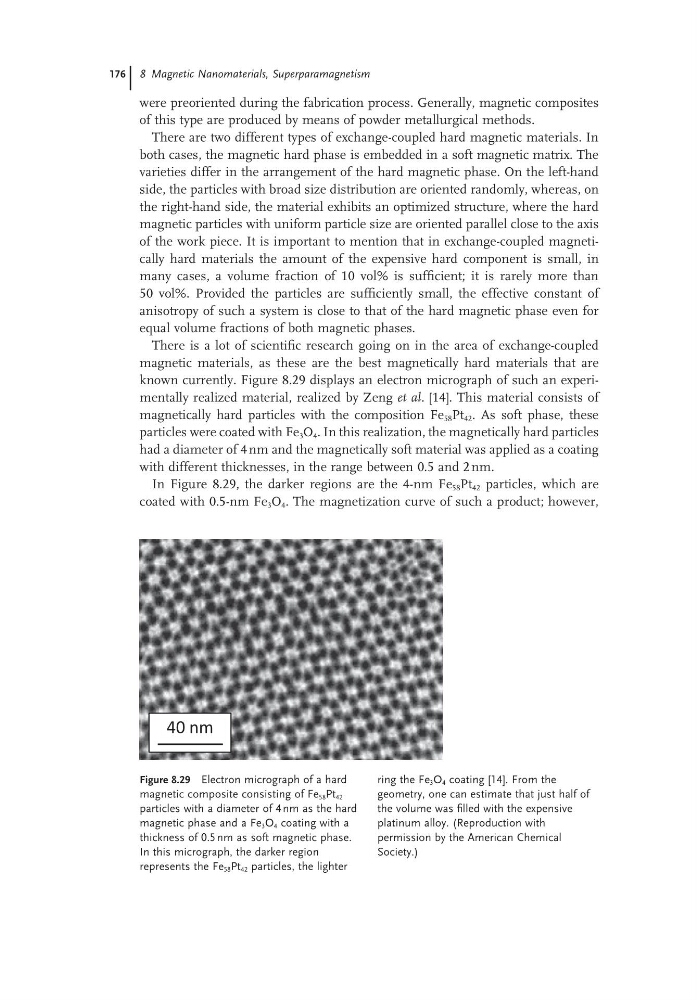
known currently. Figure 8.29 displays an electron micrograph of such an experimentally realized material, realized by Zeng et al. [14]. This material consists of
magnetically hard particles with the composition Fe 58 Pt 42 . As soft phase, these
particles were coated with Fe 3 O 4 . In this realization, the magnetically hard particles
had a diameter of 4 nm and the magnetically soft material was applied as a coating
with different thicknesses, in the range between 0.5 and 2 nm.
In Figure 8.29, the darker regions are the 4nm Fe 58 Pt 42 particles, which are
coated with 0.5nm Fe 3 O 4 . The magnetization curve of such a product; however,
Figure 8.29 Electron micrograph of a hard
magnetic composite consisting of Fe 58 Pt 42
particles with a diameter of 4 nm as the hard
magnetic phase and a Fe 3 O 4 coating with a
thickness of 0.5 nm as soft magnetic phase.
In this micrograph, the darker region
represents the Fe 58 Pt 42 particles, the lighter
ring the Fe 3 O 4 coating [14]. From the
geometry, one can estimate that just half of
the volume was filled with the expensive
platinum alloy. (Reproduction with
permission by the American Chemical
Society.)
40 nm
were preoriented during the fabrication process. Generally, magnetic composites
of this type are produced by means of powder metallurgical methods.
There are two different types of exchangecoupled hard magnetic materials. In
both cases, the magnetic hard phase is embedded in a soft magnetic matrix. The
varieties differ in the arrangement of the hard magnetic phase. On the lefthand
side, the particles with broad size distribution are oriented randomly, whereas, on
the righthand side, the material exhibits an optimized structure, where the hard
magnetic particles with uniform particle size are oriented parallel close to the axis
of the work piece. It is important to mention that in exchangecoupled magnetically hard materials the amount of the expensive hard component is small, in
many cases, a volume fraction of 10 vol% is sufficient; it is rarely more than
50 vol%. Provided the particles are sufficiently small, the effective constant of
anisotropy of such a system is close to that of the hard magnetic phase even for
equal volume fractions of both magnetic phases.
There is a lot of scientific research going on in the area of exchangecoupled
magnetic materials, as these are the best magnetically hard materials that are
known currently. Figure 8.29 displays an electron micrograph of such an experimentally realized material, realized by Zeng et al. [14]. This material consists of
magnetically hard particles with the composition Fe 58 Pt 42 . As soft phase, these
particles were coated with Fe 3 O 4 . In this realization, the magnetically hard particles
had a diameter of 4 nm and the magnetically soft material was applied as a coating
with different thicknesses, in the range between 0.5 and 2 nm.
In Figure 8.29, the darker regions are the 4nm Fe 58 Pt 42 particles, which are
coated with 0.5nm Fe 3 O 4 . The magnetization curve of such a product; however,
Figure 8.29 Electron micrograph of a hard
magnetic composite consisting of Fe 58 Pt 42
particles with a diameter of 4 nm as the hard
magnetic phase and a Fe 3 O 4 coating with a
thickness of 0.5 nm as soft magnetic phase.
In this micrograph, the darker region
represents the Fe 58 Pt 42 particles, the lighter
ring the Fe 3 O 4 coating [14]. From the
geometry, one can estimate that just half of
the volume was filled with the expensive
platinum alloy. (Reproduction with
permission by the American Chemical
Society.)
40 nm