

8.6 Exchange-Coupled Magnetic Nanoparticles 177
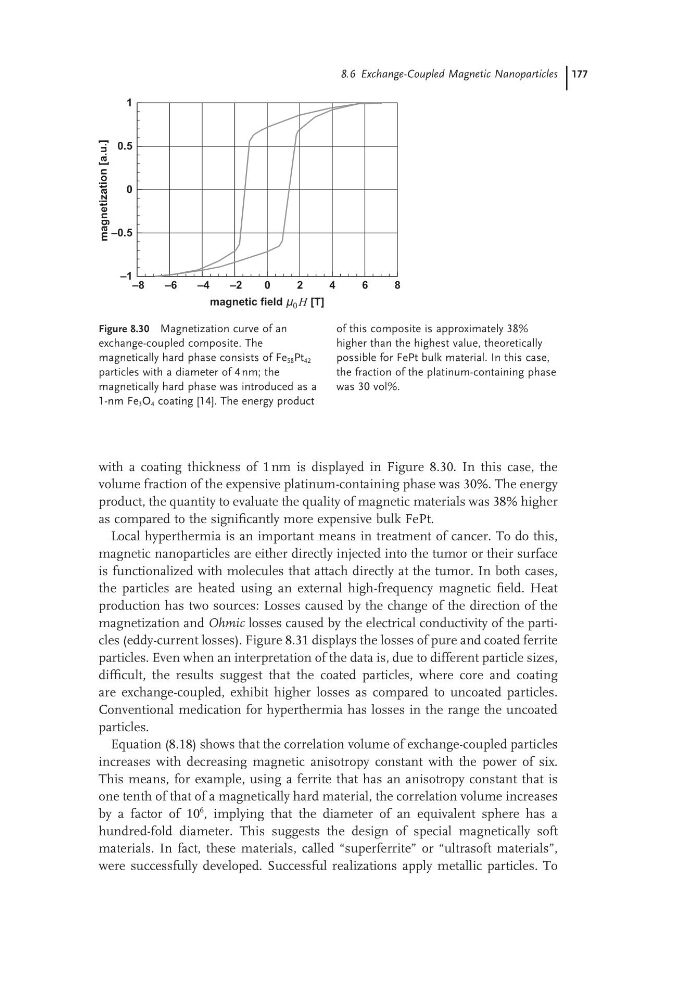
Figure 8.30 Magnetization curve of an
exchange-coupled composite. The
magnetically hard phase consists of Fe 58 Pt 42
particles with a diameter of 4 nm; the
magnetically hard phase was introduced as a
1-nm Fe 3 O 4 coating [14]. The energy product
of this composite is approximately 38%
higher than the highest value, theoretically
possible for FePt bulk material. In this case,
the fraction of the platinum-containing phase
was 30 vol%.
–8
–6
–4
–2
0
2
4
6
8
magnetic field µ 0 H [T]
–1
–0.5
0
0.5
1
magnetization
[a.u.]
with a coating thickness of 1 nm is displayed in Figure 8.30. In this case, the
volume fraction of the expensive platinumcontaining phase was 30%. The energy
product, the quantity to evaluate the quality of magnetic materials was 38% higher
as compared to the significantly more expensive bulk FePt.
Local hyperthermia is an important means in treatment of cancer. To do this,
magnetic nanoparticles are either directly injected into the tumor or their surface
is functionalized with molecules that attach directly at the tumor. In both cases,
the particles are heated using an external highfrequency magnetic field. Heat
production has two sources: Losses caused by the change of the direction of the
magnetization and Ohmic losses caused by the electrical conductivity of the particles (eddycurrent losses). Figure 8.31 displays the losses of pure and coated ferrite
particles. Even when an interpretation of the data is, due to different particle sizes,
difficult, the results suggest that the coated particles, where core and coating
are exchangecoupled, exhibit higher losses as compared to uncoated particles.
Conventional medication for hyperthermia has losses in the range the uncoated
particles.
Equation (8.18) shows that the correlation volume of exchangecoupled particles
increases with decreasing magnetic anisotropy constant with the power of six.
This means, for example, using a ferrite that has an anisotropy constant that is
one tenth of that of a magnetically hard material, the correlation volume increases
by a factor of 10
6
, implying that the diameter of an equivalent sphere has a
hundredfold diameter. This suggests the design of special magnetically soft
materials. In fact, these materials, called “superferrite” or “ultrasoft materials”,
were successfully developed. Successful realizations apply metallic particles. To
Figure 8.30 Magnetization curve of an
exchange-coupled composite. The
magnetically hard phase consists of Fe 58 Pt 42
particles with a diameter of 4 nm; the
magnetically hard phase was introduced as a
1-nm Fe 3 O 4 coating [14]. The energy product
of this composite is approximately 38%
higher than the highest value, theoretically
possible for FePt bulk material. In this case,
the fraction of the platinum-containing phase
was 30 vol%.
–8
–6
–4
–2
0
2
4
6
8
magnetic field µ 0 H [T]
–1
–0.5
0
0.5
1
magnetization
[a.u.]
with a coating thickness of 1 nm is displayed in Figure 8.30. In this case, the
volume fraction of the expensive platinumcontaining phase was 30%. The energy
product, the quantity to evaluate the quality of magnetic materials was 38% higher
as compared to the significantly more expensive bulk FePt.
Local hyperthermia is an important means in treatment of cancer. To do this,
magnetic nanoparticles are either directly injected into the tumor or their surface
is functionalized with molecules that attach directly at the tumor. In both cases,
the particles are heated using an external highfrequency magnetic field. Heat
production has two sources: Losses caused by the change of the direction of the
magnetization and Ohmic losses caused by the electrical conductivity of the particles (eddycurrent losses). Figure 8.31 displays the losses of pure and coated ferrite
particles. Even when an interpretation of the data is, due to different particle sizes,
difficult, the results suggest that the coated particles, where core and coating
are exchangecoupled, exhibit higher losses as compared to uncoated particles.
Conventional medication for hyperthermia has losses in the range the uncoated
particles.
Equation (8.18) shows that the correlation volume of exchangecoupled particles
increases with decreasing magnetic anisotropy constant with the power of six.
This means, for example, using a ferrite that has an anisotropy constant that is
one tenth of that of a magnetically hard material, the correlation volume increases
by a factor of 10
6
, implying that the diameter of an equivalent sphere has a
hundredfold diameter. This suggests the design of special magnetically soft
materials. In fact, these materials, called “superferrite” or “ultrasoft materials”,
were successfully developed. Successful realizations apply metallic particles. To