

8.6 Exchange-Coupled Magnetic Nanoparticles 175
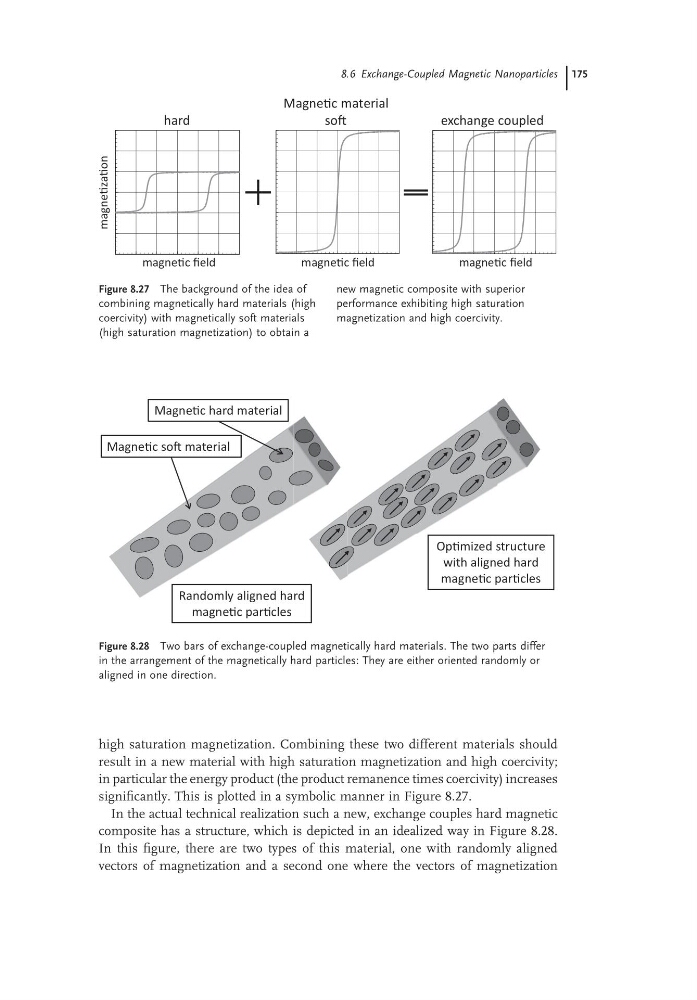
high saturation magnetization. Combining these two different materials should
result in a new material with high saturation magnetization and high coercivity;
in particular the energy product (the product remanence times coercivity) increases
significantly. This is plotted in a symbolic manner in Figure 8.27.
In the actual technical realization such a new, exchange couples hard magnetic
composite has a structure, which is depicted in an idealized way in Figure 8.28.
In this figure, there are two types of this material, one with randomly aligned
vectors of magnetization and a second one where the vectors of magnetization
Figure 8.27 The background of the idea of
combining magnetically hard materials (high
coercivity) with magnetically soft materials
(high saturation magnetization) to obtain a
new magnetic composite with superior
performance exhibiting high saturation
magnetization and high coercivity.
-60
-40
-20
0
20
40
60
-3
-2
-1
0
1
2
3
-60
-40
-20
0
20
40
60
-3
-2
-1
0
1
2
3
-60
-40
-20
0
20
40
60
-3
-2
-1
0
1
2
3
MagneƟc material
hard
soŌ
exchange coupled
magneƟc field
magneƟc field
magneƟc field
magneƟzaƟon
Figure 8.28 Two bars of exchange-coupled magnetically hard materials. The two parts differ
in the arrangement of the magnetically hard particles: They are either oriented randomly or
aligned in one direction.
OpƟmized structure
with aligned hard
magneƟc parƟcles
Randomly aligned hard
magneƟc parƟcles
MagneƟc hard material
MagneƟc soŌ material
OpƟmized structure
with aligned hard
magneƟc parƟcles
Randomly aligned ha
magneƟc parƟcles
MagneƟc hard material
MagneƟc soŌ material
rd
high saturation magnetization. Combining these two different materials should
result in a new material with high saturation magnetization and high coercivity;
in particular the energy product (the product remanence times coercivity) increases
significantly. This is plotted in a symbolic manner in Figure 8.27.
In the actual technical realization such a new, exchange couples hard magnetic
composite has a structure, which is depicted in an idealized way in Figure 8.28.
In this figure, there are two types of this material, one with randomly aligned
vectors of magnetization and a second one where the vectors of magnetization
Figure 8.27 The background of the idea of
combining magnetically hard materials (high
coercivity) with magnetically soft materials
(high saturation magnetization) to obtain a
new magnetic composite with superior
performance exhibiting high saturation
magnetization and high coercivity.
-60
-40
-20
0
20
40
60
-3
-2
-1
0
1
2
3
-60
-40
-20
0
20
40
60
-3
-2
-1
0
1
2
3
-60
-40
-20
0
20
40
60
-3
-2
-1
0
1
2
3
MagneƟc material
hard
soŌ
exchange coupled
magneƟc field
magneƟc field
magneƟc field
magneƟzaƟon
Figure 8.28 Two bars of exchange-coupled magnetically hard materials. The two parts differ
in the arrangement of the magnetically hard particles: They are either oriented randomly or
aligned in one direction.
OpƟmized structure
with aligned hard
magneƟc parƟcles
Randomly aligned hard
magneƟc parƟcles
MagneƟc hard material
MagneƟc soŌ material
OpƟmized structure
with aligned hard
magneƟc parƟcles
Randomly aligned ha
magneƟc parƟcles
MagneƟc hard material
MagneƟc soŌ material
rd