

158 8 Magnetic Nanomaterials, Superparamagnetism
M
nmL
mH
kT
T
T
→∞
→∞
=
=
lim
.
0
(8.8)
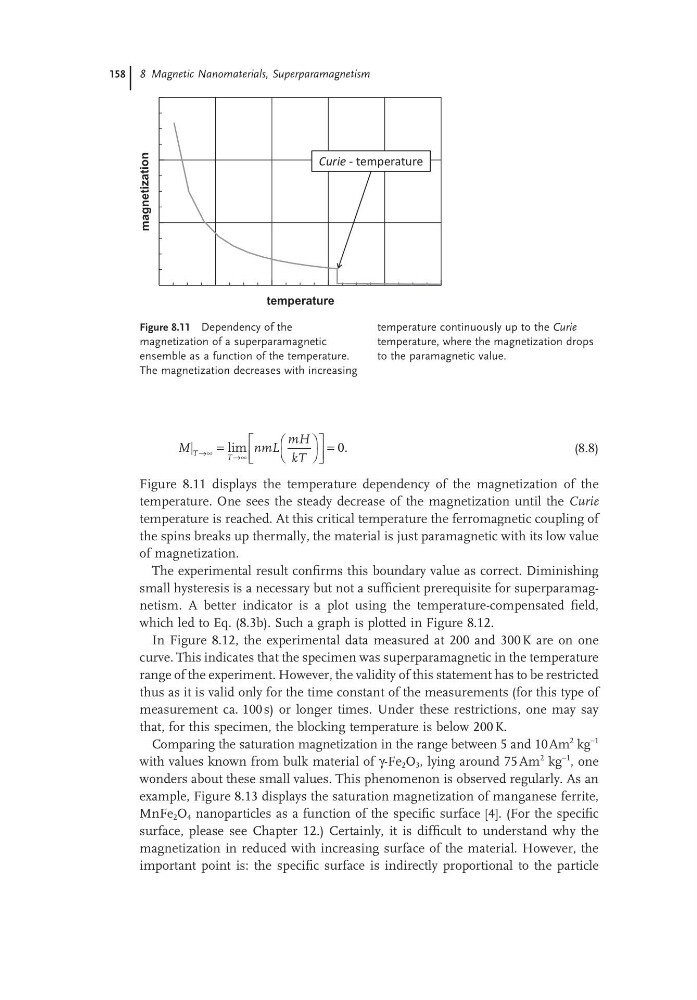
Figure 8.11 displays the temperature dependency of the magnetization of the
temperature. One sees the steady decrease of the magnetization until the Curie
temperature is reached. At this critical temperature the ferromagnetic coupling of
the spins breaks up thermally, the material is just paramagnetic with its low value
of magnetization.
The experimental result confirms this boundary value as correct. Diminishing
small hysteresis is a necessary but not a sufficient prerequisite for superparamagnetism. A better indicator is a plot using the temperaturecompensated field,
which led to Eq. (8.3b). Such a graph is plotted in Figure 8.12.
In Figure 8.12, the experimental data measured at 200 and 300 K are on one
curve. This indicates that the specimen was superparamagnetic in the temperature
range of the experiment. However, the validity of this statement has to be restricted
thus as it is valid only for the time constant of the measurements (for this type of
measurement ca. 100 s) or longer times. Under these restrictions, one may say
that, for this specimen, the blocking temperature is below 200 K.
Comparing the saturation magnetization in the range between 5 and 10 Am
2 kg
−1
with values known from bulk material of γFe 2 O 3 , lying around 75 Am
2 kg
−1
, one
wonders about these small values. This phenomenon is observed regularly. As an
example, Figure 8.13 displays the saturation magnetization of manganese ferrite,
MnFe 2 O 4 nanoparticles as a function of the specific surface [4]. (For the specific
surface, please see Chapter 12.) Certainly, it is difficult to understand why the
magnetization in reduced with increasing surface of the material. However, the
important point is: the specific surface is indirectly proportional to the particle
Figure 8.11 Dependency of the
magnetization of a superparamagnetic
ensemble as a function of the temperature.
The magnetization decreases with increasing
temperature continuously up to the Curie
temperature, where the magnetization drops
to the paramagnetic value.
0
2
4
6
8
10
temperature
0
0.2
0.4
0.6
magnetization
ƵƌŝĞ Ͳ ƚĞŵƉĞƌĂƚƵƌĞ
M
nmL
mH
kT
T
T
→∞
→∞
=
=
lim
.
0
(8.8)
Figure 8.11 displays the temperature dependency of the magnetization of the
temperature. One sees the steady decrease of the magnetization until the Curie
temperature is reached. At this critical temperature the ferromagnetic coupling of
the spins breaks up thermally, the material is just paramagnetic with its low value
of magnetization.
The experimental result confirms this boundary value as correct. Diminishing
small hysteresis is a necessary but not a sufficient prerequisite for superparamagnetism. A better indicator is a plot using the temperaturecompensated field,
which led to Eq. (8.3b). Such a graph is plotted in Figure 8.12.
In Figure 8.12, the experimental data measured at 200 and 300 K are on one
curve. This indicates that the specimen was superparamagnetic in the temperature
range of the experiment. However, the validity of this statement has to be restricted
thus as it is valid only for the time constant of the measurements (for this type of
measurement ca. 100 s) or longer times. Under these restrictions, one may say
that, for this specimen, the blocking temperature is below 200 K.
Comparing the saturation magnetization in the range between 5 and 10 Am
2 kg
−1
with values known from bulk material of γFe 2 O 3 , lying around 75 Am
2 kg
−1
, one
wonders about these small values. This phenomenon is observed regularly. As an
example, Figure 8.13 displays the saturation magnetization of manganese ferrite,
MnFe 2 O 4 nanoparticles as a function of the specific surface [4]. (For the specific
surface, please see Chapter 12.) Certainly, it is difficult to understand why the
magnetization in reduced with increasing surface of the material. However, the
important point is: the specific surface is indirectly proportional to the particle
Figure 8.11 Dependency of the
magnetization of a superparamagnetic
ensemble as a function of the temperature.
The magnetization decreases with increasing
temperature continuously up to the Curie
temperature, where the magnetization drops
to the paramagnetic value.
0
2
4
6
8
10
temperature
0
0.2
0.4
0.6
magnetization
ƵƌŝĞ Ͳ ƚĞŵƉĞƌĂƚƵƌĞ