

156 8 Magnetic Nanomaterials, Superparamagnetism
Figure 8.9 Energy of magnetic anisotropy as
a function of the orientation in a Cartesian
system of coordinates. Additionally, the
different contributions to the energy of
magnetic anisotropy and the thermal energy
are indicated. At any temperature, the
direction of magnetization fluctuates between
the directions −δ and +δ. When the
temperature is high enough, and fulfills the
condition kT ≥ K 1 v, the magnetization can
jump to the next stable directions at 0 ° and
180 °.
0
45
90
135
180
orientation
0
0.5
1
1.5
2
2.5
energy
of
anisotropy Kv
δ
−δ
K
1 v
K
0 v
kT
kT
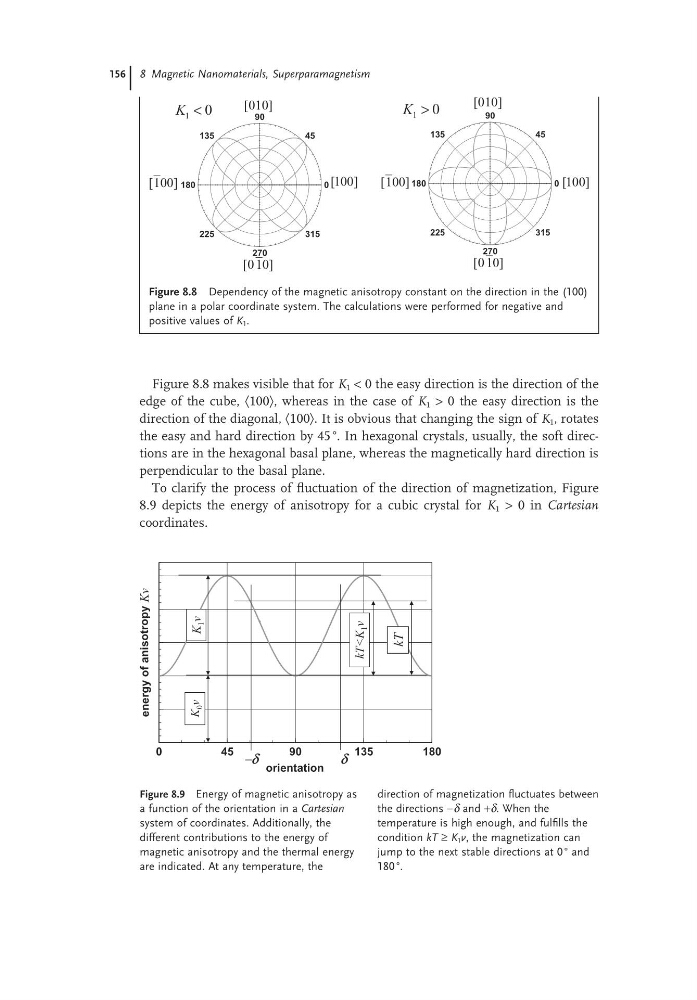
Figure 8.8 Dependency of the magnetic anisotropy constant on the direction in the (100)
plane in a polar coordinate system. The calculations were performed for negative and
positive values of K 1 .
0
45
90
135
180
225
270
315
0.8
0.8
0.6
0.6
0.4
0.4
0.2
0.2
0
0
45
90
135
180
225
270
315
2
2
1.5
1.5
1
1
0.5
0.5
0
[010]
[100]
[0 10]
[010]
[100]
[0 10]
[100]
[100]
1
0
K <
1
0
K >
Figure 8.8 makes visible that for K 1 < 0 the easy direction is the direction of the
edge of the cube, 〈100〉, whereas in the case of K 1 > 0 the easy direction is the
direction of the diagonal, 〈100〉. It is obvious that changing the sign of K 1 , rotates
the easy and hard direction by 45 °. In hexagonal crystals, usually, the soft directions are in the hexagonal basal plane, whereas the magnetically hard direction is
perpendicular to the basal plane.
To clarify the process of fluctuation of the direction of magnetization, Figure
8.9 depicts the energy of anisotropy for a cubic crystal for K 1 > 0 in Cartesian
coordinates.
Figure 8.9 Energy of magnetic anisotropy as
a function of the orientation in a Cartesian
system of coordinates. Additionally, the
different contributions to the energy of
magnetic anisotropy and the thermal energy
are indicated. At any temperature, the
direction of magnetization fluctuates between
the directions −δ and +δ. When the
temperature is high enough, and fulfills the
condition kT ≥ K 1 v, the magnetization can
jump to the next stable directions at 0 ° and
180 °.
0
45
90
135
180
orientation
0
0.5
1
1.5
2
2.5
energy
of
anisotropy Kv
δ
−δ
K
1 v
K
0 v
kT
kT
Figure 8.8 Dependency of the magnetic anisotropy constant on the direction in the (100)
plane in a polar coordinate system. The calculations were performed for negative and
positive values of K 1 .
0
45
90
135
180
225
270
315
0.8
0.8
0.6
0.6
0.4
0.4
0.2
0.2
0
0
45
90
135
180
225
270
315
2
2
1.5
1.5
1
1
0.5
0.5
0
[010]
[100]
[0 10]
[010]
[100]
[0 10]
[100]
[100]
1
0
K <
1
0
K >
Figure 8.8 makes visible that for K 1 < 0 the easy direction is the direction of the
edge of the cube, 〈100〉, whereas in the case of K 1 > 0 the easy direction is the
direction of the diagonal, 〈100〉. It is obvious that changing the sign of K 1 , rotates
the easy and hard direction by 45 °. In hexagonal crystals, usually, the soft directions are in the hexagonal basal plane, whereas the magnetically hard direction is
perpendicular to the basal plane.
To clarify the process of fluctuation of the direction of magnetization, Figure
8.9 depicts the energy of anisotropy for a cubic crystal for K 1 > 0 in Cartesian
coordinates.