

8.2 Fundamentals of Superparamagnetism 155
Box 8.2 Constants of Magnetic Anisotropy
Magnetic anisotropy or, in this context more precise magnetocrystalline
anisotropy, is an intrinsic property of any crystalline magnetic material, independent of particle size. It depends on the crystalline structure of the material and introduces a preferential direction of magnetization, the socalled
“easy direction”. This is the direction of spontaneous magnetization, provided the specimen is spherical. Additionally, there is a magnetically hard
direction; to keep the vector of magnetization in this direction, additional
energy is necessary.
In cubic materials, for any arbitrary direction, the energy of anisotropy can
be calculated using three materials constants K 0 , K 1 , and K 2 . The energy of
anisotropy is calculated for any direction with the angle α 1 to the [100], α 2 to
the [010], and α 3 to the [001] axis, by:
K K K
K
=
+
+
+
(
)
+
0
1
2
1
2
2
2
2
2
3
2
1
2
3
2
2
1
cos
cos
cos
cos
cos
cos
cos
co
α
α
α
α
α
α
α s s
cos .
2
2
2
3
α
α
(8.6)
K 1 is known for many magnetic substances; K 2 is known only for very few, K 0
is unknown for most materials. Table 8.1 gives values of K 1 for a few ferrites.
The constant of magnetic anisotropy K 1 may be positive or negative. The sign
of K 1 determines the crystallographic orientation of the easy and hard direction
of magnetization.
To present a demonstrative graph Figure 8.8 is restricted to a magnetization vector in the (100) plane of a cubic system. Therefore, the relations
a 3 = 90 ° ⇒ cos
2 a 3 = 0, and a 2 = 90 − a 1 ⇒ cos a 2 = sin a 1 are valid. This simplifies Eq. (8.4) to the relation
K K K
=
+ (
)
0
1
2
1
2
1
cos
sin
,
α
α
(8.7)
which is valid for the energy of anisotropy in the (001) plane.
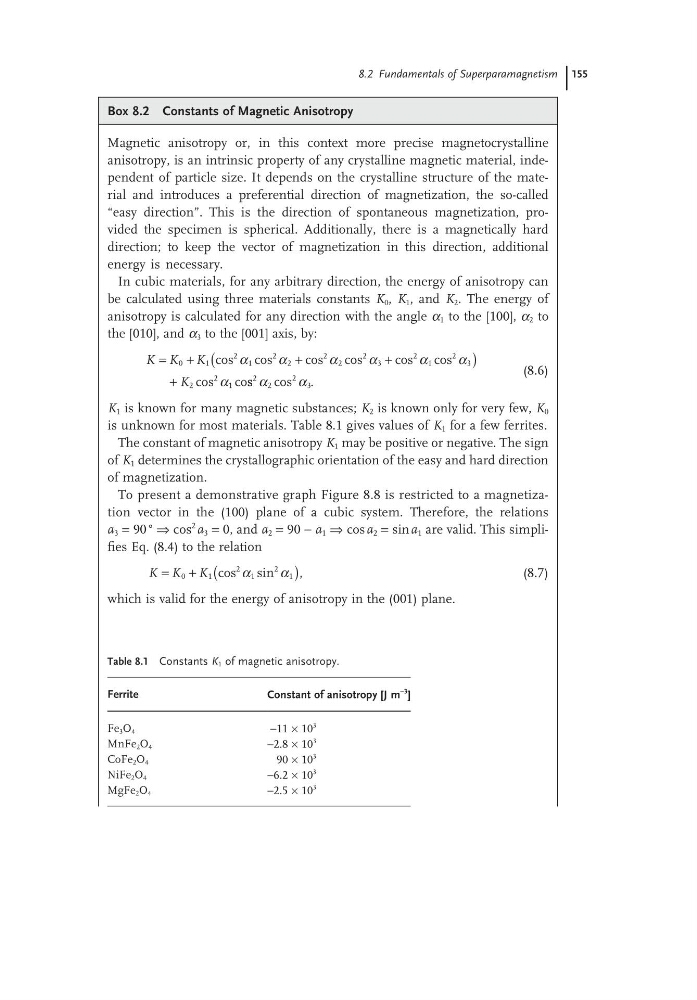
Table 8.1 Constants K 1 of magnetic anisotropy.
Ferrite
Constant of anisotropy [J m
−3 ]
Fe 3 O 4
−11 × 10
3
MnFe 2 O 4
−2.8 × 10
3
CoFe 2 O 4
90 × 10
3
NiFe 2 O 4
−6.2 × 10
3
MgFe 2 O 4
−2.5 × 10
3
Box 8.2 Constants of Magnetic Anisotropy
Magnetic anisotropy or, in this context more precise magnetocrystalline
anisotropy, is an intrinsic property of any crystalline magnetic material, independent of particle size. It depends on the crystalline structure of the material and introduces a preferential direction of magnetization, the socalled
“easy direction”. This is the direction of spontaneous magnetization, provided the specimen is spherical. Additionally, there is a magnetically hard
direction; to keep the vector of magnetization in this direction, additional
energy is necessary.
In cubic materials, for any arbitrary direction, the energy of anisotropy can
be calculated using three materials constants K 0 , K 1 , and K 2 . The energy of
anisotropy is calculated for any direction with the angle α 1 to the [100], α 2 to
the [010], and α 3 to the [001] axis, by:
K K K
K
=
+
+
+
(
)
+
0
1
2
1
2
2
2
2
2
3
2
1
2
3
2
2
1
cos
cos
cos
cos
cos
cos
cos
co
α
α
α
α
α
α
α s s
cos .
2
2
2
3
α
α
(8.6)
K 1 is known for many magnetic substances; K 2 is known only for very few, K 0
is unknown for most materials. Table 8.1 gives values of K 1 for a few ferrites.
The constant of magnetic anisotropy K 1 may be positive or negative. The sign
of K 1 determines the crystallographic orientation of the easy and hard direction
of magnetization.
To present a demonstrative graph Figure 8.8 is restricted to a magnetization vector in the (100) plane of a cubic system. Therefore, the relations
a 3 = 90 ° ⇒ cos
2 a 3 = 0, and a 2 = 90 − a 1 ⇒ cos a 2 = sin a 1 are valid. This simplifies Eq. (8.4) to the relation
K K K
=
+ (
)
0
1
2
1
2
1
cos
sin
,
α
α
(8.7)
which is valid for the energy of anisotropy in the (001) plane.
Table 8.1 Constants K 1 of magnetic anisotropy.
Ferrite
Constant of anisotropy [J m
−3 ]
Fe 3 O 4
−11 × 10
3
MnFe 2 O 4
−2.8 × 10
3
CoFe 2 O 4
90 × 10
3
NiFe 2 O 4
−6.2 × 10
3
MgFe 2 O 4
−2.5 × 10
3