

154 8 Magnetic Nanomaterials, Superparamagnetism
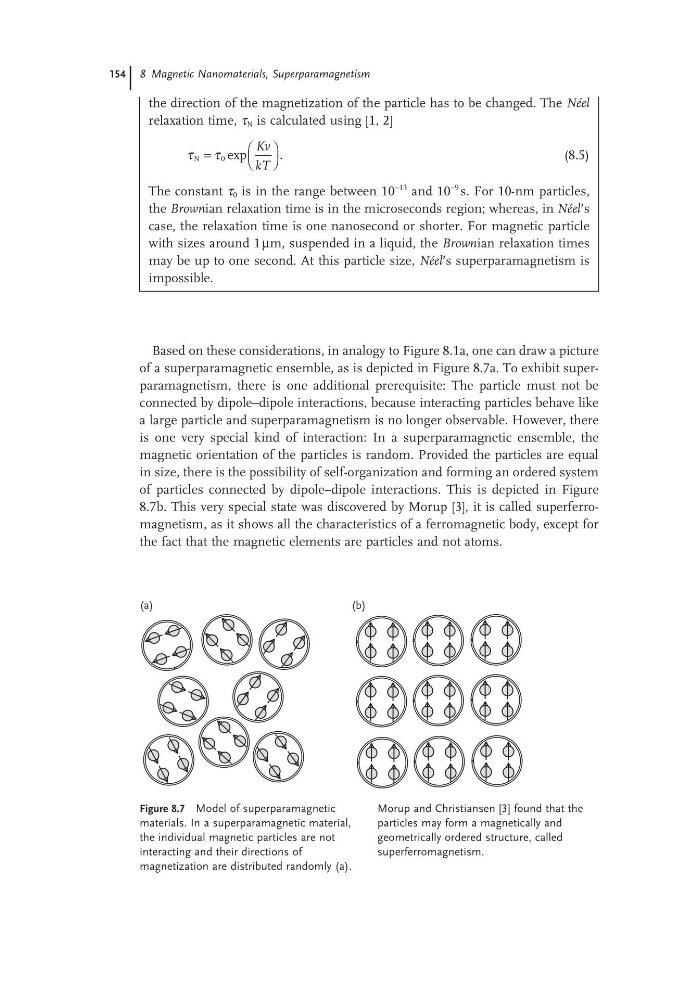
Figure 8.7 Model of superparamagnetic
materials. In a superparamagnetic material,
the individual magnetic particles are not
interacting and their directions of
magnetization are distributed randomly (a).
Morup and Christiansen [3] found that the
particles may form a magnetically and
geometrically ordered structure, called
superferromagnetism.
(a)
(b)
the direction of the magnetization of the particle has to be changed. The Néel
relaxation time, τ N is calculated using [1, 2]
τ
τ
N =
0 exp
.
Kv
kT
(8.5)
The constant τ 0 is in the range between 10
−13 and 10
−9 s. For 10nm particles,
the Brownian relaxation time is in the microseconds region; whereas, in Néel’s
case, the relaxation time is one nanosecond or shorter. For magnetic particle
with sizes around 1 μm, suspended in a liquid, the Brownian relaxation times
may be up to one second. At this particle size, Néel’s superparamagnetism is
impossible.
Based on these considerations, in analogy to Figure 8.1a, one can draw a picture
of a superparamagnetic ensemble, as is depicted in Figure 8.7a. To exhibit superparamagnetism, there is one additional prerequisite: The particle must not be
connected by dipole–dipole interactions, because interacting particles behave like
a large particle and superparamagnetism is no longer observable. However, there
is one very special kind of interaction: In a superparamagnetic ensemble, the
magnetic orientation of the particles is random. Provided the particles are equal
in size, there is the possibility of selforganization and forming an ordered system
of particles connected by dipole–dipole interactions. This is depicted in Figure
8.7b. This very special state was discovered by Morup [3], it is called superferromagnetism, as it shows all the characteristics of a ferromagnetic body, except for
the fact that the magnetic elements are particles and not atoms.
Figure 8.7 Model of superparamagnetic
materials. In a superparamagnetic material,
the individual magnetic particles are not
interacting and their directions of
magnetization are distributed randomly (a).
Morup and Christiansen [3] found that the
particles may form a magnetically and
geometrically ordered structure, called
superferromagnetism.
(a)
(b)
the direction of the magnetization of the particle has to be changed. The Néel
relaxation time, τ N is calculated using [1, 2]
τ
τ
N =
0 exp
.
Kv
kT
(8.5)
The constant τ 0 is in the range between 10
−13 and 10
−9 s. For 10nm particles,
the Brownian relaxation time is in the microseconds region; whereas, in Néel’s
case, the relaxation time is one nanosecond or shorter. For magnetic particle
with sizes around 1 μm, suspended in a liquid, the Brownian relaxation times
may be up to one second. At this particle size, Néel’s superparamagnetism is
impossible.
Based on these considerations, in analogy to Figure 8.1a, one can draw a picture
of a superparamagnetic ensemble, as is depicted in Figure 8.7a. To exhibit superparamagnetism, there is one additional prerequisite: The particle must not be
connected by dipole–dipole interactions, because interacting particles behave like
a large particle and superparamagnetism is no longer observable. However, there
is one very special kind of interaction: In a superparamagnetic ensemble, the
magnetic orientation of the particles is random. Provided the particles are equal
in size, there is the possibility of selforganization and forming an ordered system
of particles connected by dipole–dipole interactions. This is depicted in Figure
8.7b. This very special state was discovered by Morup [3], it is called superferromagnetism, as it shows all the characteristics of a ferromagnetic body, except for
the fact that the magnetic elements are particles and not atoms.