

130 7 Thermodynamics of Nanoparticles and Phase Transformations
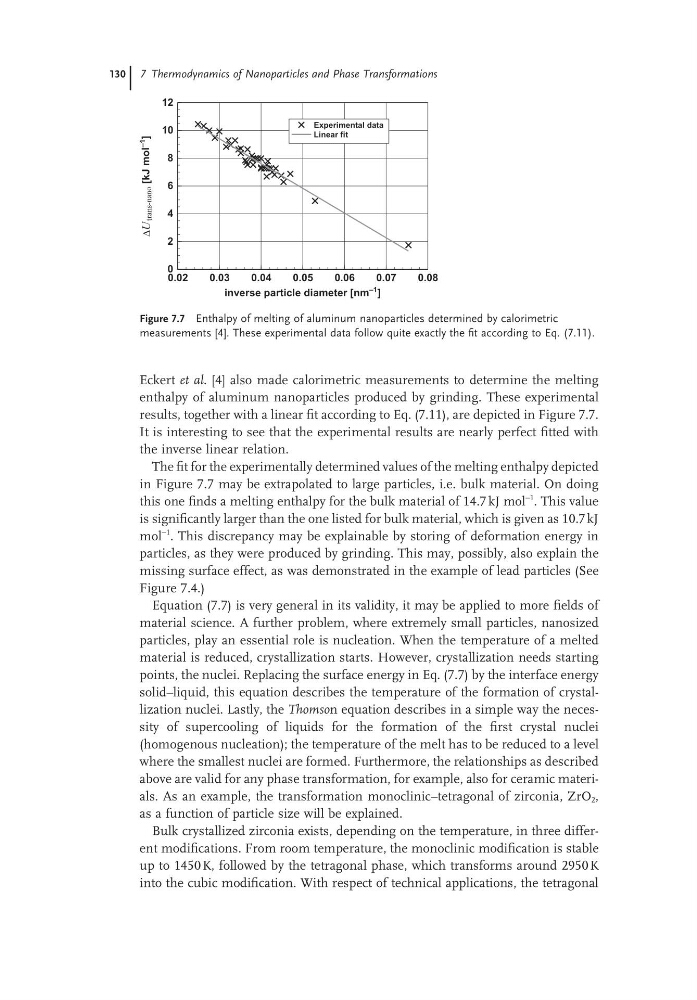
Eckert et al. [4] also made calorimetric measurements to determine the melting
enthalpy of aluminum nanoparticles produced by grinding. These experimental
results, together with a linear fit according to Eq. (7.11), are depicted in Figure 7.7.
It is interesting to see that the experimental results are nearly perfect fitted with
the inverse linear relation.
The fit for the experimentally determined values of the melting enthalpy depicted
in Figure 7.7 may be extrapolated to large particles, i.e. bulk material. On doing
this one finds a melting enthalpy for the bulk material of 14.7 kJ mol
−1 . This value
is significantly larger than the one listed for bulk material, which is given as 10.7 kJ
mol
−1
. This discrepancy may be explainable by storing of deformation energy in
particles, as they were produced by grinding. This may, possibly, also explain the
missing surface effect, as was demonstrated in the example of lead particles (See
Figure 7.4.)
Equation (7.7) is very general in its validity, it may be applied to more fields of
material science. A further problem, where extremely small particles, nanosized
particles, play an essential role is nucleation. When the temperature of a melted
material is reduced, crystallization starts. However, crystallization needs starting
points, the nuclei. Replacing the surface energy in Eq. (7.7) by the interface energy
solid–liquid, this equation describes the temperature of the formation of crystallization nuclei. Lastly, the Thomson equation describes in a simple way the necessity of supercooling of liquids for the formation of the first crystal nuclei
(homogenous nucleation); the temperature of the melt has to be reduced to a level
where the smallest nuclei are formed. Furthermore, the relationships as described
above are valid for any phase transformation, for example, also for ceramic materials. As an example, the transformation monoclinic–tetragonal of zirconia, ZrO 2 ,
as a function of particle size will be explained.
Bulk crystallized zirconia exists, depending on the temperature, in three different modifications. From room temperature, the monoclinic modification is stable
up to 1450 K, followed by the tetragonal phase, which transforms around 2950 K
into the cubic modification. With respect of technical applications, the tetragonal
Figure 7.7 Enthalpy of melting of aluminum nanoparticles determined by calorimetric
measurements [4]. These experimental data follow quite exactly the fit according to Eq. (7.11).
0.02
0.03
0.04
0.05
0.06
0.07
0.08
inverse particle diameter [nm
–1
]
0
2
4
6
8
10
12
∆U trans-nano
[kJ
mol
–1
]
Experimental data
Linear fit
Eckert et al. [4] also made calorimetric measurements to determine the melting
enthalpy of aluminum nanoparticles produced by grinding. These experimental
results, together with a linear fit according to Eq. (7.11), are depicted in Figure 7.7.
It is interesting to see that the experimental results are nearly perfect fitted with
the inverse linear relation.
The fit for the experimentally determined values of the melting enthalpy depicted
in Figure 7.7 may be extrapolated to large particles, i.e. bulk material. On doing
this one finds a melting enthalpy for the bulk material of 14.7 kJ mol
−1 . This value
is significantly larger than the one listed for bulk material, which is given as 10.7 kJ
mol
−1
. This discrepancy may be explainable by storing of deformation energy in
particles, as they were produced by grinding. This may, possibly, also explain the
missing surface effect, as was demonstrated in the example of lead particles (See
Figure 7.4.)
Equation (7.7) is very general in its validity, it may be applied to more fields of
material science. A further problem, where extremely small particles, nanosized
particles, play an essential role is nucleation. When the temperature of a melted
material is reduced, crystallization starts. However, crystallization needs starting
points, the nuclei. Replacing the surface energy in Eq. (7.7) by the interface energy
solid–liquid, this equation describes the temperature of the formation of crystallization nuclei. Lastly, the Thomson equation describes in a simple way the necessity of supercooling of liquids for the formation of the first crystal nuclei
(homogenous nucleation); the temperature of the melt has to be reduced to a level
where the smallest nuclei are formed. Furthermore, the relationships as described
above are valid for any phase transformation, for example, also for ceramic materials. As an example, the transformation monoclinic–tetragonal of zirconia, ZrO 2 ,
as a function of particle size will be explained.
Bulk crystallized zirconia exists, depending on the temperature, in three different modifications. From room temperature, the monoclinic modification is stable
up to 1450 K, followed by the tetragonal phase, which transforms around 2950 K
into the cubic modification. With respect of technical applications, the tetragonal
Figure 7.7 Enthalpy of melting of aluminum nanoparticles determined by calorimetric
measurements [4]. These experimental data follow quite exactly the fit according to Eq. (7.11).
0.02
0.03
0.04
0.05
0.06
0.07
0.08
inverse particle diameter [nm
–1
]
0
2
4
6
8
10
12
∆U trans-nano
[kJ
mol
–1
]
Experimental data
Linear fit