

7.2 Influence of the Particle Size on Thermodynamic Properties and Phase Transformations 129
Box 7.3 Total Enthalpy of Melting of Nanoparticles
Defining the total energy of melting as the sum of the melting enthalpy and
surface energy, the difference of the melting enthalpy of the bulk material and
nanoparticles ΔU trans−nano is based on Eq. (7.4), in a simplified way, given by:
∆
∆
∆
U
U
A
A
U
M
trans nano
trans
new new
old old
trans
new
new
−
=
+
−
=
−
γ
γ
γ
ρ
6
1
d d new
old
new
new
old
1
2 3
−
γ
γ
ρ
ρ
/
.
(7.10)
This formula can be simplified as
∆
∆
U
U
d
trans nano
trans
−
=
−κ
1 ,
(7.11)
showing the inverse proportionality of the enthalpy for transformation with
particle size, where κ is a proportionality factor. This relationship is experimentally well proven.
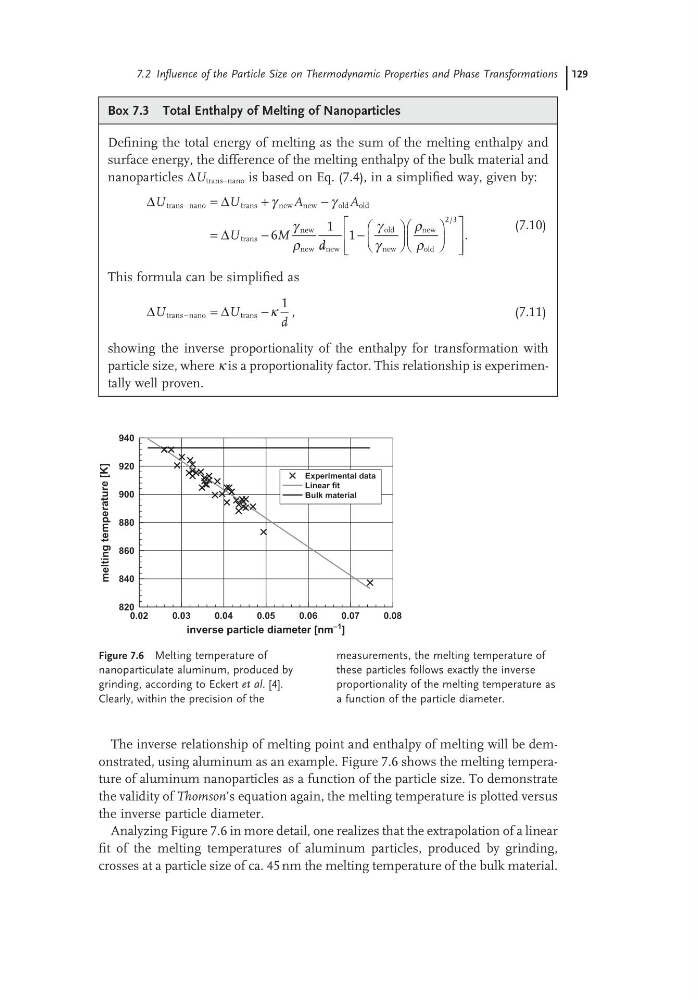
Figure 7.6 Melting temperature of
nanoparticulate aluminum, produced by
grinding, according to Eckert et al. [4].
Clearly, within the precision of the
measurements, the melting temperature of
these particles follows exactly the inverse
proportionality of the melting temperature as
a function of the particle diameter.
0.02
0.03
0.04
0.05
0.06
0.07
0.08
inverse particle diameter [nm
–1
]
820
840
860
880
900
920
940
melting
temperature
[K]
Experimental data
Linear fit
Bulk material
The inverse relationship of melting point and enthalpy of melting will be demonstrated, using aluminum as an example. Figure 7.6 shows the melting temperature of aluminum nanoparticles as a function of the particle size. To demonstrate
the validity of Thomson’s equation again, the melting temperature is plotted versus
the inverse particle diameter.
Analyzing Figure 7.6 in more detail, one realizes that the extrapolation of a linear
fit of the melting temperatures of aluminum particles, produced by grinding,
crosses at a particle size of ca. 45 nm the melting temperature of the bulk material.
Box 7.3 Total Enthalpy of Melting of Nanoparticles
Defining the total energy of melting as the sum of the melting enthalpy and
surface energy, the difference of the melting enthalpy of the bulk material and
nanoparticles ΔU trans−nano is based on Eq. (7.4), in a simplified way, given by:
∆
∆
∆
U
U
A
A
U
M
trans nano
trans
new new
old old
trans
new
new
−
=
+
−
=
−
γ
γ
γ
ρ
6
1
d d new
old
new
new
old
1
2 3
−
γ
γ
ρ
ρ
/
.
(7.10)
This formula can be simplified as
∆
∆
U
U
d
trans nano
trans
−
=
−κ
1 ,
(7.11)
showing the inverse proportionality of the enthalpy for transformation with
particle size, where κ is a proportionality factor. This relationship is experimentally well proven.
Figure 7.6 Melting temperature of
nanoparticulate aluminum, produced by
grinding, according to Eckert et al. [4].
Clearly, within the precision of the
measurements, the melting temperature of
these particles follows exactly the inverse
proportionality of the melting temperature as
a function of the particle diameter.
0.02
0.03
0.04
0.05
0.06
0.07
0.08
inverse particle diameter [nm
–1
]
820
840
860
880
900
920
940
melting
temperature
[K]
Experimental data
Linear fit
Bulk material
The inverse relationship of melting point and enthalpy of melting will be demonstrated, using aluminum as an example. Figure 7.6 shows the melting temperature of aluminum nanoparticles as a function of the particle size. To demonstrate
the validity of Thomson’s equation again, the melting temperature is plotted versus
the inverse particle diameter.
Analyzing Figure 7.6 in more detail, one realizes that the extrapolation of a linear
fit of the melting temperatures of aluminum particles, produced by grinding,
crosses at a particle size of ca. 45 nm the melting temperature of the bulk material.