

128 7 Thermodynamics of Nanoparticles and Phase Transformations
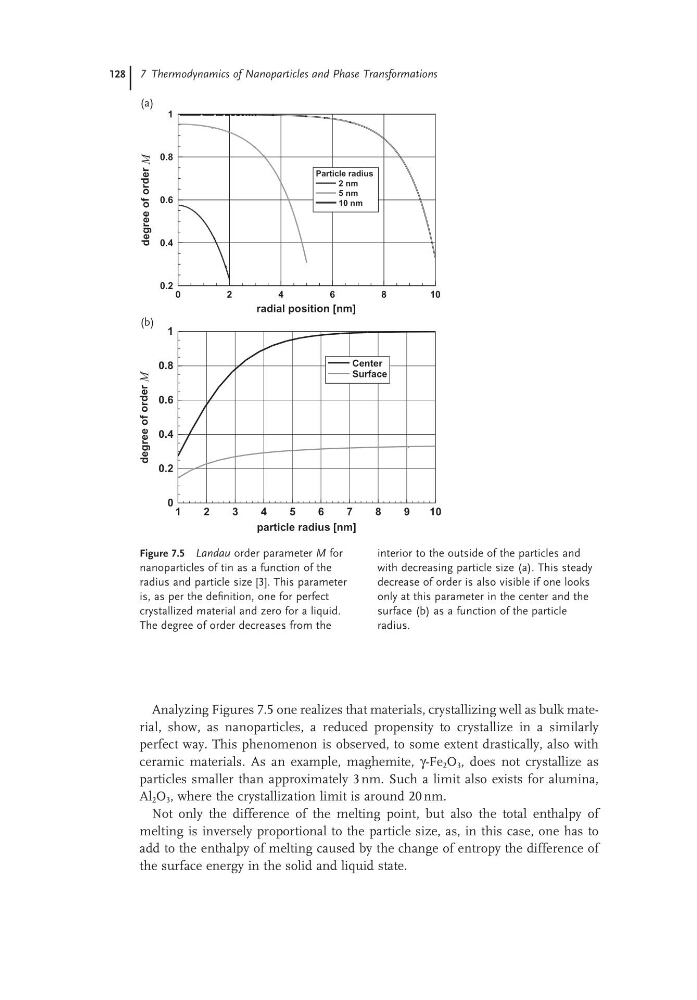
Analyzing Figures 7.5 one realizes that materials, crystallizing well as bulk material, show, as nanoparticles, a reduced propensity to crystallize in a similarly
perfect way. This phenomenon is observed, to some extent drastically, also with
ceramic materials. As an example, maghemite, γ-Fe 2 O 3 , does not crystallize as
particles smaller than approximately 3 nm. Such a limit also exists for alumina,
Al 2 O 3 , where the crystallization limit is around 20 nm.
Not only the difference of the melting point, but also the total enthalpy of
melting is inversely proportional to the particle size, as, in this case, one has to
add to the enthalpy of melting caused by the change of entropy the difference of
the surface energy in the solid and liquid state.
Figure 7.5 Landau order parameter M for
nanoparticles of tin as a function of the
radius and particle size [3]. This parameter
is, as per the definition, one for perfect
crystallized material and zero for a liquid.
The degree of order decreases from the
interior to the outside of the particles and
with decreasing particle size (a). This steady
decrease of order is also visible if one looks
only at this parameter in the center and the
surface (b) as a function of the particle
radius.
0
2
4
6
8
10
radial position [nm]
0.2
0.4
0.6
0.8
1
degree
of
order M
Particle radius
2 nm
5 nm
10 nm
1
2
3
4
5
6
7
8
9
10
particle radius [nm]
0
0.2
0.4
0.6
0.8
1
degree
of
order M
Center
Surface
(a)
(b)
Analyzing Figures 7.5 one realizes that materials, crystallizing well as bulk material, show, as nanoparticles, a reduced propensity to crystallize in a similarly
perfect way. This phenomenon is observed, to some extent drastically, also with
ceramic materials. As an example, maghemite, γ-Fe 2 O 3 , does not crystallize as
particles smaller than approximately 3 nm. Such a limit also exists for alumina,
Al 2 O 3 , where the crystallization limit is around 20 nm.
Not only the difference of the melting point, but also the total enthalpy of
melting is inversely proportional to the particle size, as, in this case, one has to
add to the enthalpy of melting caused by the change of entropy the difference of
the surface energy in the solid and liquid state.
Figure 7.5 Landau order parameter M for
nanoparticles of tin as a function of the
radius and particle size [3]. This parameter
is, as per the definition, one for perfect
crystallized material and zero for a liquid.
The degree of order decreases from the
interior to the outside of the particles and
with decreasing particle size (a). This steady
decrease of order is also visible if one looks
only at this parameter in the center and the
surface (b) as a function of the particle
radius.
0
2
4
6
8
10
radial position [nm]
0.2
0.4
0.6
0.8
1
degree
of
order M
Particle radius
2 nm
5 nm
10 nm
1
2
3
4
5
6
7
8
9
10
particle radius [nm]
0
0.2
0.4
0.6
0.8
1
degree
of
order M
Center
Surface
(a)
(b)