

7.2 Influence of the Particle Size on Thermodynamic Properties and Phase Transformations 131
phase is the most important one. This phase can be stabilized down to room
temperature by adding a few weight percent yttria, Y 2 O 3 , or magnesia, MgO. Small
grain sizes reduce the transformation temperature to the monoclinic phase. With
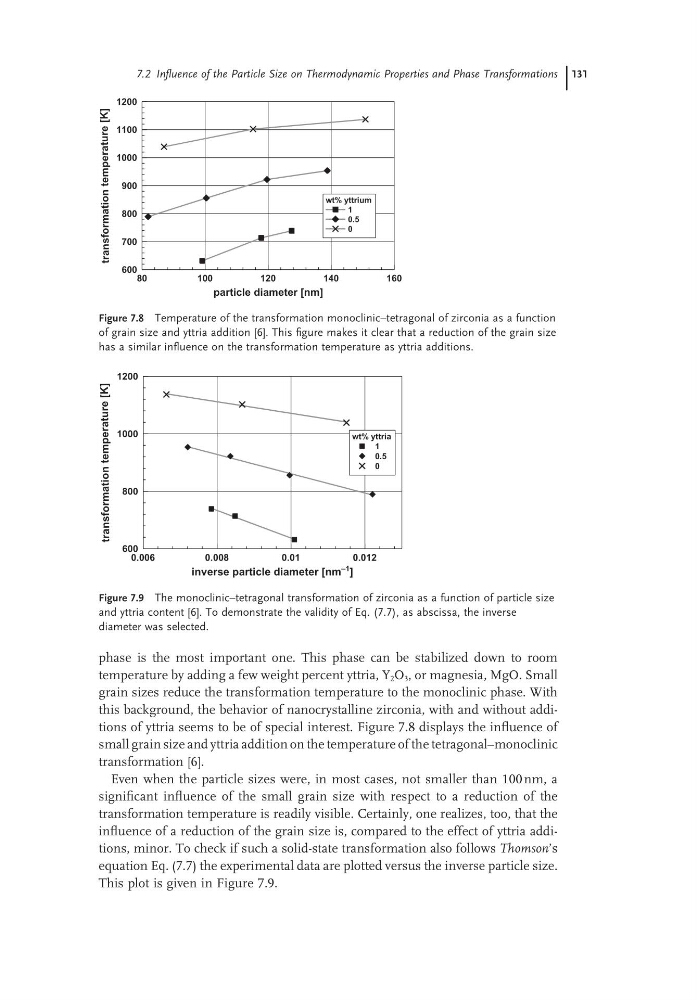
this background, the behavior of nanocrystalline zirconia, with and without additions of yttria seems to be of special interest. Figure 7.8 displays the influence of
small grain size and yttria addition on the temperature of the tetragonal–monoclinic
transformation [6].
Even when the particle sizes were, in most cases, not smaller than 100 nm, a
significant influence of the small grain size with respect to a reduction of the
transformation temperature is readily visible. Certainly, one realizes, too, that the
influence of a reduction of the grain size is, compared to the effect of yttria additions, minor. To check if such a solid-state transformation also follows Thomson’s
equation Eq. (7.7) the experimental data are plotted versus the inverse particle size.
This plot is given in Figure 7.9.
Figure 7.8 Temperature of the transformation monoclinic–tetragonal of zirconia as a function
of grain size and yttria addition [6]. This figure makes it clear that a reduction of the grain size
has a similar influence on the transformation temperature as yttria additions.
80
100
120
140
160
particle diameter [nm]
600
700
800
900
1000
1100
1200
transformation
temperature
[K]
wt% yttrium
1
0.5
0
Figure 7.9 The monoclinic–tetragonal transformation of zirconia as a function of particle size
and yttria content [6]. To demonstrate the validity of Eq. (7.7), as abscissa, the inverse
diameter was selected.
0.006
0.008
0.01
0.012
inverse particle diameter [nm
–1 ]
600
800
1000
1200
transformation
temperature
[K]
wt% yttria
1
0.5
0
phase is the most important one. This phase can be stabilized down to room
temperature by adding a few weight percent yttria, Y 2 O 3 , or magnesia, MgO. Small
grain sizes reduce the transformation temperature to the monoclinic phase. With
this background, the behavior of nanocrystalline zirconia, with and without additions of yttria seems to be of special interest. Figure 7.8 displays the influence of
small grain size and yttria addition on the temperature of the tetragonal–monoclinic
transformation [6].
Even when the particle sizes were, in most cases, not smaller than 100 nm, a
significant influence of the small grain size with respect to a reduction of the
transformation temperature is readily visible. Certainly, one realizes, too, that the
influence of a reduction of the grain size is, compared to the effect of yttria additions, minor. To check if such a solid-state transformation also follows Thomson’s
equation Eq. (7.7) the experimental data are plotted versus the inverse particle size.
This plot is given in Figure 7.9.
Figure 7.8 Temperature of the transformation monoclinic–tetragonal of zirconia as a function
of grain size and yttria addition [6]. This figure makes it clear that a reduction of the grain size
has a similar influence on the transformation temperature as yttria additions.
80
100
120
140
160
particle diameter [nm]
600
700
800
900
1000
1100
1200
transformation
temperature
[K]
wt% yttrium
1
0.5
0
Figure 7.9 The monoclinic–tetragonal transformation of zirconia as a function of particle size
and yttria content [6]. To demonstrate the validity of Eq. (7.7), as abscissa, the inverse
diameter was selected.
0.006
0.008
0.01
0.012
inverse particle diameter [nm
–1 ]
600
800
1000
1200
transformation
temperature
[K]
wt% yttria
1
0.5
0