

7.2 Influence of the Particle Size on Thermodynamic Properties and Phase Transformations 123
The question on the influence of the particle size on the melting temperature
is quite old. The first answers, based on strict application of equilibrium thermodynamics, were given at the end of the nineteenth century. More generally, to
calculate the influence of the particle size on phase transformations, one has to
look at the equilibrium between the parent phase, called “old” and the other phase,
called “new”. At equilibrium, the relation
G
G
old
new
=
(7.3)
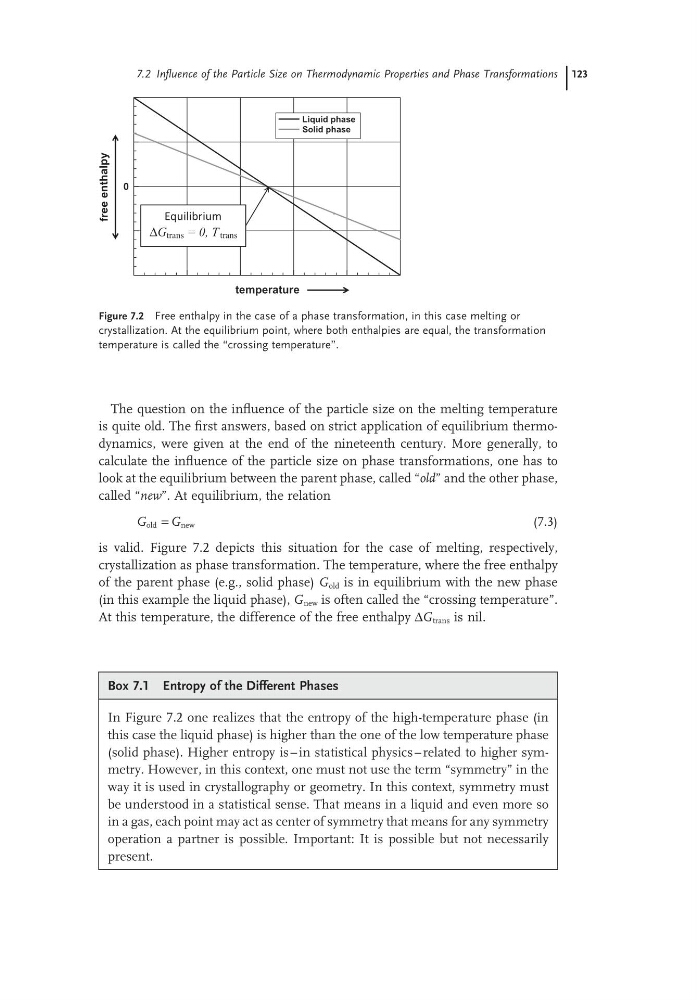
is valid. Figure 7.2 depicts this situation for the case of melting, respectively,
crystallization as phase transformation. The temperature, where the free enthalpy
of the parent phase (e.g., solid phase) G old is in equilibrium with the new phase
(in this example the liquid phase), G new is often called the “crossing temperature”.
At this temperature, the difference of the free enthalpy ΔG trans is nil.
Figure 7.2 Free enthalpy in the case of a phase transformation, in this case melting or
crystallization. At the equilibrium point, where both enthalpies are equal, the transformation
temperature is called the “crossing temperature”.
0
0.2
0.4
0.6
0.8
1
temperature
-1
-0.5
0
0.5
1
free
enthalpy
Liquid phase
Solid phase
Equilibrium
∆G trans = 0, T trans
Box 7.1 Entropy of the Different Phases
In Figure 7.2 one realizes that the entropy of the high-temperature phase (in
this case the liquid phase) is higher than the one of the low temperature phase
(solid phase). Higher entropy is – in statistical physics – related to higher symmetry. However, in this context, one must not use the term “symmetry” in the
way it is used in crystallography or geometry. In this context, symmetry must
be understood in a statistical sense. That means in a liquid and even more so
in a gas, each point may act as center of symmetry that means for any symmetry
operation a partner is possible. Important: It is possible but not necessarily
present.
The question on the influence of the particle size on the melting temperature
is quite old. The first answers, based on strict application of equilibrium thermodynamics, were given at the end of the nineteenth century. More generally, to
calculate the influence of the particle size on phase transformations, one has to
look at the equilibrium between the parent phase, called “old” and the other phase,
called “new”. At equilibrium, the relation
G
G
old
new
=
(7.3)
is valid. Figure 7.2 depicts this situation for the case of melting, respectively,
crystallization as phase transformation. The temperature, where the free enthalpy
of the parent phase (e.g., solid phase) G old is in equilibrium with the new phase
(in this example the liquid phase), G new is often called the “crossing temperature”.
At this temperature, the difference of the free enthalpy ΔG trans is nil.
Figure 7.2 Free enthalpy in the case of a phase transformation, in this case melting or
crystallization. At the equilibrium point, where both enthalpies are equal, the transformation
temperature is called the “crossing temperature”.
0
0.2
0.4
0.6
0.8
1
temperature
-1
-0.5
0
0.5
1
free
enthalpy
Liquid phase
Solid phase
Equilibrium
∆G trans = 0, T trans
Box 7.1 Entropy of the Different Phases
In Figure 7.2 one realizes that the entropy of the high-temperature phase (in
this case the liquid phase) is higher than the one of the low temperature phase
(solid phase). Higher entropy is – in statistical physics – related to higher symmetry. However, in this context, one must not use the term “symmetry” in the
way it is used in crystallography or geometry. In this context, symmetry must
be understood in a statistical sense. That means in a liquid and even more so
in a gas, each point may act as center of symmetry that means for any symmetry
operation a partner is possible. Important: It is possible but not necessarily
present.