

122 7 Thermodynamics of Nanoparticles and Phase Transformations
quantified; therefore, in most cases, this quantity is assumed to be independent
of the particle size. To a first rough approximation, the molar quantities U and S
may also be assumed to be particle-size independent. This allows us to rewrite
Eqs. (7.1a) and (7.1b) as functions of the particle diameter d, using u
U
N
U
d
M
= =
ρπ
3
6
,
s
S
N
S
d
M
= =
ρπ
3
6
, a
A
N
A
d
M
= =
ρπ
3
6
, and a = πd
2 ,
g U
d
M
TS
d
M
d
=
−
+
ρπ
ρπ
γ π
3
3
2
6
6
,
(7.2a)
G U TS
M
v
a U TS
M
d
= − +
= − +
γ ρ
γ ρ
6 .
(7.2b)
In these equations, N stands for the number of particles per mol, M for the
molecular weight and ρ for the density of the material. For thermodynamic considerations, most important are the molar quantities as they are given in Eq. (7.2b).
To analyze phase transformations; the surface energy of the different phases, for
example, solid or liquid must be taken into account. The same is valid for the
volume change connected to phase transformations. Looking at Eq. (7.2b), one
realizes that the free enthalpy increases with decreasing particle diameter. As an
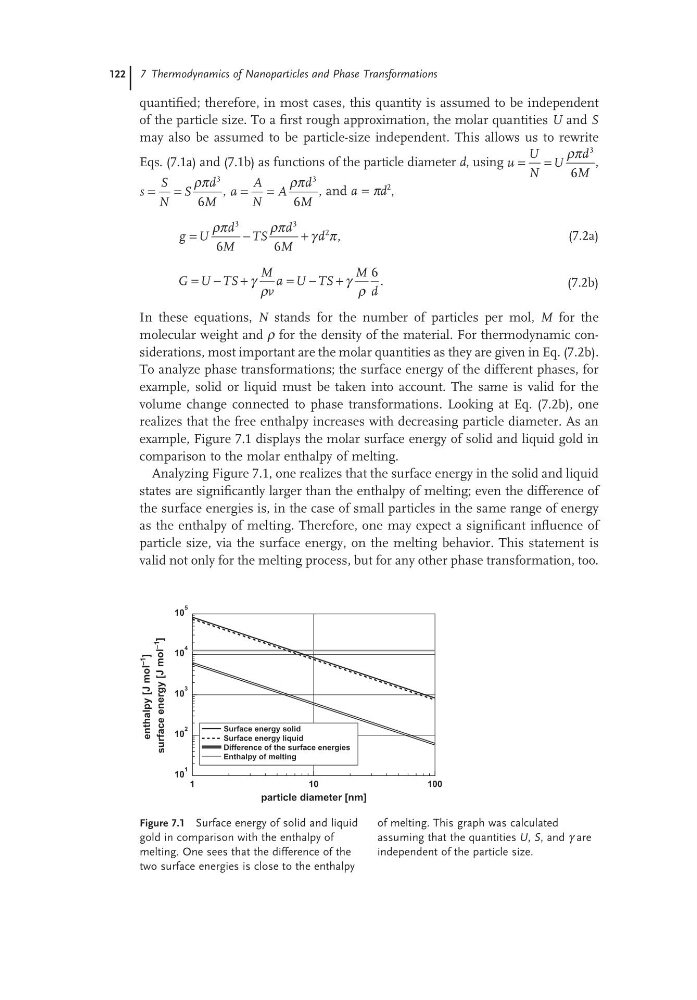
example, Figure 7.1 displays the molar surface energy of solid and liquid gold in
comparison to the molar enthalpy of melting.
Analyzing Figure 7.1, one realizes that the surface energy in the solid and liquid
states are significantly larger than the enthalpy of melting; even the difference of
the surface energies is, in the case of small particles in the same range of energy
as the enthalpy of melting. Therefore, one may expect a significant influence of
particle size, via the surface energy, on the melting behavior. This statement is
valid not only for the melting process, but for any other phase transformation, too.
Figure 7.1 Surface energy of solid and liquid
gold in comparison with the enthalpy of
melting. One sees that the difference of the
two surface energies is close to the enthalpy
of melting. This graph was calculated
assuming that the quantities U, S, and γ are
independent of the particle size.
1
10
100
particle diameter [nm]
10
1
10
2
10
3
10
4
10
5
enthalpy
[J
mol
–1
]
surface
energy
[J
mol
–1
]
Surface energy solid
Surface energy liquid
Difference of the surface energies
Enthalpy of melting
quantified; therefore, in most cases, this quantity is assumed to be independent
of the particle size. To a first rough approximation, the molar quantities U and S
may also be assumed to be particle-size independent. This allows us to rewrite
Eqs. (7.1a) and (7.1b) as functions of the particle diameter d, using u
U
N
U
d
M
= =
ρπ
3
6
,
s
S
N
S
d
M
= =
ρπ
3
6
, a
A
N
A
d
M
= =
ρπ
3
6
, and a = πd
2 ,
g U
d
M
TS
d
M
d
=
−
+
ρπ
ρπ
γ π
3
3
2
6
6
,
(7.2a)
G U TS
M
v
a U TS
M
d
= − +
= − +
γ ρ
γ ρ
6 .
(7.2b)
In these equations, N stands for the number of particles per mol, M for the
molecular weight and ρ for the density of the material. For thermodynamic considerations, most important are the molar quantities as they are given in Eq. (7.2b).
To analyze phase transformations; the surface energy of the different phases, for
example, solid or liquid must be taken into account. The same is valid for the
volume change connected to phase transformations. Looking at Eq. (7.2b), one
realizes that the free enthalpy increases with decreasing particle diameter. As an
example, Figure 7.1 displays the molar surface energy of solid and liquid gold in
comparison to the molar enthalpy of melting.
Analyzing Figure 7.1, one realizes that the surface energy in the solid and liquid
states are significantly larger than the enthalpy of melting; even the difference of
the surface energies is, in the case of small particles in the same range of energy
as the enthalpy of melting. Therefore, one may expect a significant influence of
particle size, via the surface energy, on the melting behavior. This statement is
valid not only for the melting process, but for any other phase transformation, too.
Figure 7.1 Surface energy of solid and liquid
gold in comparison with the enthalpy of
melting. One sees that the difference of the
two surface energies is close to the enthalpy
of melting. This graph was calculated
assuming that the quantities U, S, and γ are
independent of the particle size.
1
10
100
particle diameter [nm]
10
1
10
2
10
3
10
4
10
5
enthalpy
[J
mol
–1
]
surface
energy
[J
mol
–1
]
Surface energy solid
Surface energy liquid
Difference of the surface energies
Enthalpy of melting