

124 7 Thermodynamics of Nanoparticles and Phase Transformations
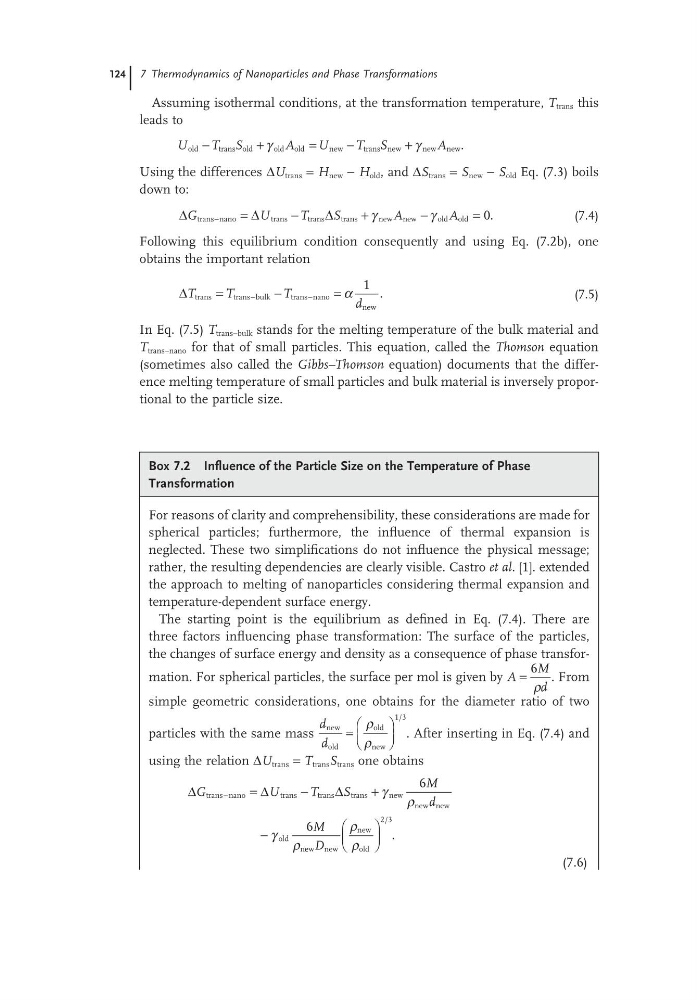
Assuming isothermal conditions, at the transformation temperature, T trans this
leads to
U
T S
A
U
T S
A
old
trans old
old old
new
trans new
new new
−
+
=
−
+
γ
γ
.
Using the differences ΔU trans = H new − H old , and ΔS trans = S new − S old Eq. (7.3) boils
down to:
∆
∆
∆
G
U
T
S
A
A
trans nano
trans
trans
trans
new new
old old
−
=
−
+
−
=
γ
γ
0.
(7.4)
Following this equilibrium condition consequently and using Eq. (7.2b), one
obtains the important relation
∆T
T
T
d
trans
trans bulk
trans nano
new
=
−
=
−
−
α
1 .
(7.5)
In Eq. (7.5) T trans−bulk stands for the melting temperature of the bulk material and
T trans−nano for that of small particles. This equation, called the Thomson equation
(sometimes also called the Gibbs–Thomson equation) documents that the difference melting temperature of small particles and bulk material is inversely proportional to the particle size.
Box 7.2 Influence of the Particle Size on the Temperature of Phase
Transformation
For reasons of clarity and comprehensibility, these considerations are made for
spherical particles; furthermore, the influence of thermal expansion is
neglected. These two simplifications do not influence the physical message;
rather, the resulting dependencies are clearly visible. Castro et al. [1]. extended
the approach to melting of nanoparticles considering thermal expansion and
temperature-dependent surface energy.
The starting point is the equilibrium as defined in Eq. (7.4). There are
three factors influencing phase transformation: The surface of the particles,
the changes of surface energy and density as a consequence of phase transformation. For spherical particles, the surface per mol is given by A
M
d
=
6
ρ
. From
simple geometric considerations, one obtains for the diameter ratio of two
particles with the same mass
d
d
new
old
old
new
=
ρ
ρ
1 3
/
. After inserting in Eq. (7.4) and
using the relation ΔU trans = T trans S trans one obtains
∆
∆
∆
G
U
T
S
M
d
M
trans nano
trans
trans
trans
new
new new
old
n
−
=
−
+
−
γ ρ
γ ρ
6
6
e ew new
new
old
D
ρ
ρ
2 3
/
.
(7.6)
Assuming isothermal conditions, at the transformation temperature, T trans this
leads to
U
T S
A
U
T S
A
old
trans old
old old
new
trans new
new new
−
+
=
−
+
γ
γ
.
Using the differences ΔU trans = H new − H old , and ΔS trans = S new − S old Eq. (7.3) boils
down to:
∆
∆
∆
G
U
T
S
A
A
trans nano
trans
trans
trans
new new
old old
−
=
−
+
−
=
γ
γ
0.
(7.4)
Following this equilibrium condition consequently and using Eq. (7.2b), one
obtains the important relation
∆T
T
T
d
trans
trans bulk
trans nano
new
=
−
=
−
−
α
1 .
(7.5)
In Eq. (7.5) T trans−bulk stands for the melting temperature of the bulk material and
T trans−nano for that of small particles. This equation, called the Thomson equation
(sometimes also called the Gibbs–Thomson equation) documents that the difference melting temperature of small particles and bulk material is inversely proportional to the particle size.
Box 7.2 Influence of the Particle Size on the Temperature of Phase
Transformation
For reasons of clarity and comprehensibility, these considerations are made for
spherical particles; furthermore, the influence of thermal expansion is
neglected. These two simplifications do not influence the physical message;
rather, the resulting dependencies are clearly visible. Castro et al. [1]. extended
the approach to melting of nanoparticles considering thermal expansion and
temperature-dependent surface energy.
The starting point is the equilibrium as defined in Eq. (7.4). There are
three factors influencing phase transformation: The surface of the particles,
the changes of surface energy and density as a consequence of phase transformation. For spherical particles, the surface per mol is given by A
M
d
=
6
ρ
. From
simple geometric considerations, one obtains for the diameter ratio of two
particles with the same mass
d
d
new
old
old
new
=
ρ
ρ
1 3
/
. After inserting in Eq. (7.4) and
using the relation ΔU trans = T trans S trans one obtains
∆
∆
∆
G
U
T
S
M
d
M
trans nano
trans
trans
trans
new
new new
old
n
−
=
−
+
−
γ ρ
γ ρ
6
6
e ew new
new
old
D
ρ
ρ
2 3
/
.
(7.6)