

6.3 Ferrofluids 117
6.3.2
Applications of Ferrofluids
For applications, the possibility to adjust viscosity with an external magnetic field
is most important. This property allows adjustment of shock absorbers of cars or
of high-performance CD or DVD players within milliseconds to changing external
conditions. In particular, for precision instrumentation, systems using ferrofluids
may replace piezoelectric devices. Lastly, the application of ferrofluids allows controlling powers in the kilowatt range with a few Watt. Furthermore, ferrofluids are
applied to transfer magnetic fields or to close magnetic circuits in a simple way
without complicated shaped parts. A further broad range of technical applications
is found in the visualization of magnetic structures, which are essential in quality
control of magnetic devices and, most importantly, for searching small defects in
cast parts and weldings. For these applications, quite often one applies external
magnetic fields to enhance the contrast. In addition, the application of bifunctional
magnetic particles, exhibiting luminescence besides ferromagnetism, is often of
advantage. The last point in this listing are medical applications, for example, to
increase the contrast in nuclear spin tomography by locally influencing the magnetic field.
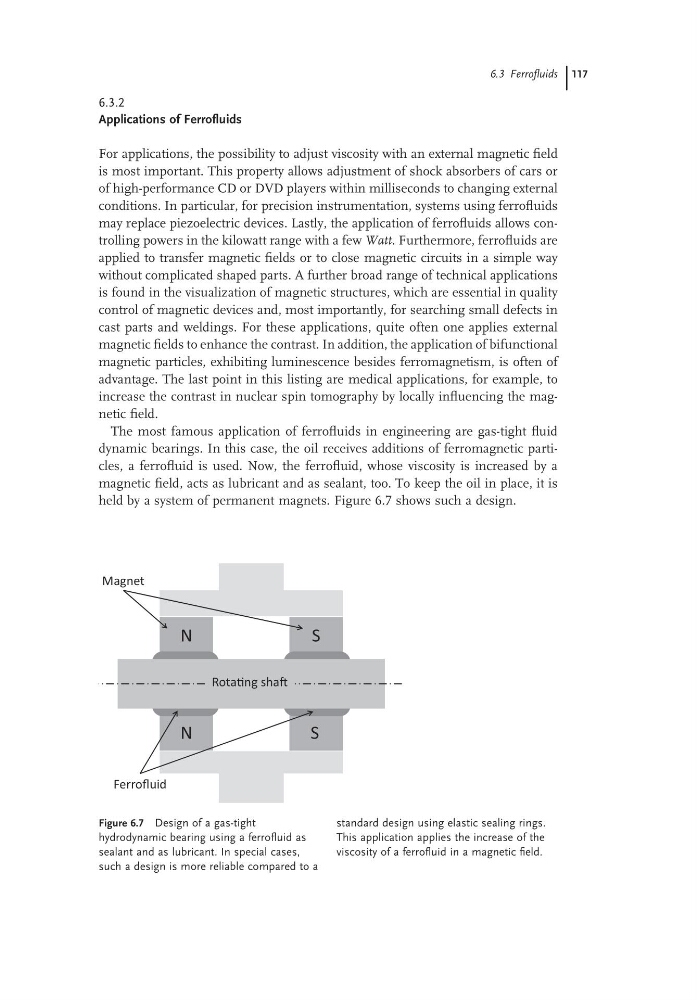
The most famous application of ferrofluids in engineering are gas-tight fluid
dynamic bearings. In this case, the oil receives additions of ferromagnetic particles, a ferrofluid is used. Now, the ferrofluid, whose viscosity is increased by a
magnetic field, acts as lubricant and as sealant, too. To keep the oil in place, it is
held by a system of permanent magnets. Figure 6.7 shows such a design.
Figure 6.7 Design of a gas-tight
hydrodynamic bearing using a ferrofluid as
sealant and as lubricant. In special cases,
such a design is more reliable compared to a
standard design using elastic sealing rings.
This application applies the increase of the
viscosity of a ferrofluid in a magnetic field.
Magnet
Ferrofluid
RotaƟng shaŌ
S
S
N
N
RotaƟng shaŌ
6.3.2
Applications of Ferrofluids
For applications, the possibility to adjust viscosity with an external magnetic field
is most important. This property allows adjustment of shock absorbers of cars or
of high-performance CD or DVD players within milliseconds to changing external
conditions. In particular, for precision instrumentation, systems using ferrofluids
may replace piezoelectric devices. Lastly, the application of ferrofluids allows controlling powers in the kilowatt range with a few Watt. Furthermore, ferrofluids are
applied to transfer magnetic fields or to close magnetic circuits in a simple way
without complicated shaped parts. A further broad range of technical applications
is found in the visualization of magnetic structures, which are essential in quality
control of magnetic devices and, most importantly, for searching small defects in
cast parts and weldings. For these applications, quite often one applies external
magnetic fields to enhance the contrast. In addition, the application of bifunctional
magnetic particles, exhibiting luminescence besides ferromagnetism, is often of
advantage. The last point in this listing are medical applications, for example, to
increase the contrast in nuclear spin tomography by locally influencing the magnetic field.
The most famous application of ferrofluids in engineering are gas-tight fluid
dynamic bearings. In this case, the oil receives additions of ferromagnetic particles, a ferrofluid is used. Now, the ferrofluid, whose viscosity is increased by a
magnetic field, acts as lubricant and as sealant, too. To keep the oil in place, it is
held by a system of permanent magnets. Figure 6.7 shows such a design.
Figure 6.7 Design of a gas-tight
hydrodynamic bearing using a ferrofluid as
sealant and as lubricant. In special cases,
such a design is more reliable compared to a
standard design using elastic sealing rings.
This application applies the increase of the
viscosity of a ferrofluid in a magnetic field.
Magnet
Ferrofluid
RotaƟng shaŌ
S
S
N
N
RotaƟng shaŌ