

118 6 Nanofluids
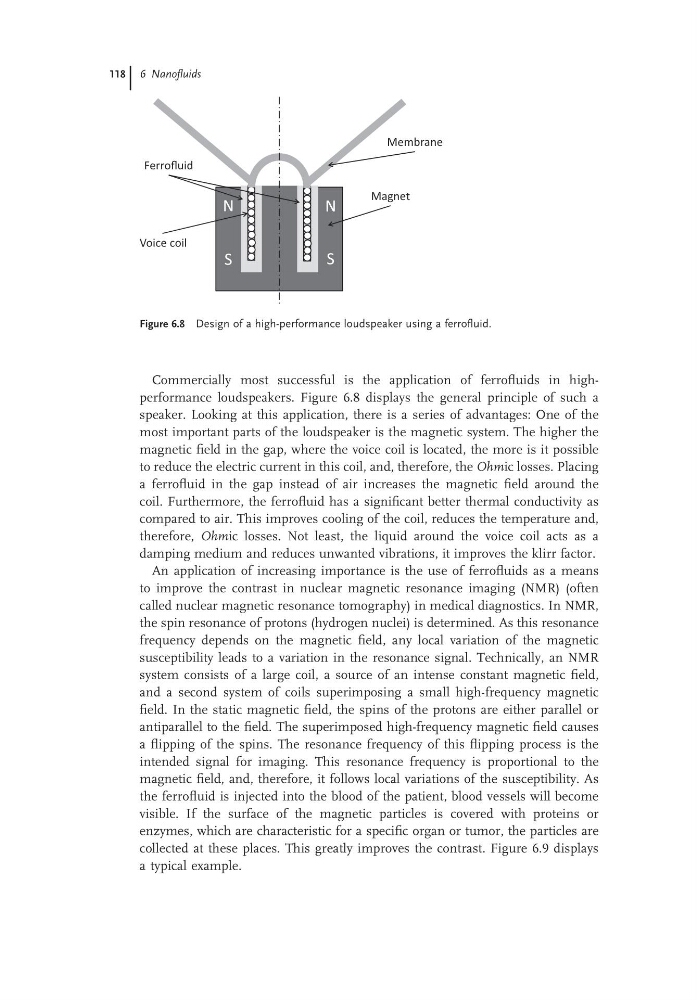
Commercially most successful is the application of ferrofluids in highperformance loudspeakers. Figure 6.8 displays the general principle of such a
speaker. Looking at this application, there is a series of advantages: One of the
most important parts of the loudspeaker is the magnetic system. The higher the
magnetic field in the gap, where the voice coil is located, the more is it possible
to reduce the electric current in this coil, and, therefore, the Ohmic losses. Placing
a ferrofluid in the gap instead of air increases the magnetic field around the
coil. Furthermore, the ferrofluid has a significant better thermal conductivity as
compared to air. This improves cooling of the coil, reduces the temperature and,
therefore, Ohmic losses. Not least, the liquid around the voice coil acts as a
damping medium and reduces unwanted vibrations, it improves the klirr factor.
An application of increasing importance is the use of ferrofluids as a means
to improve the contrast in nuclear magnetic resonance imaging (NMR) (often
called nuclear magnetic resonance tomography) in medical diagnostics. In NMR,
the spin resonance of protons (hydrogen nuclei) is determined. As this resonance
frequency depends on the magnetic field, any local variation of the magnetic
susceptibility leads to a variation in the resonance signal. Technically, an NMR
system consists of a large coil, a source of an intense constant magnetic field,
and a second system of coils superimposing a small high-frequency magnetic
field. In the static magnetic field, the spins of the protons are either parallel or
antiparallel to the field. The superimposed high-frequency magnetic field causes
a flipping of the spins. The resonance frequency of this flipping process is the
intended signal for imaging. This resonance frequency is proportional to the
magnetic field, and, therefore, it follows local variations of the susceptibility. As
the ferrofluid is injected into the blood of the patient, blood vessels will become
visible. If the surface of the magnetic particles is covered with proteins or
enzymes, which are characteristic for a specific organ or tumor, the particles are
collected at these places. This greatly improves the contrast. Figure 6.9 displays
a typical example.
Figure 6.8 Design of a high-performance loudspeaker using a ferrofluid.
Membrane
Magnet
Ferrofluid
Voice coil
N
N
S
S
Commercially most successful is the application of ferrofluids in highperformance loudspeakers. Figure 6.8 displays the general principle of such a
speaker. Looking at this application, there is a series of advantages: One of the
most important parts of the loudspeaker is the magnetic system. The higher the
magnetic field in the gap, where the voice coil is located, the more is it possible
to reduce the electric current in this coil, and, therefore, the Ohmic losses. Placing
a ferrofluid in the gap instead of air increases the magnetic field around the
coil. Furthermore, the ferrofluid has a significant better thermal conductivity as
compared to air. This improves cooling of the coil, reduces the temperature and,
therefore, Ohmic losses. Not least, the liquid around the voice coil acts as a
damping medium and reduces unwanted vibrations, it improves the klirr factor.
An application of increasing importance is the use of ferrofluids as a means
to improve the contrast in nuclear magnetic resonance imaging (NMR) (often
called nuclear magnetic resonance tomography) in medical diagnostics. In NMR,
the spin resonance of protons (hydrogen nuclei) is determined. As this resonance
frequency depends on the magnetic field, any local variation of the magnetic
susceptibility leads to a variation in the resonance signal. Technically, an NMR
system consists of a large coil, a source of an intense constant magnetic field,
and a second system of coils superimposing a small high-frequency magnetic
field. In the static magnetic field, the spins of the protons are either parallel or
antiparallel to the field. The superimposed high-frequency magnetic field causes
a flipping of the spins. The resonance frequency of this flipping process is the
intended signal for imaging. This resonance frequency is proportional to the
magnetic field, and, therefore, it follows local variations of the susceptibility. As
the ferrofluid is injected into the blood of the patient, blood vessels will become
visible. If the surface of the magnetic particles is covered with proteins or
enzymes, which are characteristic for a specific organ or tumor, the particles are
collected at these places. This greatly improves the contrast. Figure 6.9 displays
a typical example.
Figure 6.8 Design of a high-performance loudspeaker using a ferrofluid.
Membrane
Magnet
Ferrofluid
Voice coil
N
N
S
S