

116 6 Nanofluids
Box 6.1 Viscosity of a Ferrofluid in an Alternating Magnetic Field
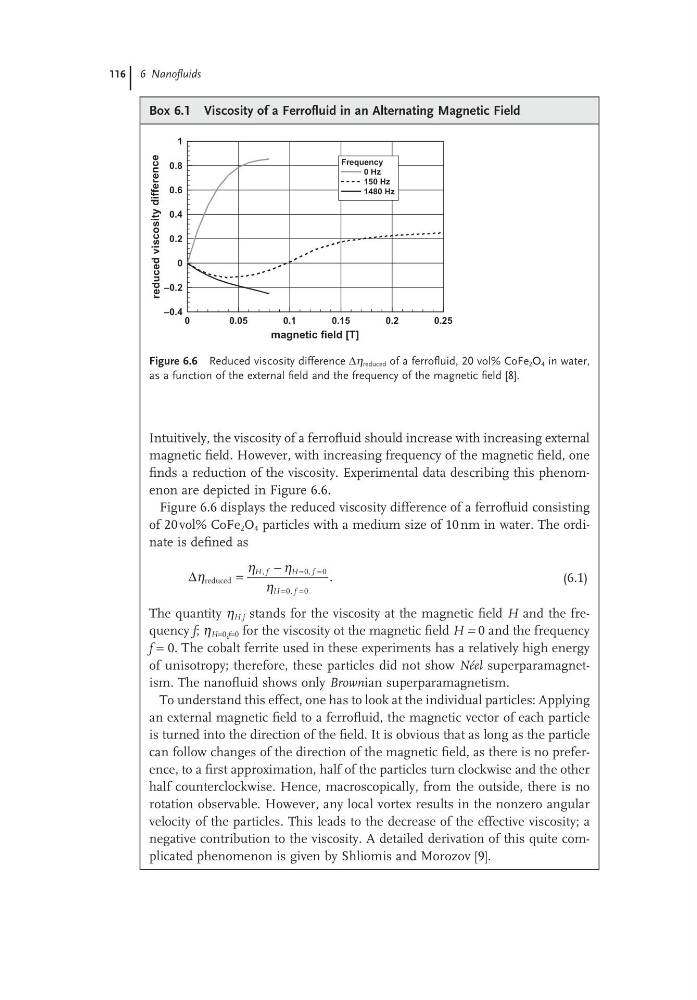
Figure 6.6 Reduced viscosity difference Δη reduced of a ferrofluid, 20 vol% CoFe 2 O 4 in water,
as a function of the external field and the frequency of the magnetic field [8].
0
0.05
0.1
0.15
0.2
0.25
magnetic field [T]
–0.4
–0.2
0
0.2
0.4
0.6
0.8
1
reduced
viscosity
difference
Frequency
0 Hz
150 Hz
1480 Hz
Intuitively, the viscosity of a ferrofluid should increase with increasing external
magnetic field. However, with increasing frequency of the magnetic field, one
finds a reduction of the viscosity. Experimental data describing this phenomenon are depicted in Figure 6.6.
Figure 6.6 displays the reduced viscosity difference of a ferrofluid consisting
of 20 vol% CoFe 2 O 4 particles with a medium size of 10 nm in water. The ordinate is defined as
∆η
η
η
η
reduced =
− = =
=
=
H f
H
f
H
f
,
,
,
.
0
0
0
0
(6.1)
The quantity η H,f stands for the viscosity at the magnetic field H and the frequency f; η H=0,f=0 for the viscosity ot the magnetic field H = 0 and the frequency
f = 0. The cobalt ferrite used in these experiments has a relatively high energy
of unisotropy; therefore, these particles did not show Néel superparamagnetism. The nanofluid shows only Brownian superparamagnetism.
To understand this effect, one has to look at the individual particles: Applying
an external magnetic field to a ferrofluid, the magnetic vector of each particle
is turned into the direction of the field. It is obvious that as long as the particle
can follow changes of the direction of the magnetic field, as there is no preference, to a first approximation, half of the particles turn clockwise and the other
half counterclockwise. Hence, macroscopically, from the outside, there is no
rotation observable. However, any local vortex results in the nonzero angular
velocity of the particles. This leads to the decrease of the effective viscosity; a
negative contribution to the viscosity. A detailed derivation of this quite complicated phenomenon is given by Shliomis and Morozov [9].
Box 6.1 Viscosity of a Ferrofluid in an Alternating Magnetic Field
Figure 6.6 Reduced viscosity difference Δη reduced of a ferrofluid, 20 vol% CoFe 2 O 4 in water,
as a function of the external field and the frequency of the magnetic field [8].
0
0.05
0.1
0.15
0.2
0.25
magnetic field [T]
–0.4
–0.2
0
0.2
0.4
0.6
0.8
1
reduced
viscosity
difference
Frequency
0 Hz
150 Hz
1480 Hz
Intuitively, the viscosity of a ferrofluid should increase with increasing external
magnetic field. However, with increasing frequency of the magnetic field, one
finds a reduction of the viscosity. Experimental data describing this phenomenon are depicted in Figure 6.6.
Figure 6.6 displays the reduced viscosity difference of a ferrofluid consisting
of 20 vol% CoFe 2 O 4 particles with a medium size of 10 nm in water. The ordinate is defined as
∆η
η
η
η
reduced =
− = =
=
=
H f
H
f
H
f
,
,
,
.
0
0
0
0
(6.1)
The quantity η H,f stands for the viscosity at the magnetic field H and the frequency f; η H=0,f=0 for the viscosity ot the magnetic field H = 0 and the frequency
f = 0. The cobalt ferrite used in these experiments has a relatively high energy
of unisotropy; therefore, these particles did not show Néel superparamagnetism. The nanofluid shows only Brownian superparamagnetism.
To understand this effect, one has to look at the individual particles: Applying
an external magnetic field to a ferrofluid, the magnetic vector of each particle
is turned into the direction of the field. It is obvious that as long as the particle
can follow changes of the direction of the magnetic field, as there is no preference, to a first approximation, half of the particles turn clockwise and the other
half counterclockwise. Hence, macroscopically, from the outside, there is no
rotation observable. However, any local vortex results in the nonzero angular
velocity of the particles. This leads to the decrease of the effective viscosity; a
negative contribution to the viscosity. A detailed derivation of this quite complicated phenomenon is given by Shliomis and Morozov [9].