

6.3 Ferrofluids 115
Looking at technical applications of ferrofluids, one has to analyze the properties
of these nanofluids. Most importantly, in this context, is the possibility to control
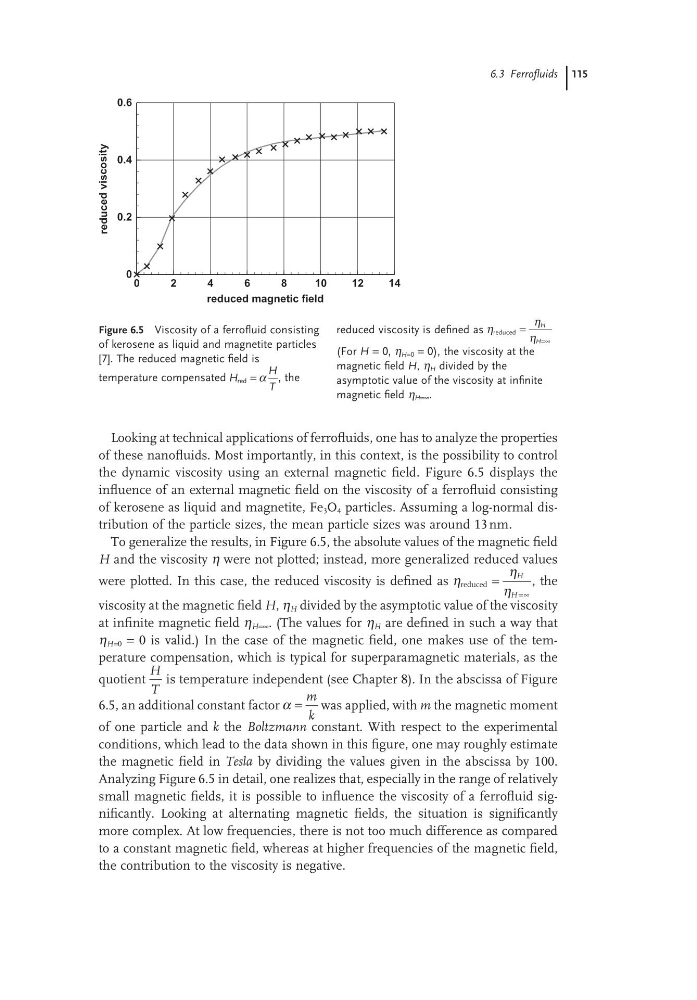
the dynamic viscosity using an external magnetic field. Figure 6.5 displays the
influence of an external magnetic field on the viscosity of a ferrofluid consisting
of kerosene as liquid and magnetite, Fe 3 O 4 particles. Assuming a log-normal distribution of the particle sizes, the mean particle sizes was around 13 nm.
To generalize the results, in Figure 6.5, the absolute values of the magnetic field
H and the viscosity η were not plotted; instead, more generalized reduced values
were plotted. In this case, the reduced viscosity is defined as η
η
η
reduced =
=∞
H
H
, the
viscosity at the magnetic field H, η H divided by the asymptotic value of the viscosity
at infinite magnetic field η H=∞ . (The values for η H are defined in such a way that
η H=0 = 0 is valid.) In the case of the magnetic field, one makes use of the temperature compensation, which is typical for superparamagnetic materials, as the
quotient
H
T
is temperature independent (see Chapter 8). In the abscissa of Figure
6.5, an additional constant factor α =
m
k
was applied, with m the magnetic moment
of one particle and k the Boltzmann constant. With respect to the experimental
conditions, which lead to the data shown in this figure, one may roughly estimate
the magnetic field in Tesla by dividing the values given in the abscissa by 100.
Analyzing Figure 6.5 in detail, one realizes that, especially in the range of relatively
small magnetic fields, it is possible to influence the viscosity of a ferrofluid significantly. Looking at alternating magnetic fields, the situation is significantly
more complex. At low frequencies, there is not too much difference as compared
to a constant magnetic field, whereas at higher frequencies of the magnetic field,
the contribution to the viscosity is negative.
Figure 6.5 Viscosity of a ferrofluid consisting
of kerosene as liquid and magnetite particles
[7]. The reduced magnetic field is
temperature compensated H
H
T
red = α , the
0
2
4
6
8
10
12
14
reduced magnetic field
0
0.2
0.4
0.6
reduced
viscosity
reduced viscosity is defined as η
η
η
reduced =
=∞
H
H
(For H = 0, η H=0 = 0), the viscosity at the
magnetic field H, η H divided by the
asymptotic value of the viscosity at infinite
magnetic field η H=∞ .
Looking at technical applications of ferrofluids, one has to analyze the properties
of these nanofluids. Most importantly, in this context, is the possibility to control
the dynamic viscosity using an external magnetic field. Figure 6.5 displays the
influence of an external magnetic field on the viscosity of a ferrofluid consisting
of kerosene as liquid and magnetite, Fe 3 O 4 particles. Assuming a log-normal distribution of the particle sizes, the mean particle sizes was around 13 nm.
To generalize the results, in Figure 6.5, the absolute values of the magnetic field
H and the viscosity η were not plotted; instead, more generalized reduced values
were plotted. In this case, the reduced viscosity is defined as η
η
η
reduced =
=∞
H
H
, the
viscosity at the magnetic field H, η H divided by the asymptotic value of the viscosity
at infinite magnetic field η H=∞ . (The values for η H are defined in such a way that
η H=0 = 0 is valid.) In the case of the magnetic field, one makes use of the temperature compensation, which is typical for superparamagnetic materials, as the
quotient
H
T
is temperature independent (see Chapter 8). In the abscissa of Figure
6.5, an additional constant factor α =
m
k
was applied, with m the magnetic moment
of one particle and k the Boltzmann constant. With respect to the experimental
conditions, which lead to the data shown in this figure, one may roughly estimate
the magnetic field in Tesla by dividing the values given in the abscissa by 100.
Analyzing Figure 6.5 in detail, one realizes that, especially in the range of relatively
small magnetic fields, it is possible to influence the viscosity of a ferrofluid significantly. Looking at alternating magnetic fields, the situation is significantly
more complex. At low frequencies, there is not too much difference as compared
to a constant magnetic field, whereas at higher frequencies of the magnetic field,
the contribution to the viscosity is negative.
Figure 6.5 Viscosity of a ferrofluid consisting
of kerosene as liquid and magnetite particles
[7]. The reduced magnetic field is
temperature compensated H
H
T
red = α , the
0
2
4
6
8
10
12
14
reduced magnetic field
0
0.2
0.4
0.6
reduced
viscosity
reduced viscosity is defined as η
η
η
reduced =
=∞
H
H
(For H = 0, η H=0 = 0), the viscosity at the
magnetic field H, η H divided by the
asymptotic value of the viscosity at infinite
magnetic field η H=∞ .