

5.3 Nanostructures Related to Compounds with Layered Structures 103
electrodes. Furthermore, carbon nanotubes and fullerenes are obtained by laserablation processes. In all cases, the yield can be improved significantly by adding
catalysts. As catalyst, one quite often applies iron, nickel, and alloys of these
metals, perhaps with some yttrium added. Depending on the composition of
the catalyst, the composition of the product may be shifted in one or the other
direction.
Nanotube formation at high temperature, above 5000 K, seems to go via a liquid
phase. This may be seen in the electron micrograph depicted in Figure 5.27. In
this electron micrograph, one realizes frozen droplets on carbon nanotubes. As
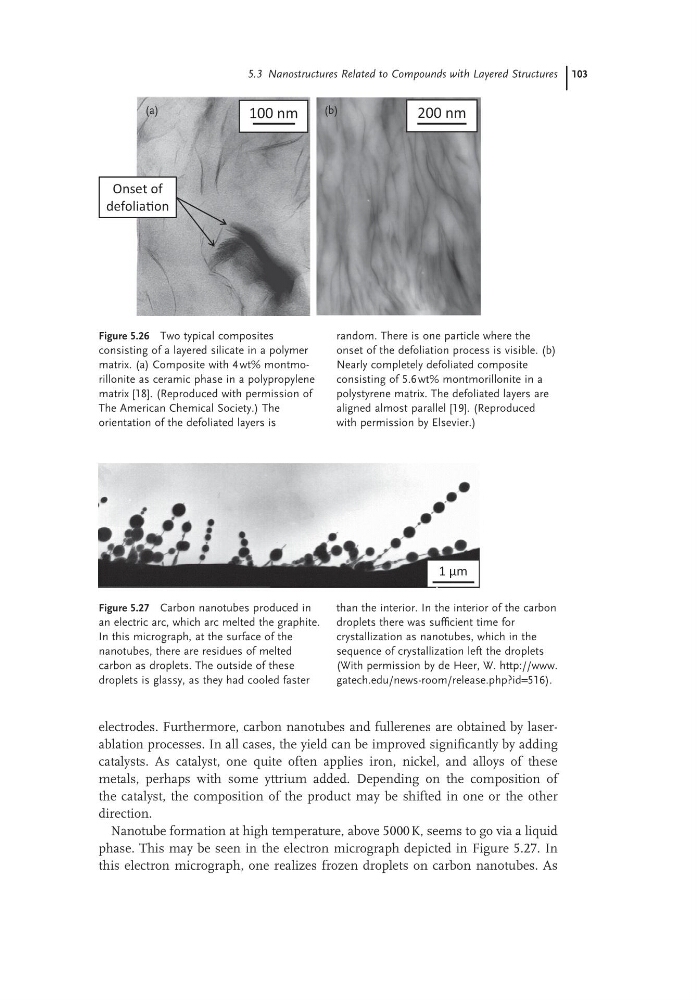
Figure 5.26 Two typical composites
consisting of a layered silicate in a polymer
matrix. (a) Composite with 4 wt% montmorillonite as ceramic phase in a polypropylene
matrix [18]. (Reproduced with permission of
The American Chemical Society.) The
orientation of the defoliated layers is
random. There is one particle where the
onset of the defoliation process is visible. (b)
Nearly completely defoliated composite
consisting of 5.6 wt% montmorillonite in a
polystyrene matrix. The defoliated layers are
aligned almost parallel [19]. (Reproduced
with permission by Elsevier.)
100 nm
200 nm
Onset of
defoliaƟon
(a)
(b)
Figure 5.27 Carbon nanotubes produced in
an electric arc, which arc melted the graphite.
In this micrograph, at the surface of the
nanotubes, there are residues of melted
carbon as droplets. The outside of these
droplets is glassy, as they had cooled faster
than the interior. In the interior of the carbon
droplets there was sufficient time for
crystallization as nanotubes, which in the
sequence of crystallization left the droplets
(With permission by de Heer, W. http://www.
gatech.edu/news-room/release.php?id=516).
1 µm
electrodes. Furthermore, carbon nanotubes and fullerenes are obtained by laserablation processes. In all cases, the yield can be improved significantly by adding
catalysts. As catalyst, one quite often applies iron, nickel, and alloys of these
metals, perhaps with some yttrium added. Depending on the composition of
the catalyst, the composition of the product may be shifted in one or the other
direction.
Nanotube formation at high temperature, above 5000 K, seems to go via a liquid
phase. This may be seen in the electron micrograph depicted in Figure 5.27. In
this electron micrograph, one realizes frozen droplets on carbon nanotubes. As
Figure 5.26 Two typical composites
consisting of a layered silicate in a polymer
matrix. (a) Composite with 4 wt% montmorillonite as ceramic phase in a polypropylene
matrix [18]. (Reproduced with permission of
The American Chemical Society.) The
orientation of the defoliated layers is
random. There is one particle where the
onset of the defoliation process is visible. (b)
Nearly completely defoliated composite
consisting of 5.6 wt% montmorillonite in a
polystyrene matrix. The defoliated layers are
aligned almost parallel [19]. (Reproduced
with permission by Elsevier.)
100 nm
200 nm
Onset of
defoliaƟon
(a)
(b)
Figure 5.27 Carbon nanotubes produced in
an electric arc, which arc melted the graphite.
In this micrograph, at the surface of the
nanotubes, there are residues of melted
carbon as droplets. The outside of these
droplets is glassy, as they had cooled faster
than the interior. In the interior of the carbon
droplets there was sufficient time for
crystallization as nanotubes, which in the
sequence of crystallization left the droplets
(With permission by de Heer, W. http://www.
gatech.edu/news-room/release.php?id=516).
1 µm