

104 5 One- and Two-Dimensional Nanoparticles
the mechanism for the formation of these aggregates, one assumes that the carbon
droplets are freezing very fast, forming a glassy surface layer. Within the droplets,
the liquid carbon gets supercooled and starts to crystallize. The crystallizing nanotubes, growing from the liquid layer at the cathode, drag along small droplets of
supercooled carbon. As a result, which supports this mechanism, one observes,
besides the glassy droplets, a thin amorphous layer at the surface of the carbon
nanotube.
The high-temperature processes to obtain carbon nanotubes and fullerenes
always produce large amounts of soot. The soot is removed by careful oxidation
in the temperature range between 1000 and 1100 K, as residue, one obtains carbon
nanotubes, because soot is more susceptible to oxidation as compared to the
intended product.
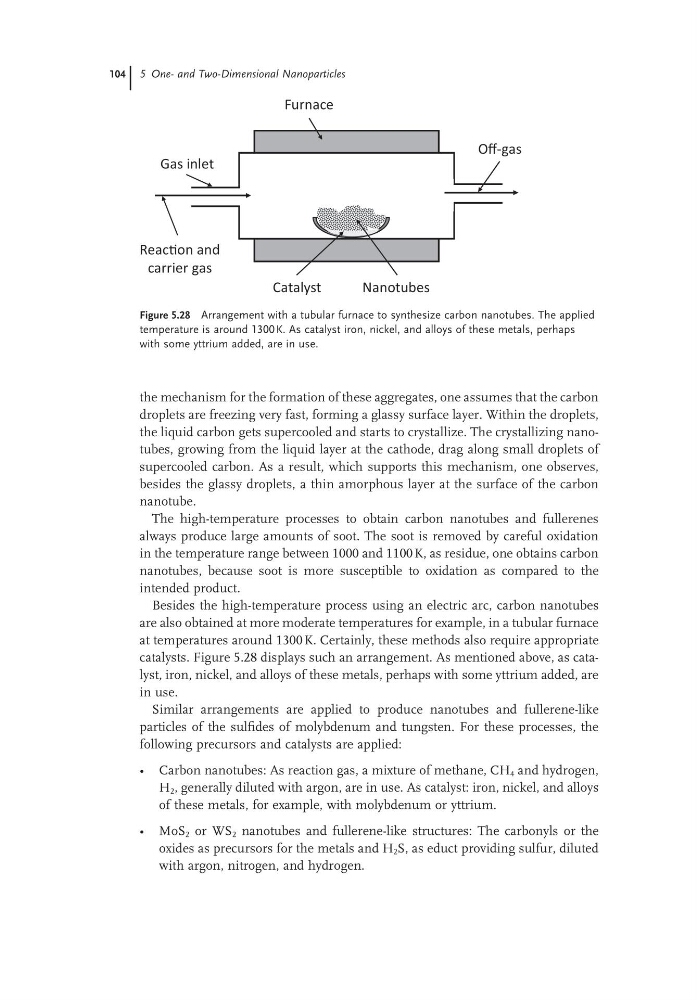
Besides the high-temperature process using an electric arc, carbon nanotubes
are also obtained at more moderate temperatures for example, in a tubular furnace
at temperatures around 1300 K. Certainly, these methods also require appropriate
catalysts. Figure 5.28 displays such an arrangement. As mentioned above, as catalyst, iron, nickel, and alloys of these metals, perhaps with some yttrium added, are
in use.
Similar arrangements are applied to produce nanotubes and fullerene-like
particles of the sulfides of molybdenum and tungsten. For these processes, the
following precursors and catalysts are applied:
• Carbon nanotubes: As reaction gas, a mixture of methane, CH 4 and hydrogen,
H 2 , generally diluted with argon, are in use. As catalyst: iron, nickel, and alloys
of these metals, for example, with molybdenum or yttrium.
• MoS 2 or WS 2 nanotubes and fullerene-like structures: The carbonyls or the
oxides as precursors for the metals and H 2 S, as educt providing sulfur, diluted
with argon, nitrogen, and hydrogen.
Figure 5.28 Arrangement with a tubular furnace to synthesize carbon nanotubes. The applied
temperature is around 1300 K. As catalyst iron, nickel, and alloys of these metals, perhaps
with some yttrium added, are in use.
Furnace
Gas inlet
Off-gas
ReacƟon and
carrier gas
Catalyst
Nanotubes
the mechanism for the formation of these aggregates, one assumes that the carbon
droplets are freezing very fast, forming a glassy surface layer. Within the droplets,
the liquid carbon gets supercooled and starts to crystallize. The crystallizing nanotubes, growing from the liquid layer at the cathode, drag along small droplets of
supercooled carbon. As a result, which supports this mechanism, one observes,
besides the glassy droplets, a thin amorphous layer at the surface of the carbon
nanotube.
The high-temperature processes to obtain carbon nanotubes and fullerenes
always produce large amounts of soot. The soot is removed by careful oxidation
in the temperature range between 1000 and 1100 K, as residue, one obtains carbon
nanotubes, because soot is more susceptible to oxidation as compared to the
intended product.
Besides the high-temperature process using an electric arc, carbon nanotubes
are also obtained at more moderate temperatures for example, in a tubular furnace
at temperatures around 1300 K. Certainly, these methods also require appropriate
catalysts. Figure 5.28 displays such an arrangement. As mentioned above, as catalyst, iron, nickel, and alloys of these metals, perhaps with some yttrium added, are
in use.
Similar arrangements are applied to produce nanotubes and fullerene-like
particles of the sulfides of molybdenum and tungsten. For these processes, the
following precursors and catalysts are applied:
• Carbon nanotubes: As reaction gas, a mixture of methane, CH 4 and hydrogen,
H 2 , generally diluted with argon, are in use. As catalyst: iron, nickel, and alloys
of these metals, for example, with molybdenum or yttrium.
• MoS 2 or WS 2 nanotubes and fullerene-like structures: The carbonyls or the
oxides as precursors for the metals and H 2 S, as educt providing sulfur, diluted
with argon, nitrogen, and hydrogen.
Figure 5.28 Arrangement with a tubular furnace to synthesize carbon nanotubes. The applied
temperature is around 1300 K. As catalyst iron, nickel, and alloys of these metals, perhaps
with some yttrium added, are in use.
Furnace
Gas inlet
Off-gas
ReacƟon and
carrier gas
Catalyst
Nanotubes