

102 5 One- and Two-Dimensional Nanoparticles
values in the range between 2 and 3 nm. In the further progress of the process,
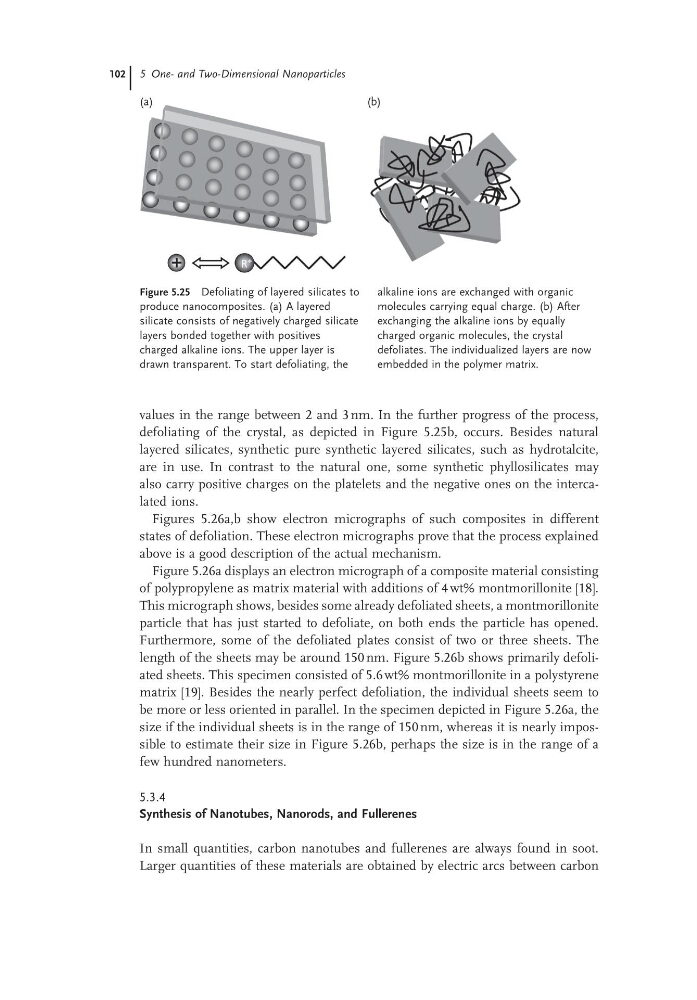
defoliating of the crystal, as depicted in Figure 5.25b, occurs. Besides natural
layered silicates, synthetic pure synthetic layered silicates, such as hydrotalcite,
are in use. In contrast to the natural one, some synthetic phyllosilicates may
also carry positive charges on the platelets and the negative ones on the intercalated ions.
Figures 5.26a,b show electron micrographs of such composites in different
states of defoliation. These electron micrographs prove that the process explained
above is a good description of the actual mechanism.
Figure 5.26a displays an electron micrograph of a composite material consisting
of polypropylene as matrix material with additions of 4 wt% montmorillonite [18].
This micrograph shows, besides some already defoliated sheets, a montmorillonite
particle that has just started to defoliate, on both ends the particle has opened.
Furthermore, some of the defoliated plates consist of two or three sheets. The
length of the sheets may be around 150 nm. Figure 5.26b shows primarily defoliated sheets. This specimen consisted of 5.6 wt% montmorillonite in a polystyrene
matrix [19]. Besides the nearly perfect defoliation, the individual sheets seem to
be more or less oriented in parallel. In the specimen depicted in Figure 5.26a, the
size if the individual sheets is in the range of 150 nm, whereas it is nearly impossible to estimate their size in Figure 5.26b, perhaps the size is in the range of a
few hundred nanometers.
5.3.4
Synthesis of Nanotubes, Nanorods, and Fullerenes
In small quantities, carbon nanotubes and fullerenes are always found in soot.
Larger quantities of these materials are obtained by electric arcs between carbon
Figure 5.25 Defoliating of layered silicates to
produce nanocomposites. (a) A layered
silicate consists of negatively charged silicate
layers bonded together with positives
charged alkaline ions. The upper layer is
drawn transparent. To start defoliating, the
alkaline ions are exchanged with organic
molecules carrying equal charge. (b) After
exchanging the alkaline ions by equally
charged organic molecules, the crystal
defoliates. The individualized layers are now
embedded in the polymer matrix.
values in the range between 2 and 3 nm. In the further progress of the process,
defoliating of the crystal, as depicted in Figure 5.25b, occurs. Besides natural
layered silicates, synthetic pure synthetic layered silicates, such as hydrotalcite,
are in use. In contrast to the natural one, some synthetic phyllosilicates may
also carry positive charges on the platelets and the negative ones on the intercalated ions.
Figures 5.26a,b show electron micrographs of such composites in different
states of defoliation. These electron micrographs prove that the process explained
above is a good description of the actual mechanism.
Figure 5.26a displays an electron micrograph of a composite material consisting
of polypropylene as matrix material with additions of 4 wt% montmorillonite [18].
This micrograph shows, besides some already defoliated sheets, a montmorillonite
particle that has just started to defoliate, on both ends the particle has opened.
Furthermore, some of the defoliated plates consist of two or three sheets. The
length of the sheets may be around 150 nm. Figure 5.26b shows primarily defoliated sheets. This specimen consisted of 5.6 wt% montmorillonite in a polystyrene
matrix [19]. Besides the nearly perfect defoliation, the individual sheets seem to
be more or less oriented in parallel. In the specimen depicted in Figure 5.26a, the
size if the individual sheets is in the range of 150 nm, whereas it is nearly impossible to estimate their size in Figure 5.26b, perhaps the size is in the range of a
few hundred nanometers.
5.3.4
Synthesis of Nanotubes, Nanorods, and Fullerenes
In small quantities, carbon nanotubes and fullerenes are always found in soot.
Larger quantities of these materials are obtained by electric arcs between carbon
Figure 5.25 Defoliating of layered silicates to
produce nanocomposites. (a) A layered
silicate consists of negatively charged silicate
layers bonded together with positives
charged alkaline ions. The upper layer is
drawn transparent. To start defoliating, the
alkaline ions are exchanged with organic
molecules carrying equal charge. (b) After
exchanging the alkaline ions by equally
charged organic molecules, the crystal
defoliates. The individualized layers are now
embedded in the polymer matrix.