

98 5 One- and Two-Dimensional Nanoparticles
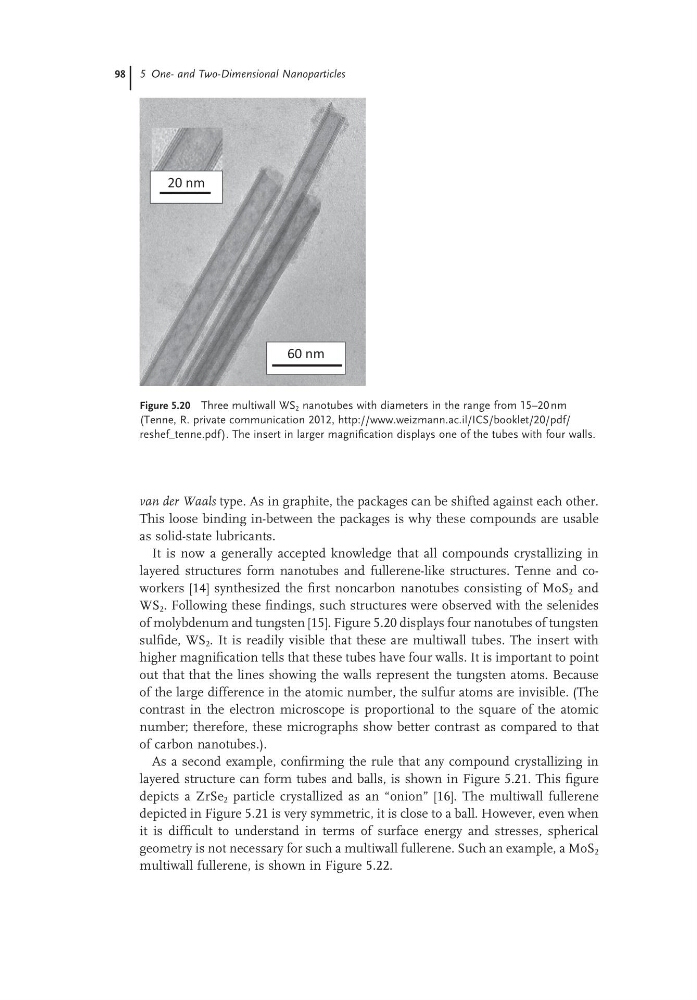
Figure 5.20 Three multiwall WS 2 nanotubes with diameters in the range from 15–20 nm
(Tenne, R. private communication 2012, http://www.weizmann.ac.il/ICS/booklet/20/pdf/
reshef_tenne.pdf ). The insert in larger magnification displays one of the tubes with four walls.
60 nm
20 nm
van der Waals type. As in graphite, the packages can be shifted against each other.
This loose binding in-between the packages is why these compounds are usable
as solid-state lubricants.
It is now a generally accepted knowledge that all compounds crystallizing in
layered structures form nanotubes and fullerene-like structures. Tenne and coworkers [14] synthesized the first noncarbon nanotubes consisting of MoS 2 and
WS 2 . Following these findings, such structures were observed with the selenides
of molybdenum and tungsten [15]. Figure 5.20 displays four nanotubes of tungsten
sulfide, WS 2 . It is readily visible that these are multiwall tubes. The insert with
higher magnification tells that these tubes have four walls. It is important to point
out that that the lines showing the walls represent the tungsten atoms. Because
of the large difference in the atomic number, the sulfur atoms are invisible. (The
contrast in the electron microscope is proportional to the square of the atomic
number; therefore, these micrographs show better contrast as compared to that
of carbon nanotubes.).
As a second example, confirming the rule that any compound crystallizing in
layered structure can form tubes and balls, is shown in Figure 5.21. This figure
depicts a ZrSe 2 particle crystallized as an “onion” [16]. The multiwall fullerene
depicted in Figure 5.21 is very symmetric, it is close to a ball. However, even when
it is difficult to understand in terms of surface energy and stresses, spherical
geometry is not necessary for such a multiwall fullerene. Such an example, a MoS 2
multiwall fullerene, is shown in Figure 5.22.
Figure 5.20 Three multiwall WS 2 nanotubes with diameters in the range from 15–20 nm
(Tenne, R. private communication 2012, http://www.weizmann.ac.il/ICS/booklet/20/pdf/
reshef_tenne.pdf ). The insert in larger magnification displays one of the tubes with four walls.
60 nm
20 nm
van der Waals type. As in graphite, the packages can be shifted against each other.
This loose binding in-between the packages is why these compounds are usable
as solid-state lubricants.
It is now a generally accepted knowledge that all compounds crystallizing in
layered structures form nanotubes and fullerene-like structures. Tenne and coworkers [14] synthesized the first noncarbon nanotubes consisting of MoS 2 and
WS 2 . Following these findings, such structures were observed with the selenides
of molybdenum and tungsten [15]. Figure 5.20 displays four nanotubes of tungsten
sulfide, WS 2 . It is readily visible that these are multiwall tubes. The insert with
higher magnification tells that these tubes have four walls. It is important to point
out that that the lines showing the walls represent the tungsten atoms. Because
of the large difference in the atomic number, the sulfur atoms are invisible. (The
contrast in the electron microscope is proportional to the square of the atomic
number; therefore, these micrographs show better contrast as compared to that
of carbon nanotubes.).
As a second example, confirming the rule that any compound crystallizing in
layered structure can form tubes and balls, is shown in Figure 5.21. This figure
depicts a ZrSe 2 particle crystallized as an “onion” [16]. The multiwall fullerene
depicted in Figure 5.21 is very symmetric, it is close to a ball. However, even when
it is difficult to understand in terms of surface energy and stresses, spherical
geometry is not necessary for such a multiwall fullerene. Such an example, a MoS 2
multiwall fullerene, is shown in Figure 5.22.