

5.3 Nanostructures Related to Compounds with Layered Structures 97
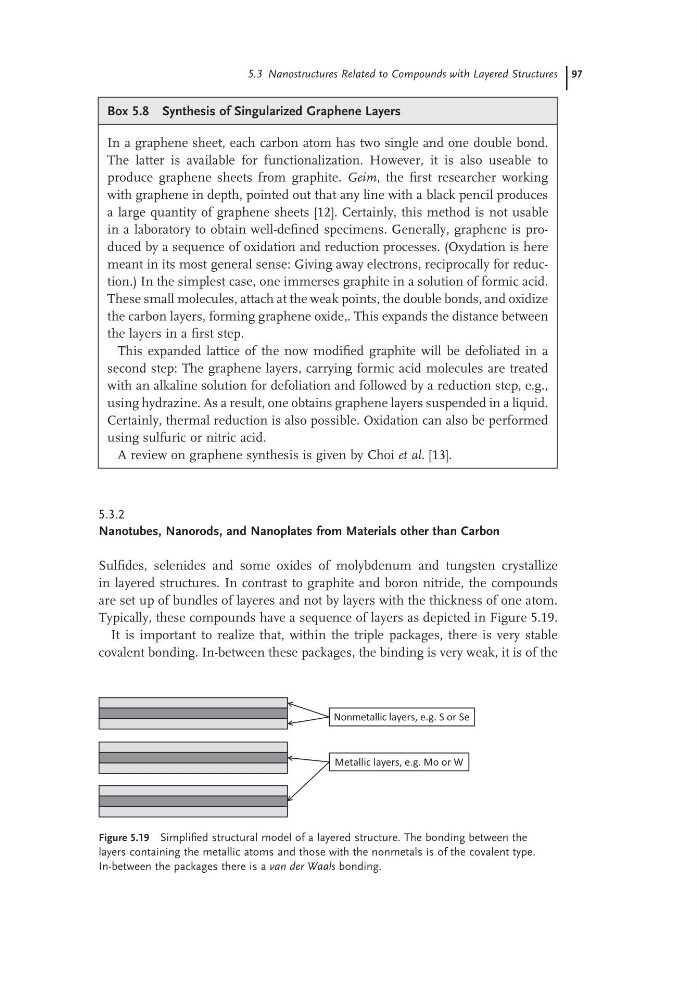
Figure 5.19 Simplified structural model of a layered structure. The bonding between the
layers containing the metallic atoms and those with the nonmetals is of the covalent type.
In-between the packages there is a van der Waals bonding.
Metallic layers, e.g. Mo or W
Nonmetallic layers, e.g. S or Se
Box 5.8 Synthesis of Singularized Graphene Layers
In a graphene sheet, each carbon atom has two single and one double bond.
The latter is available for functionalization. However, it is also useable to
produce graphene sheets from graphite. Geim, the first researcher working
with graphene in depth, pointed out that any line with a black pencil produces
a large quantity of graphene sheets [12]. Certainly, this method is not usable
in a laboratory to obtain well-defined specimens. Generally, graphene is produced by a sequence of oxidation and reduction processes. (Oxydation is here
meant in its most general sense: Giving away electrons, reciprocally for reduction.) In the simplest case, one immerses graphite in a solution of formic acid.
These small molecules, attach at the weak points, the double bonds, and oxidize
the carbon layers, forming graphene oxide,. This expands the distance between
the layers in a first step.
This expanded lattice of the now modified graphite will be defoliated in a
second step: The graphene layers, carrying formic acid molecules are treated
with an alkaline solution for defoliation and followed by a reduction step, e.g.,
using hydrazine. As a result, one obtains graphene layers suspended in a liquid.
Certainly, thermal reduction is also possible. Oxidation can also be performed
using sulfuric or nitric acid.
A review on graphene synthesis is given by Choi et al. [13].
5.3.2
Nanotubes, Nanorods, and Nanoplates from Materials other than Carbon
Sulfides, selenides and some oxides of molybdenum and tungsten crystallize
in layered structures. In contrast to graphite and boron nitride, the compounds
are set up of bundles of layeres and not by layers with the thickness of one atom.
Typically, these compounds have a sequence of layers as depicted in Figure 5.19.
It is important to realize that, within the triple packages, there is very stable
covalent bonding. In-between these packages, the binding is very weak, it is of the
Figure 5.19 Simplified structural model of a layered structure. The bonding between the
layers containing the metallic atoms and those with the nonmetals is of the covalent type.
In-between the packages there is a van der Waals bonding.
Metallic layers, e.g. Mo or W
Nonmetallic layers, e.g. S or Se
Box 5.8 Synthesis of Singularized Graphene Layers
In a graphene sheet, each carbon atom has two single and one double bond.
The latter is available for functionalization. However, it is also useable to
produce graphene sheets from graphite. Geim, the first researcher working
with graphene in depth, pointed out that any line with a black pencil produces
a large quantity of graphene sheets [12]. Certainly, this method is not usable
in a laboratory to obtain well-defined specimens. Generally, graphene is produced by a sequence of oxidation and reduction processes. (Oxydation is here
meant in its most general sense: Giving away electrons, reciprocally for reduction.) In the simplest case, one immerses graphite in a solution of formic acid.
These small molecules, attach at the weak points, the double bonds, and oxidize
the carbon layers, forming graphene oxide,. This expands the distance between
the layers in a first step.
This expanded lattice of the now modified graphite will be defoliated in a
second step: The graphene layers, carrying formic acid molecules are treated
with an alkaline solution for defoliation and followed by a reduction step, e.g.,
using hydrazine. As a result, one obtains graphene layers suspended in a liquid.
Certainly, thermal reduction is also possible. Oxidation can also be performed
using sulfuric or nitric acid.
A review on graphene synthesis is given by Choi et al. [13].
5.3.2
Nanotubes, Nanorods, and Nanoplates from Materials other than Carbon
Sulfides, selenides and some oxides of molybdenum and tungsten crystallize
in layered structures. In contrast to graphite and boron nitride, the compounds
are set up of bundles of layeres and not by layers with the thickness of one atom.
Typically, these compounds have a sequence of layers as depicted in Figure 5.19.
It is important to realize that, within the triple packages, there is very stable
covalent bonding. In-between these packages, the binding is very weak, it is of the